Camillus
Details
The story
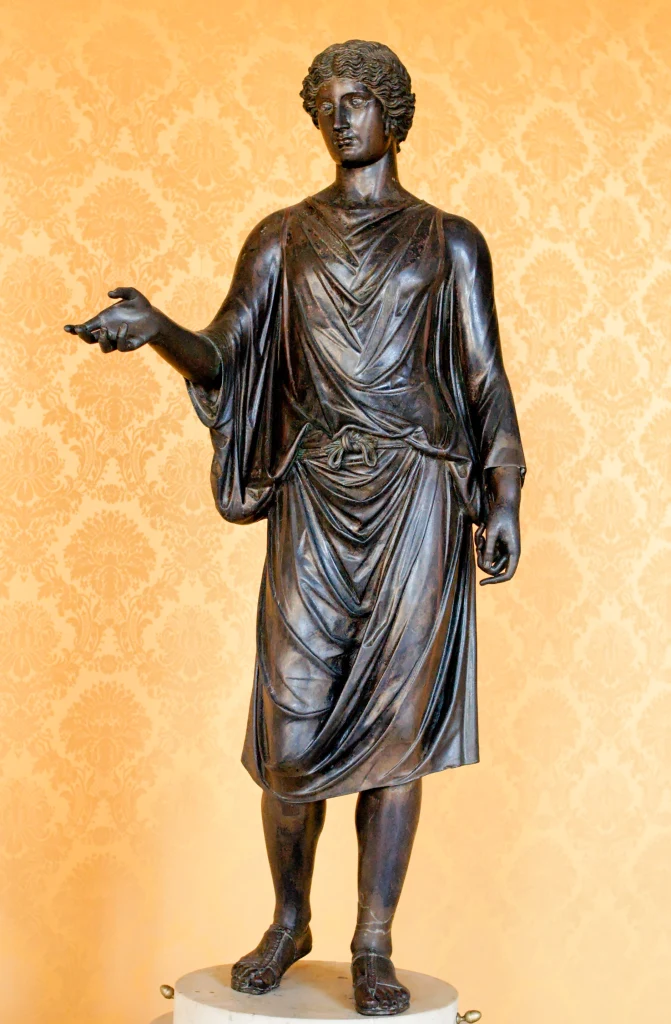
At a Roman sacrifice the priest did not stand alone. Beside him was a camillus, a boy who carried the ritual vessels and handed them over at the right moment, and custom required that he be freeborn, with both his parents still alive. This bronze is one of them. He wears a short belted tunic with sleeves and sandals on his feet. His eyes are inlaid with silver, and two copper strips run down the front of the tunic to imitate the purple bands of those who took part in the rite.
The museum's catalogue points to a curious mixture. The stance follows the classical scheme of the sculptor Polykleitos, with the weight carried on one leg, while the face, hair and brows are modelled on classical images of goddesses. The pose may even be borrowed from a statue of Hebe, cupbearer of the gods, made for the temple of Hera at Argos. In Rome the statue went by a woman's nickname, la Zingara, the Gypsy girl.
The museum dates it to the 1st century AD. It came to the Capitol in 1471 with the other bronzes from the Lateran, and it left the hill for the first time in 2008, on loan to an exhibition in Mantua.




