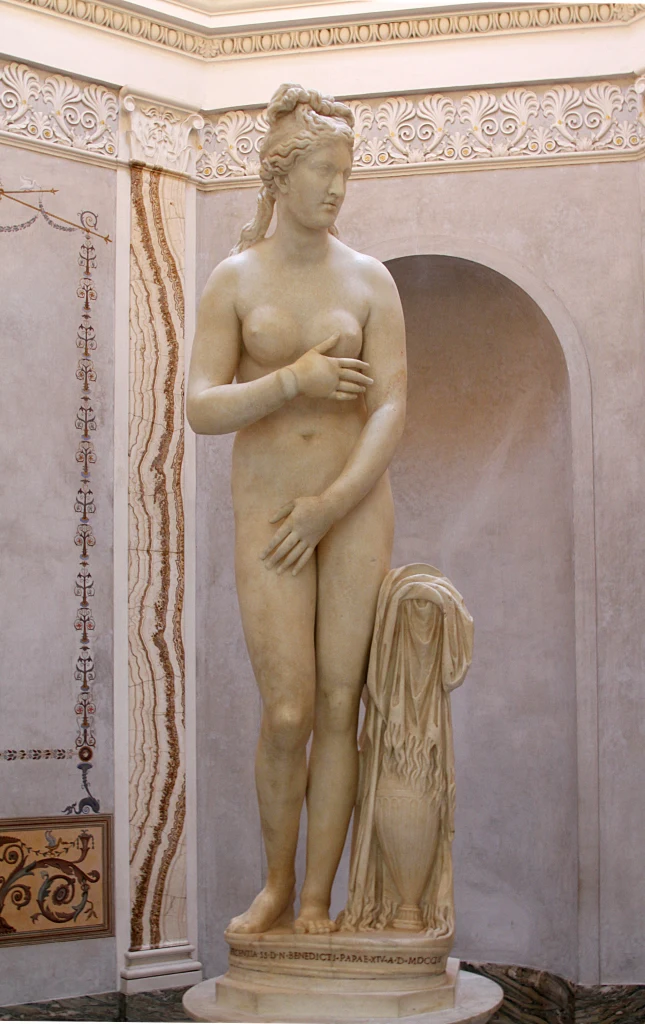
Capitoline Venus
Details
The story
The Roman writer Pliny the Elder tells how the Athenian sculptor Praxiteles, in the 4th century BC, made two statues of Aphrodite and offered them for sale together. The people of the island of Kos chose the draped one, which seemed to them the decent choice. The nude went to Knidos, a city on the coast of Asia Minor, and became so famous that travellers sailed there just to see it.
That lost Knidian Aphrodite is the ancestor of this marble, slightly larger than life. The goddess has stepped out of her bath and leans a little forward, her arms drawn in to cover her breast and her lap, her hair gathered in a high knot. The museum calls her a variant of the so-called modest Venus. About 100 copies of this version are known, so many that it has given its name to a whole type, the Capitoline Venus, and the museum suggests that this may be one of the earliest and most faithful of them, made to adorn some refined imperial residence.
She was found near the church of San Vitale, on the Viminal hill, between about 1666 and 1670, and Pope Benedict XIV bought her and gave her to the Capitoline in 1752. She stands alone at the centre of a small octagonal room.




