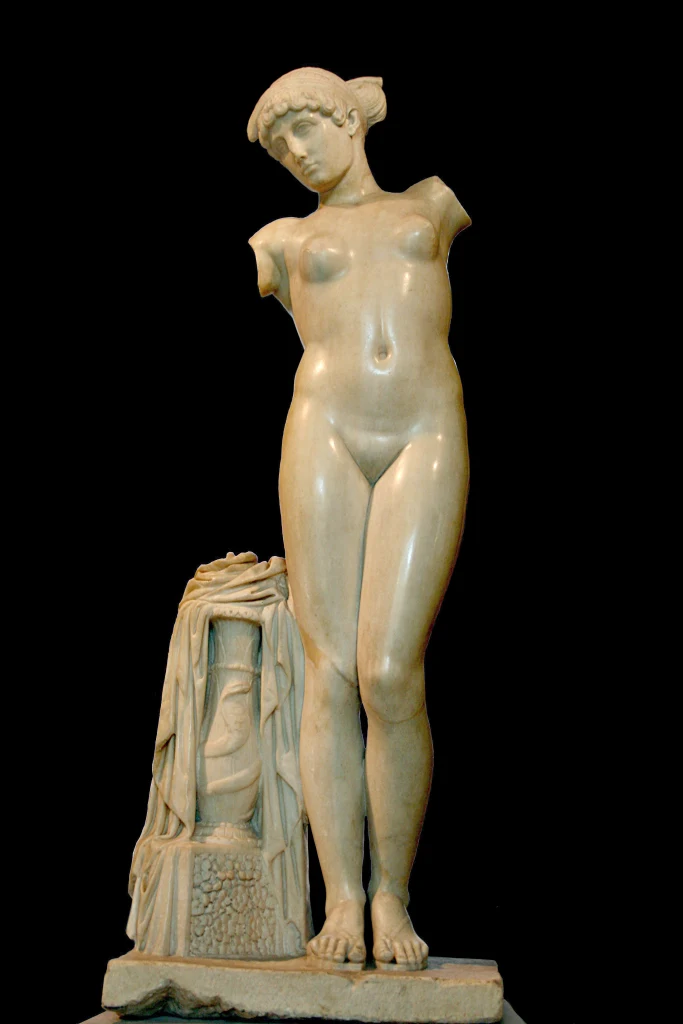
Esquiline Venus
Details
The story
In 1874 Rome had been the capital of the new Kingdom of Italy for barely three years, and the Esquiline hill was being dug up for the apartment blocks of the new city. The excavations ran through the Horti Lamiani, gardens that had passed to the emperors in the time of Tiberius, near today's Piazza Vittorio, and there this young woman came out of the ground. She stands naked, tying a band around her hair. Her arms are lost, but the fingers of her left hand still rest at the back of her head.
Who she is has never been settled. Beside her stands a vase with a cobra coiled around it, set on a chest full of roses, attributes linked both to Aphrodite and to the Egyptian goddess Isis, so she was first published as an Isis-Aphrodite. Unlike other statues of Aphrodite she wears sandals, which led some to think of another woman altogether. More recently she has been compared with coin portraits of Cleopatra, seen in profile with her hair gathered at the nape and bound with a band. The museum's room label says only early Imperial period, but its own information sheet places her in the second half of the 1st century BC, perhaps the years Cleopatra spent in Rome with Caesar.




