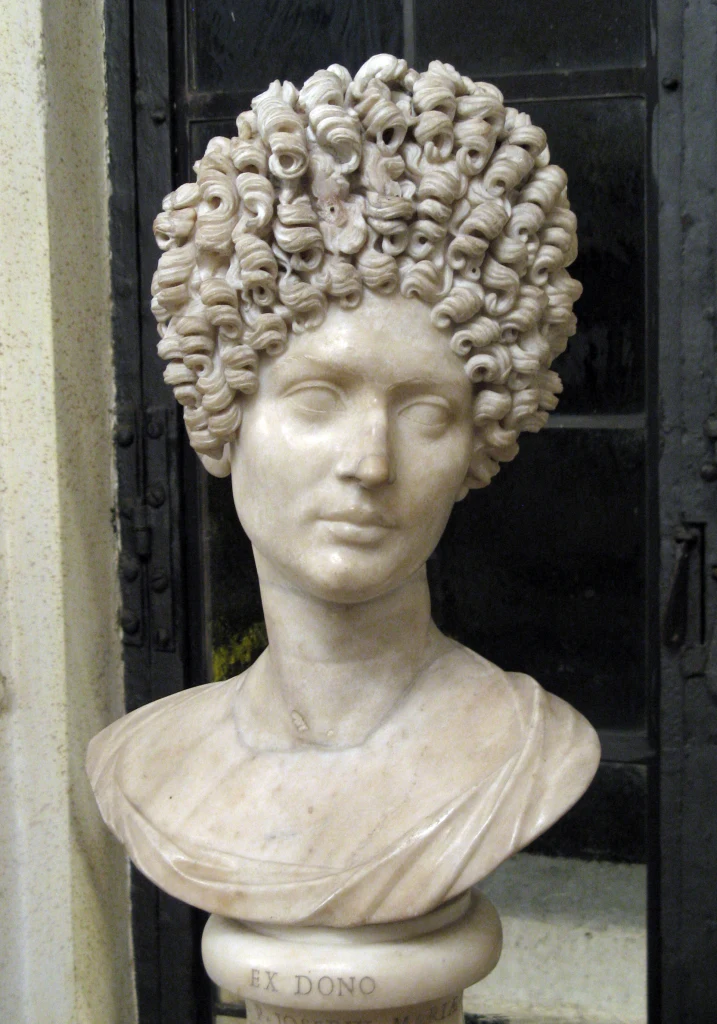
Fonseca Bust
Details
The story
Roman women of the late 1st and early 2nd centuries AD could wear their hair like architecture. The poet Juvenal mocked a woman who piled her head so high, in so many tiers and storeys, that from the front she looked like a tragic heroine and from behind she was a head shorter. This bust shows the fashion at its peak, a tall horseshoe of spiral curls rising over the forehead, with the rest of the hair braided and coiled into a bun at the back. The sculptor used the drill to cut deep between the curls.
Nobody knows who she was. Without an inscription or a recorded findspot, the hairstyle is the chief clue to her date. Many books call her Flavian, from the age of Vespasian and his sons, while the Capitoline Museums place her at the beginning of the 2nd century. The name comes from Giuseppe Maria Fonseca, a Portuguese cleric who gave the bust to the museum.
Around 2005 Janet Stephens, a hairdresser in Baltimore, set out to rebuild such styles on living heads. She argued that a Latin word long translated as hairpin could also mean a needle and thread, and in 2008 she published the idea in the Journal of Roman Archaeology. Later she published a step-by-step reconstruction of this very hairstyle, its curls stitched into place.




