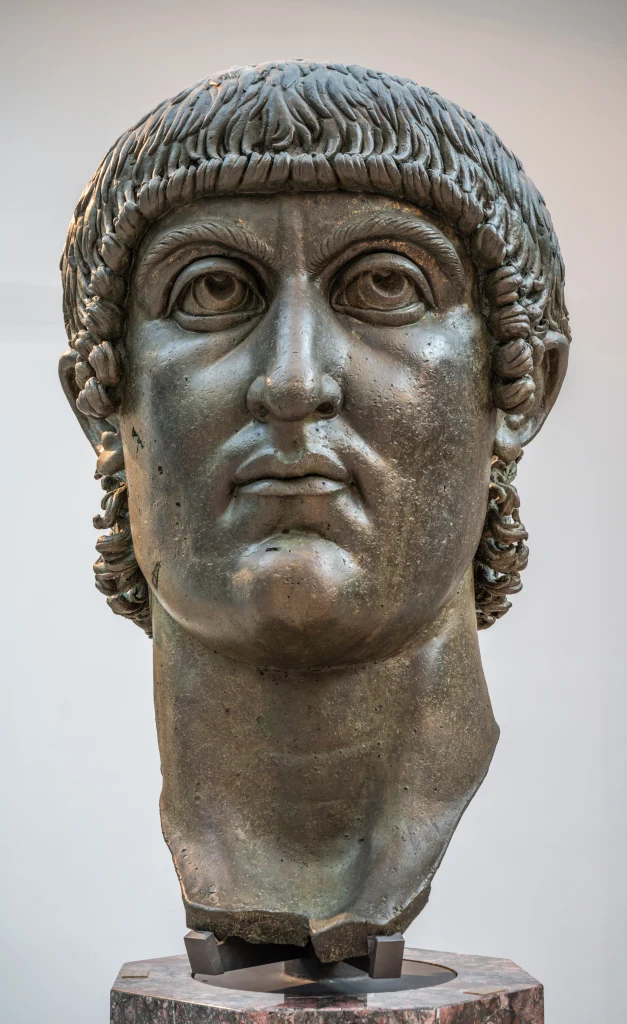
Head of the Bronze Colossus of Constantine
Details
The story
In the Middle Ages, in front of the Lateran palace where the popes lived, three pieces of a giant bronze emperor stood each on a column of its own, this head, a left hand and a globe. Almost every bronze of ancient Rome was melted down for its metal in those centuries, and these survived because the papacy kept them on show.
A medieval source says the head still wore a crown of gold set with precious stones. The crown is lost, and the row of holes that held it is still there in the hair, which is modelled as one compact cap. With its modern neck the head stands 177 centimetres high.
This is no longer a young man's face. The museum points to the large eyes weighed down by heavy bags, the lines of expression and the sagging cheeks, an emperor well into maturity. It identifies him as Constantine the Great, emperor from 306 to 337, and dates the colossus to the 4th century. For a long time the head was taken for his son Constantius II, who looked much like his father, and some scholars still leave that possibility open. The hand and the globe are displayed beside it.




