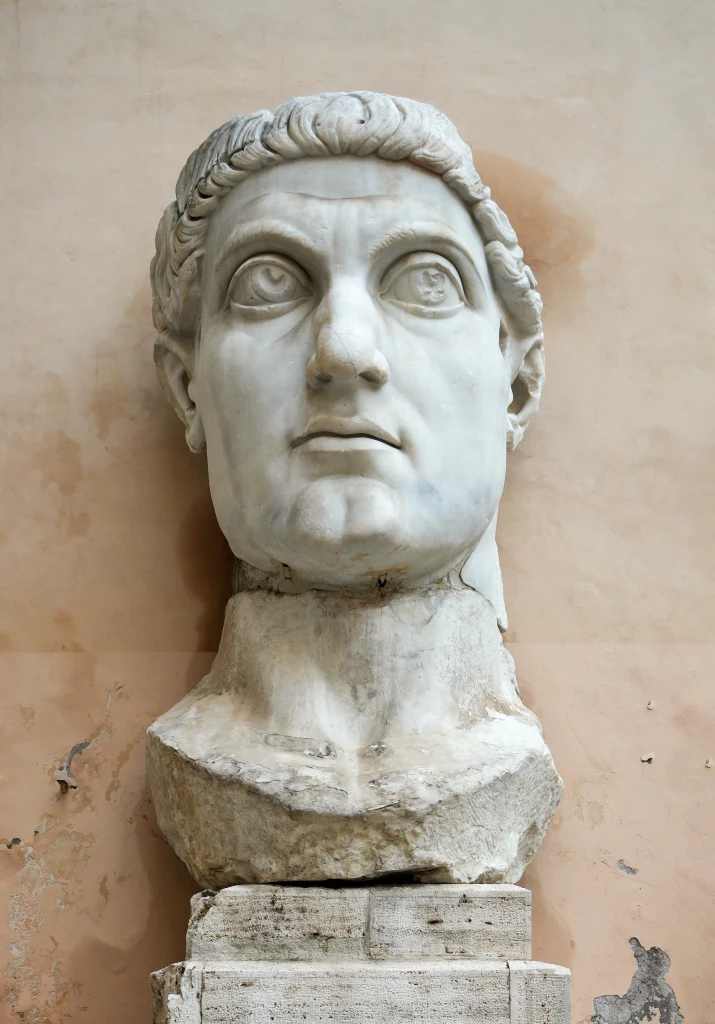
Head of the Colossus of Constantine
Details
The story
On 28 October 312 Constantine defeated his rival Maxentius at the Milvian Bridge, just north of Rome, and took over the city together with the vast basilica Maxentius had been building beside the Forum. Constantine finished it, and in its western apse he set an enormous seated image of himself. The museum dates the colossus between 313 and 324.
Only the head, arms, hands and feet were marble. The body was a brick core on a wooden frame, probably sheathed in gilded bronze, and the whole figure is estimated to have stood between 10 and 12 metres high. The head alone is 2.6 metres. It follows the emperor's official portrait, created in 311, with the square face, the hooked nose, the wide-open eyes fixed straight ahead and the fringe of hair forming an almond shape over the forehead, the same face that appears on the Arch of Constantine. Some scholars think it was recut from an older colossal statue.
The bishop Eusebius, who wrote Constantine's life, says that in Rome the emperor had a statue of himself made holding the sign of the cross in his right hand, and historians have long wondered whether this was the one. The fragments came to light in 1486, in the ruins of the basilica, and the head now lies in the palace courtyard with nine other pieces of the body.




