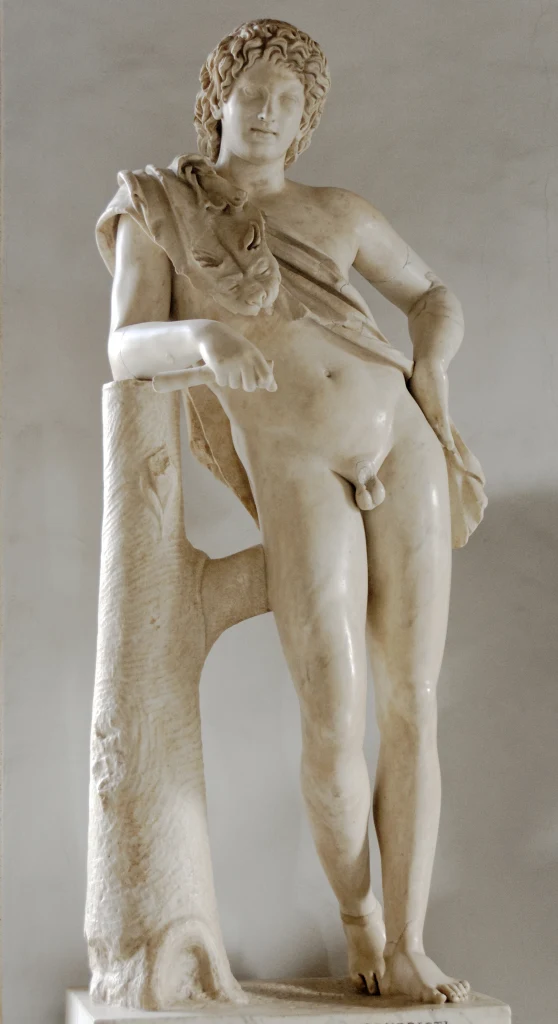
Resting Satyr
Details
The story
On 22 April 1858 the American novelist Nathaniel Hawthorne, then living in Rome with his family, stopped in front of this statue in the sculpture gallery of the Capitol and wrote about it in his notebook. Two years later it had become a novel, The Marble Faun. The book opens in this very room, which held then, as it does now, the Dying Gaul, at the time still called the Dying Gladiator, along with an Antinous and an Amazon that are still here. Three artist friends notice that their companion, a young Italian count named Donatello, is the very image of the faun of Praxiteles.
Hawthorne's faun is this satyr. He leans his right elbow on a tree trunk, a panther skin slung across his body from shoulder to hip, his curls bound with a band and his pointed ears showing. The figure goes back to a celebrated statue by Praxiteles of the 4th century BC, known from many Roman copies, and the museum counts this among the best of them. The flute in his right hand is a modern addition.
The statue came from the Villa d'Este at Tivoli, and Pope Benedict XIV gave it to the Capitoline in 1753.




