In 1632 the Swedish army of Gustavus Adolphus occupied Munich, and the Swedes carried off to Stockholm three paintings from a cycle that Duke Wilhelm IV of Bavaria had been commissioning for the Munich Residenz since 1528. The cycle showed heroes and heroines of ancient and biblical history, and the three that went to Sweden were Ludwig Refinger's Horatius Cocles and Manlius Torquatus and Abraham Schöpfer's Mucius Scaevola. They have been in the Nationalmuseum in Stockholm ever since. The other panels of the cycle stayed in Munich, Altdorfer's Battle of Alexander among them.
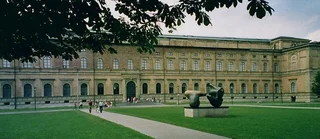
The building for the paintings that Bavaria's rulers had been collecting since the 16th century was put up by King Ludwig I. The architect Leo von Klenze designed it, the foundation stone was laid on 7 April 1826, the Pinakothek opened in 1836, and its halls were lit from above. In the Second World War bombs destroyed part of the building, and in the 1950s the architect Hans Döllgast rebuilt it and filled the breach in the wall with bare brick.
The dukes commission paintings (1528–1616)
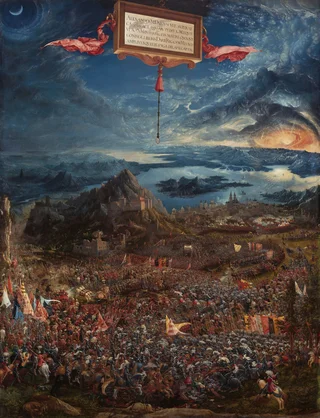
1. The Battle of Alexander at Issus — Albrecht Altdorfer, 1529
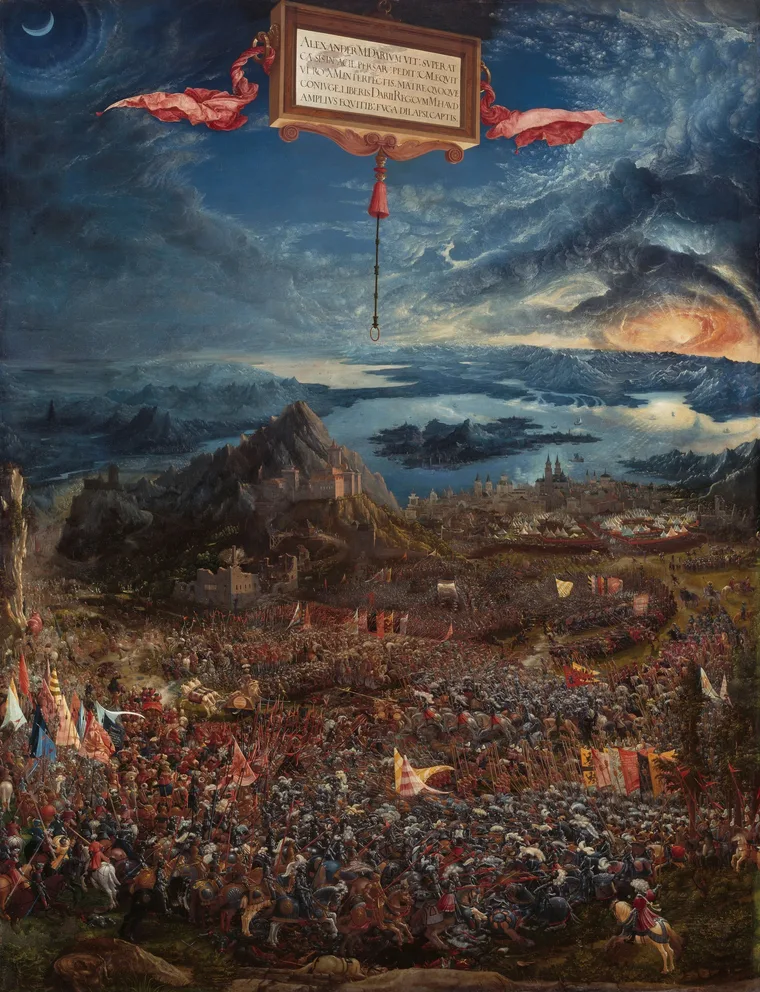
In 1528 the Regensburg city council elected Albrecht Altdorfer mayor, and he declined the office, explaining that he had taken on a large work for Duke Wilhelm of Bavaria. Altdorfer was a painter, an architect and a member of the inner council, and as city architect he was in charge of the fortifications in case of a Turkish invasion. The painting is not named in the council's record, and it is usually taken to be this panel, dated 1529.
The painting stayed in the collection of the Bavarian dukes and electors for almost three centuries. In 1800 the French army of General Moreau occupied Munich, French commissioners chose paintings to be sent to Paris, and the Battle of Alexander went with them. In 1803 the German writer Friedrich Schlegel saw it in the Louvre's restoration workshop. What happened next is told in a story that nobody has been able to document. Napoleon is said to have taken the painting for himself and hung it in his bathroom at the palace of Saint-Cloud outside Paris, where the Prussians who occupied the palace found it in 1814. In 1815, after Napoleon's fall, the painting was returned to the king of Bavaria.
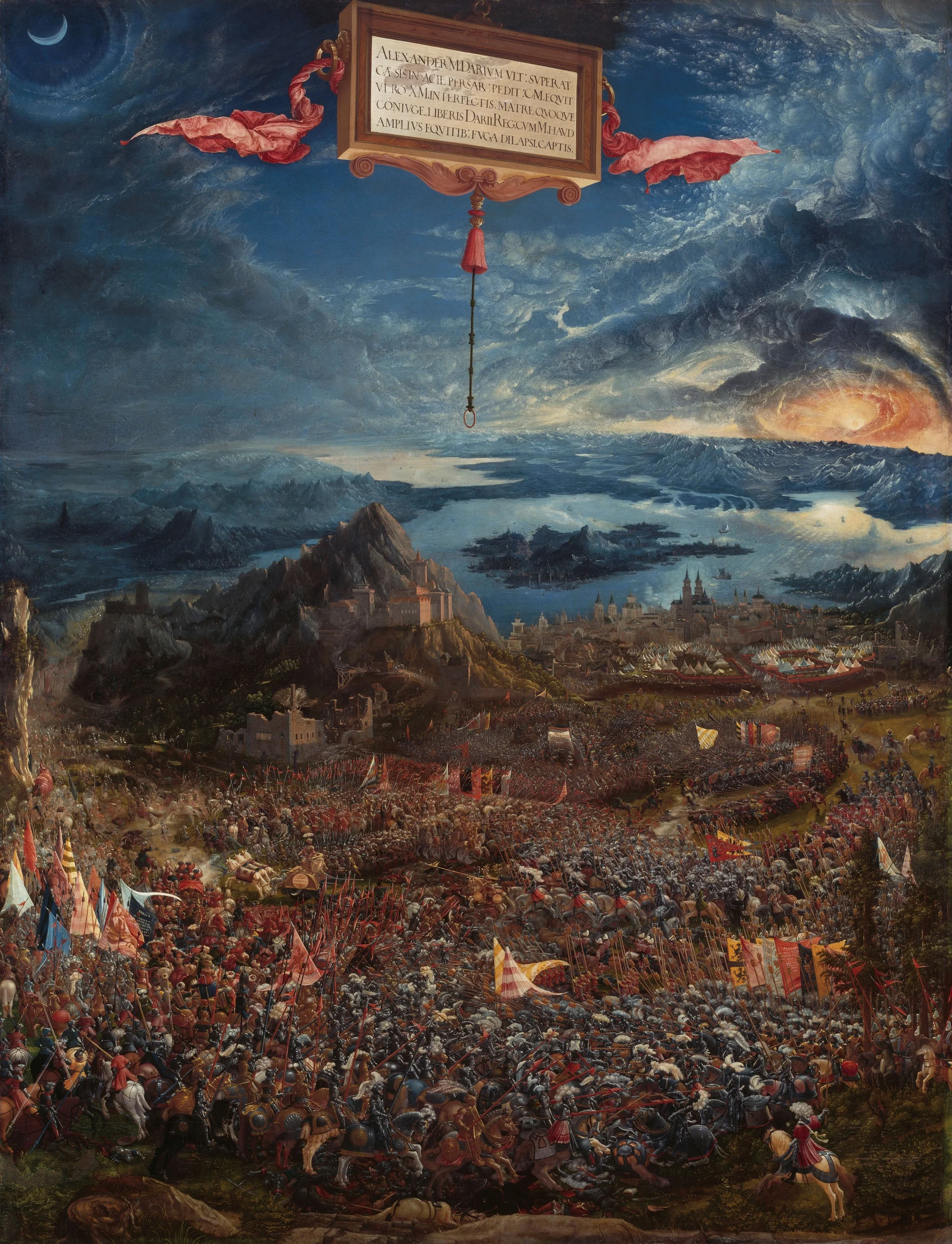
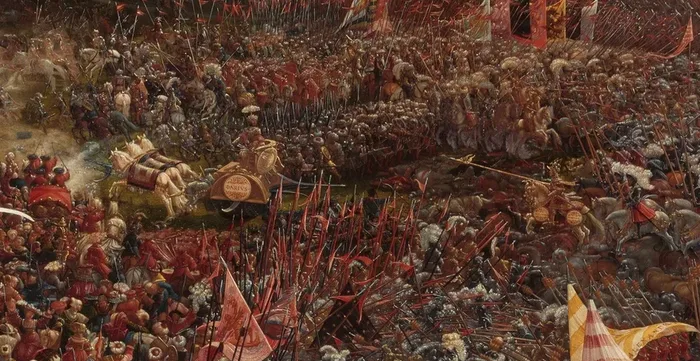
The lower half of the panel is packed with thousands of tiny horsemen and foot soldiers under a forest of lances and banners. The upper half is sky, sea and mountains seen from an enormous height, and up there the horizon curves. In the upper left a thin crescent moon hangs in a dark blue sky, and on the right the sun blazes above the horizon in an orange-gold swirl of cloud. In the middle of the sky a tablet with a Latin inscription hangs on red ribbons, with a red tassel below it and a long cord ending in a ring, and the cord points down at the two protagonists. Left of centre Darius, in a golden chariot with DARIVS on its side, races away to the left behind three white horses, and close behind him rides Alexander in golden armour, levelling his long lance at him. Altdorfer received the commission in 1528, a year before the Ottoman army besieged Vienna, and yet historians usually connect the painting with the Turks because of the crescent in the sky and the white and red turbans in Darius's army in the lower left corner. The inscription on the tablet lists the Persian dead, 100,000 foot soldiers and 10,000 horsemen, and records that Darius's mother, wife and children were taken prisoner while he himself fled with no more than 1,000 horsemen.
2. The Hippopotamus and Crocodile Hunt — Peter Paul Rubens, c. 1616
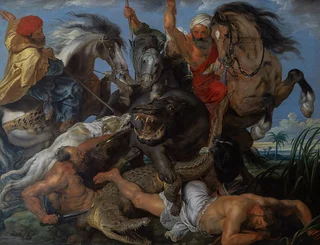
The hippopotamus was almost unknown to Rubens's contemporaries. In 1601 Federico Zerenghi, a surgeon from Narni, exhibited two hippopotamuses in Rome and Naples which, he said, he had killed himself in Egypt and whose skins he had stuffed in Venice, and the museum believes that Rubens painted the animal in this picture from such a stuffed specimen. Rubens lived in Italy from 1600 to 1608, in Mantua and Rome, so he could have seen it himself. By the mid-1610s he ran a large workshop in Antwerp that produced huge canvases for the rulers of other countries, and he was only beginning to sell the hunt as a new genre. In October 1616 he still had no buyer for the Wolf and Fox Hunt.
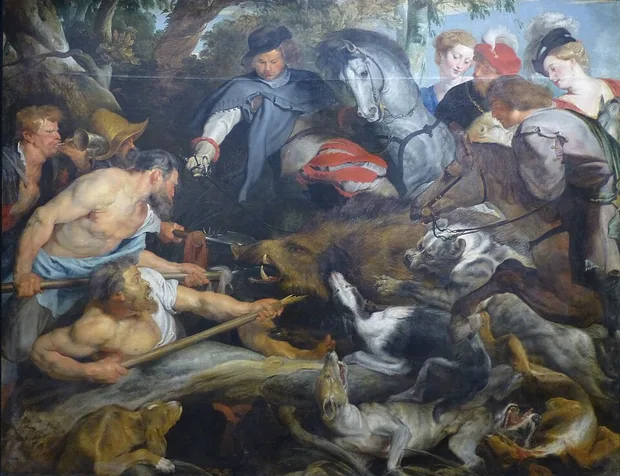
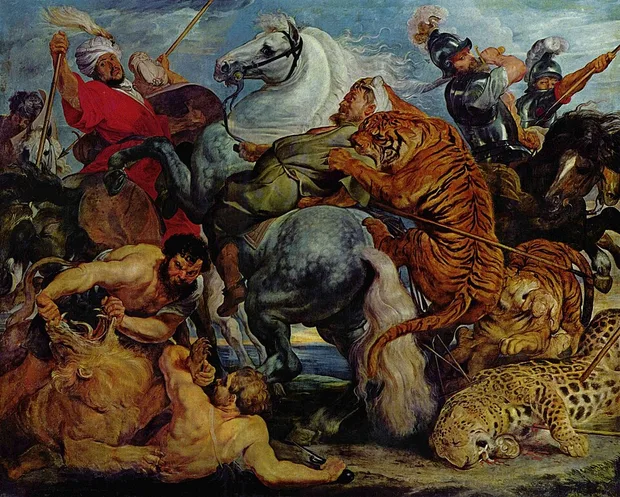
Duke Maximilian I of Bavaria ordered this hunt and three others for the Old Palace at Schleissheim outside Munich. Maximilian became an elector, one of the princes who chose the emperor, only in 1623. Arnout Balis, who wrote the volume on the hunts in the complete catalogue of Rubens's work, believes that assistants did much of the painting on the four Schleissheim canvases under the master's direction.
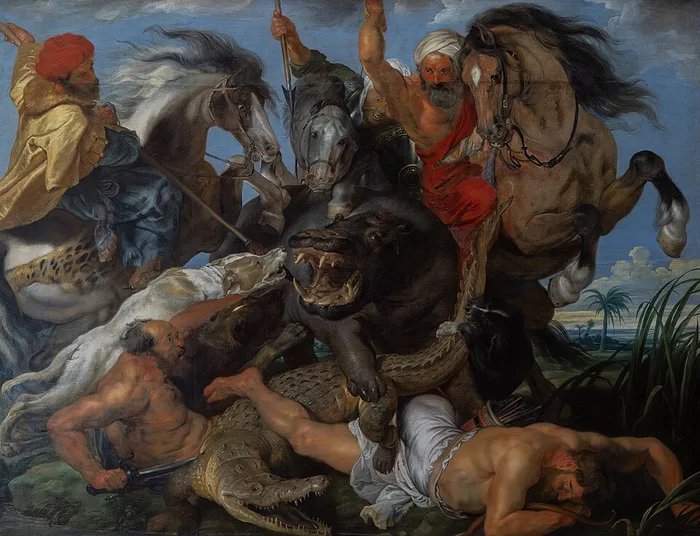
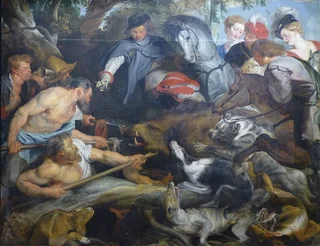
The hippopotamus stands in the centre, a dark greyish brown, its pink mouth with curved yellow tusks gaping at a white dog that lunges at it from the left. A rider in a red turban and a yellow-gold cloak drives a long spear into its mouth, and on the right a grey-bearded rider in a white turban has raised his arm to strike and scowls straight out at the viewer. With a foreleg the hippopotamus pins down a crocodile that lies across the bottom of the canvas, its pale scaly belly twisted upward. With a hind foot the crocodile has caught the white loincloth of a dead man lying face down at the bottom edge, and red spots of blood show on the cloth nearby. The historian of science Dániel Margócsy has suggested that the stuffing distorted the animal's shape, and that this is why Rubens hid most of its body behind men, horses and dogs and pushed the jaws forward.
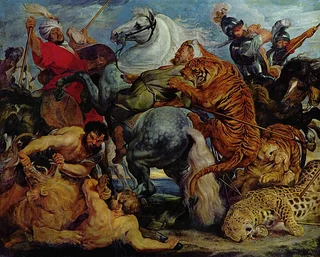
On 30 August 1800 the French commissioner Neveu took all four hunts to Paris. Three of them were sent to provincial museums in France and never reclaimed, and only the hippopotamus hunt came back to Munich. The Boar Hunt is now in Marseille and the Tiger, Lion and Leopard Hunt in Rennes, while the Lion Hunt was sent to Bordeaux, where it burned on 7 December 1870.
Maximilian I takes Dürer from Nuremberg (1613–1627)
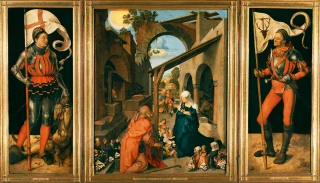
3. The Paumgartner Altarpiece — Albrecht Dürer, c. 1500–1503
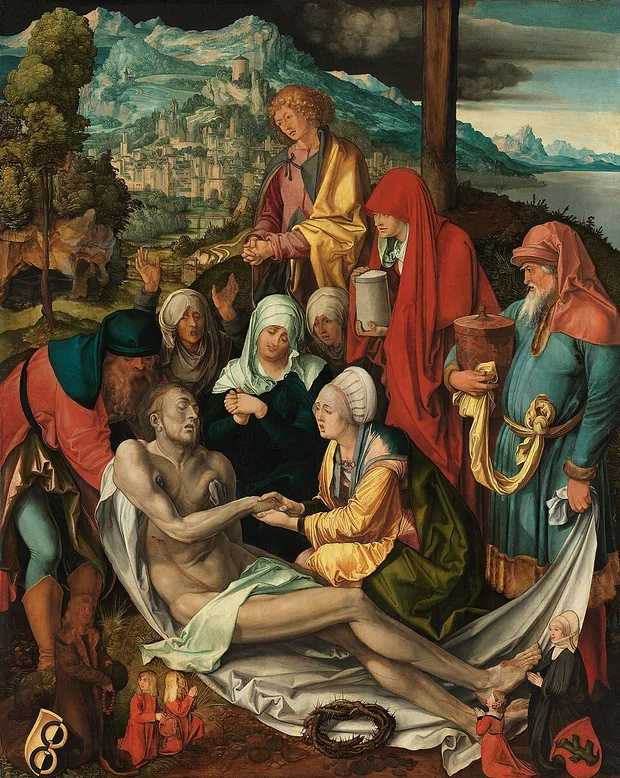
On 21 April 1988 Hans-Joachim Bohlmann, who had damaged paintings several times before and was out of a psychiatric hospital on leave that day, threw sulphuric acid over three paintings by Dürer in the Alte Pinakothek. He had brought the acid in two small liqueur bottles. Schoolchildren who happened to be nearby pushed him away, and then the guards held him. Bohlmann said it was a protest against deductions from his pension of 900 marks, from which 158.60 marks were taken every month towards earlier damages claims. The court sentenced him to two years' imprisonment with treatment.
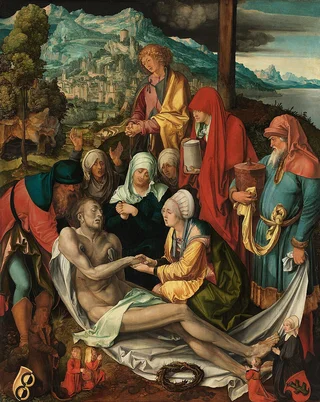
Besides the altarpiece, the acid hit the Lamentation of Christ and the Mater Dolorosa. Restorers at the Doerner Institut, the conservation laboratory of the Bavarian State Painting Collections, first developed a new way to neutralise the acid with ion exchangers, and the restoration itself took 23,000 working hours. In 1998, ten years after the attack, the altarpiece went back on show, and the Mater Dolorosa was finished only in 2005.
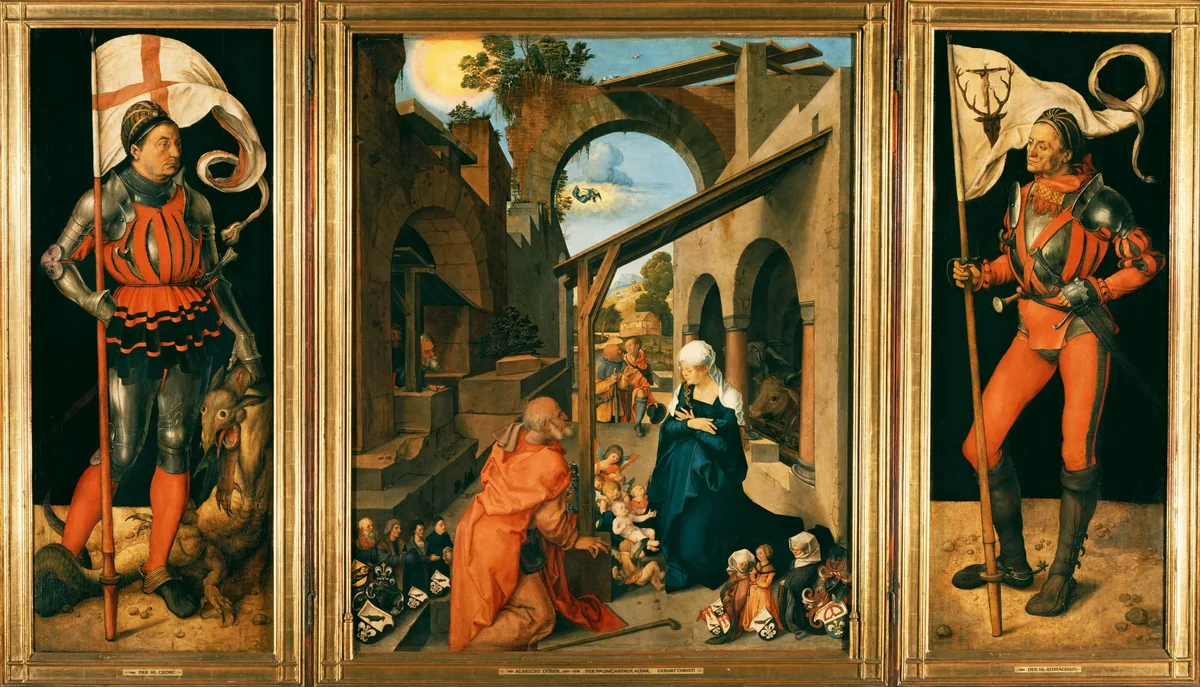
The altarpiece was commissioned by the brothers Stephan and Lukas Paumgartner, Nuremberg patricians, for the church of the Dominican nuns of St Catherine in Nuremberg. In 1498 Dürer published the Apocalypse woodcuts that made him famous, and in the same years he was working on this altarpiece. A 17th-century chronicle says that he painted the saintly knights on the wings from the brothers, and Stephan is identified as St George on the left, Lukas as St Eustace on the right. George holds by the neck a small brown dragon that sits at his foot with its beak open, and on Eustace's banner is a stag's head with a crucifix between the antlers. In the centre Dürer set the Nativity among the ruins of a large building and lit it as if by day, with a white sun in the upper left corner, although the scene was usually painted at night. His AD monogram is written small and faint on a wooden post to the right of Joseph's lantern.
In 1613 Nuremberg gave the altarpiece to Duke Maximilian I to secure his favour, and ordered copies for itself from the painter Jobst Harrich. In Munich Maximilian had the altarpiece altered to his taste. The donor family in the centre panel was painted over, strips were added to the wings, and the knights were given helmets, horses and landscapes. This overpaint was later removed, and the knights once again stand against a black background, while in the lower corners of the Nativity the donors are visible again, doll-sized, with their coats of arms. Kneeling on the left are the father, Martin Paumgartner, who died in 1478, his sons and, in the museum's view, the mother's second husband, Hans Schönbach, and on the right the mother, Barbara, with her daughters.
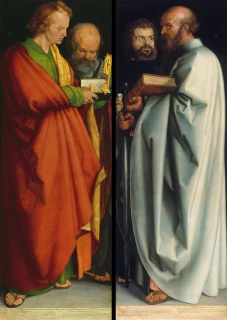
4. The Four Apostles — Albrecht Dürer, 1526
In the autumn of 1526 Dürer offered the Nuremberg city council two tall, narrow panels that he had painted without any commission. In a letter he said that he had taken more trouble over them than over his other paintings, and asked that the city keep them in memory of him. On 6 October the council accepted them and paid 100 gulden to the painter, 12 to his wife and two to his servant. The year before, Nuremberg had officially adopted the Reformation. Dürer painted no more large pictures after these, and he died in April 1528.
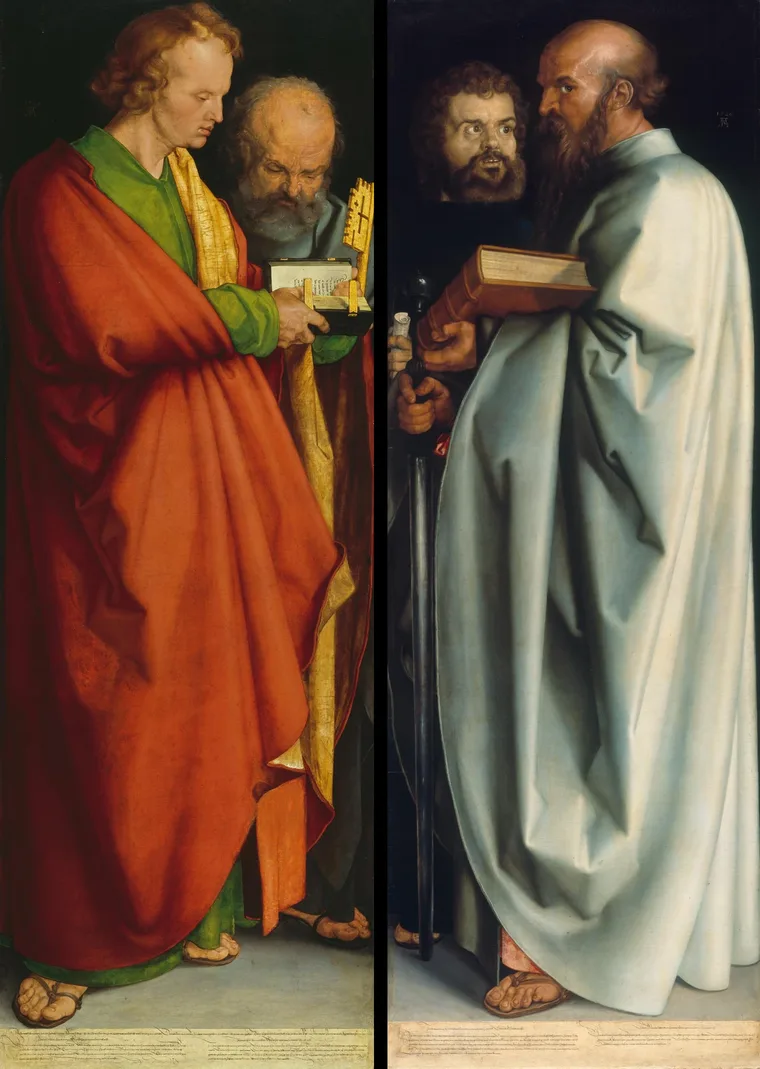
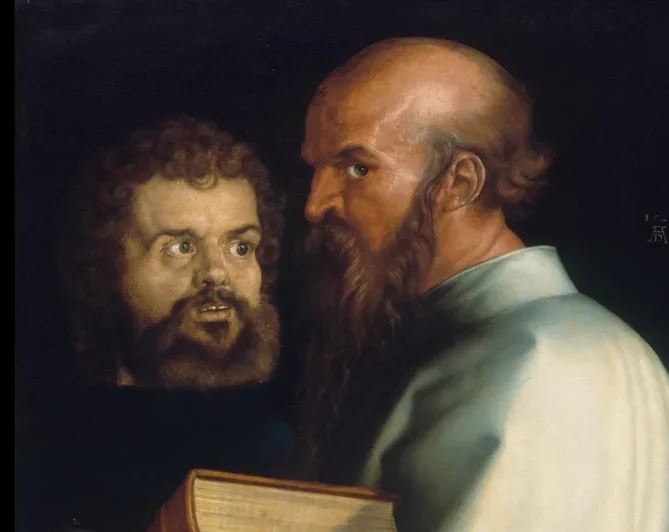
On the left panel, in front, the young, beardless John stands in a huge red cloak over a green robe, reading an open book, and old, balding Peter, holding a large golden key, looks into the same book over his shoulder. On the right panel, in front, bald, bearded Paul stands in profile, wrapped in a heavy white-grey cloak, with a closed book against his chest and a long sword, and he casts a sidelong glance at the viewer. Behind him Mark, with a dark curly beard, has opened his eyes so wide that the whites show, and his lips are parted over his teeth. Mark was an evangelist and did not belong among the apostles, so the title was given to the painting later. As early as 1547 the Nuremberg writing master Johann Neudörffer, who had lettered the texts for these panels, saw the four temperaments in the four figures, John as the sanguine, Peter the phlegmatic, Mark the choleric and Paul the melancholic.
Beneath the figures a pale strip runs along the bottom edge of each panel, carrying Neudörffer's handwritten German text. These are quotations from the New Testament in Luther's translation of 1522, and they open with an address to “all worldly rulers” to beware of “false prophets”. Historians disagree about whom Dürer had in mind. Earlier they thought he meant the Catholic Church. Since the mid-20th century they have more often thought of the radical reformers who had been tried in Nuremberg the year before, among them painters from Dürer's own circle.
In 1627, at the height of the Thirty Years' War, the panels were wanted by Maximilian I, by now an elector, a Catholic and a determined collector of Dürer. Protestant Nuremberg needed the goodwill of its powerful Catholic neighbour, and after about three months of negotiation the city gave way. The council tried a ruse and ordered full-size copies from the painter Vischer, which were sent to Munich along with the originals in the hope that the elector would keep the copies. He kept the originals. In Munich the strips with Luther's text were sawn off, partly because of the text itself and partly because Maximilian made a habit of removing from paintings anything that recalled their former place and purpose. The strips were joined to the panels again only in 1922.
The copy of the centre panel of the Paumgartner Altarpiece that Jobst Harrich painted in 1613 stands in the church of St Lorenz in Nuremberg, and the copies of its wings are in the Germanisches Nationalmuseum in Nuremberg. The copies of the Four Apostles painted in 1627 belong to the museums of Nuremberg, and Nuremberg also kept an 18th-century copy of the Self-Portrait with Fur-Trimmed Robe, attributed to Küfner.
An elector buys in Antwerp (1698)
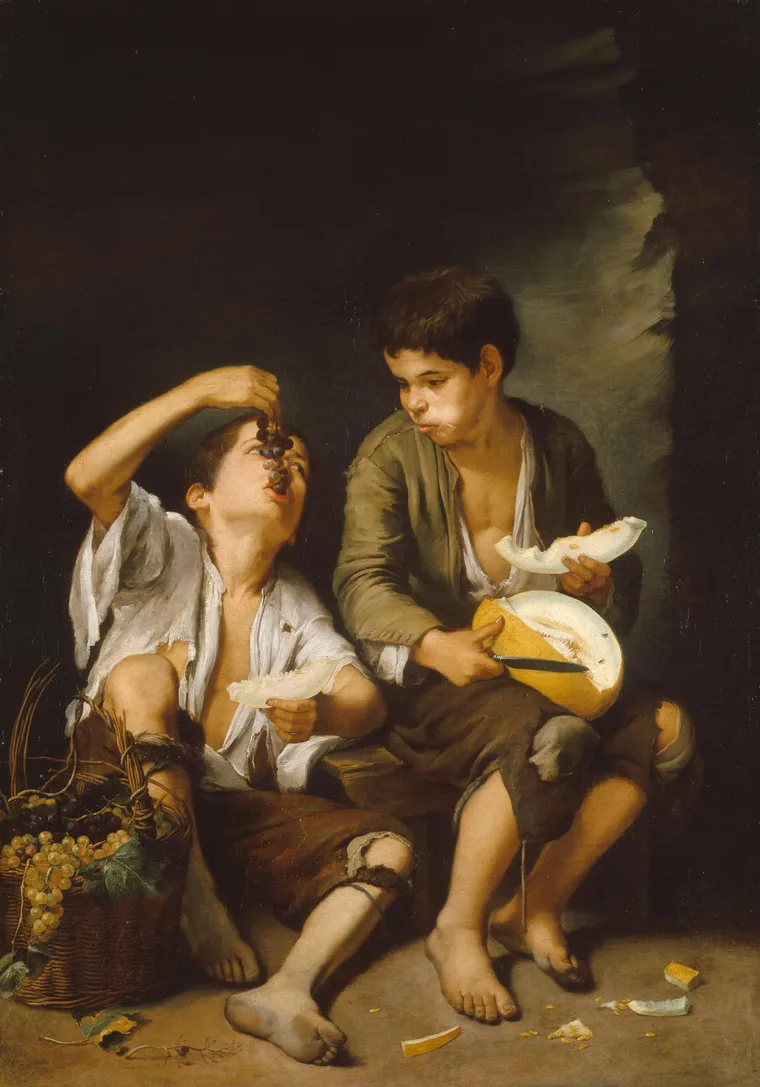
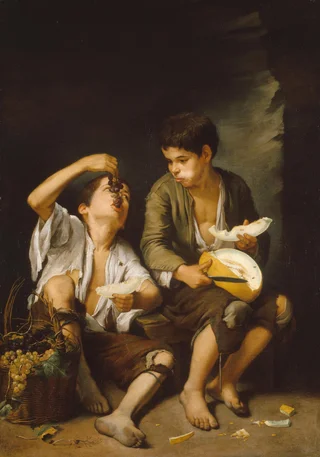
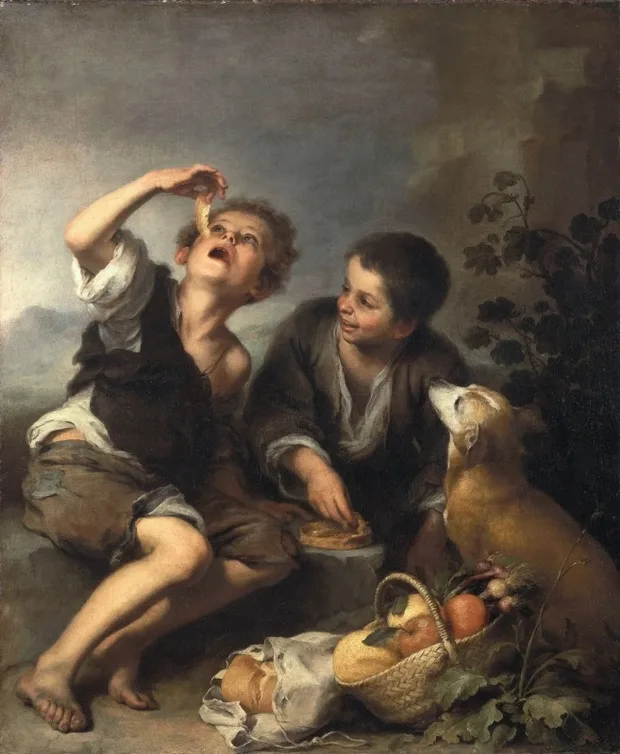
5. Grape and Melon Eaters — Bartolomé Esteban Murillo, 1645
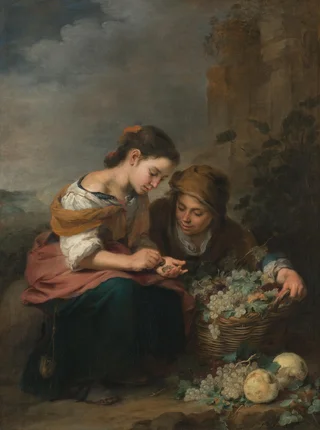
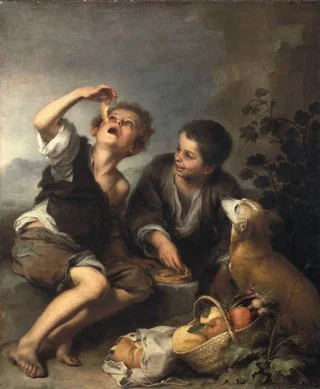
Two flies sit on the white flesh of half a melon that the boy on the right holds on his knees and cuts with a dark-bladed knife, one just above the blade, the other right by its tip. The boy sits on a low wooden block in an olive jacket over an open shirt, his cheek bulging with melon, and glances sideways at his companion. The companion sits on the ground with his head thrown back, lowering a bunch of dark grapes into his mouth, and in his other hand he holds a bitten slice of melon. At the lower left stands a wicker basket full of green and black grapes with their leaves. Both boys' shirts are torn, their trousers ripped at the knee, their bare feet dirty, and seeds and rinds lie scattered on the ground. The light falls from the upper left on the faces, shirts, feet and fruit, and the background is almost black.
Murillo spent his whole life in Seville, and the museum dates the painting to 1645, the year he received his first major commission, a cycle of paintings for the small cloister of the Franciscan friary. According to the museum, it is one of his earliest secular paintings of children.
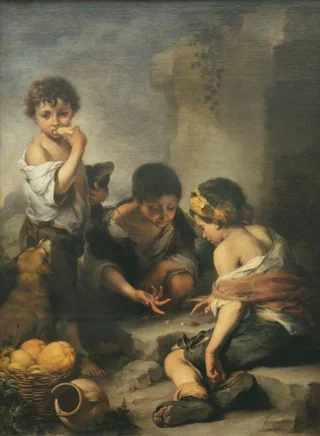
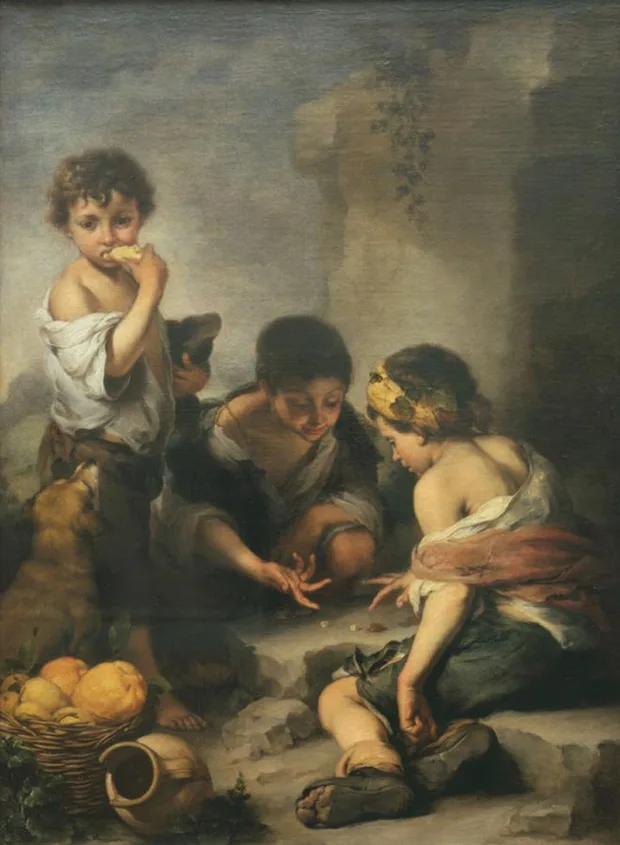
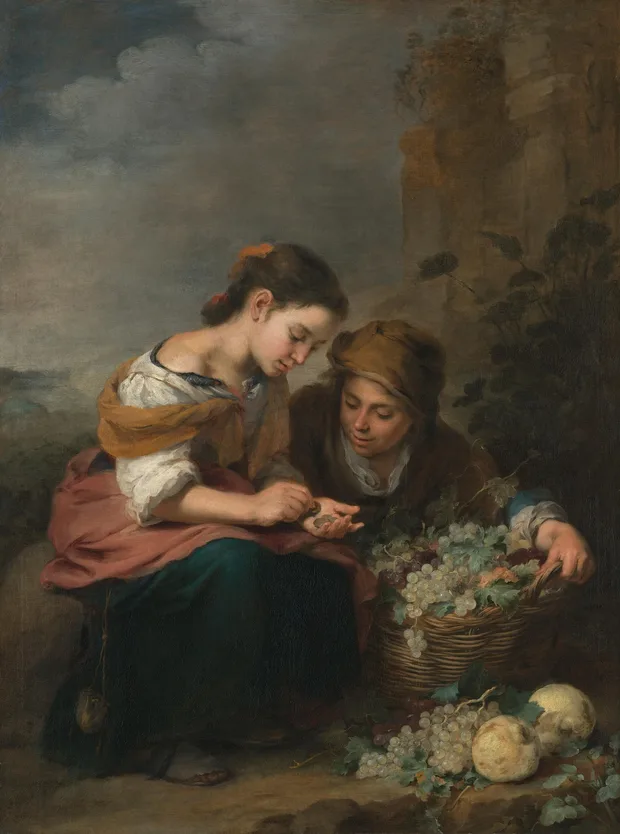
The painting was probably bought in Antwerp around 1698 for Max Emanuel, Elector of Bavaria, who was then governor of the Spanish Netherlands. The museum's records do not name the seller. Another painting, Young Boys Playing Dice, was sold to Max Emanuel in the same year, 1698, by the Antwerp merchant Gisbert van Colen, two more Murillos with children came in 1768 as the bequest of the court councillor Franz Joseph von Dufresne, and one came from Mannheim in 1799. In this way Munich came to hold five of Murillo's roughly twenty known paintings of street children, more than any other collection.
The Palatine galleries move to Munich (to 1806)
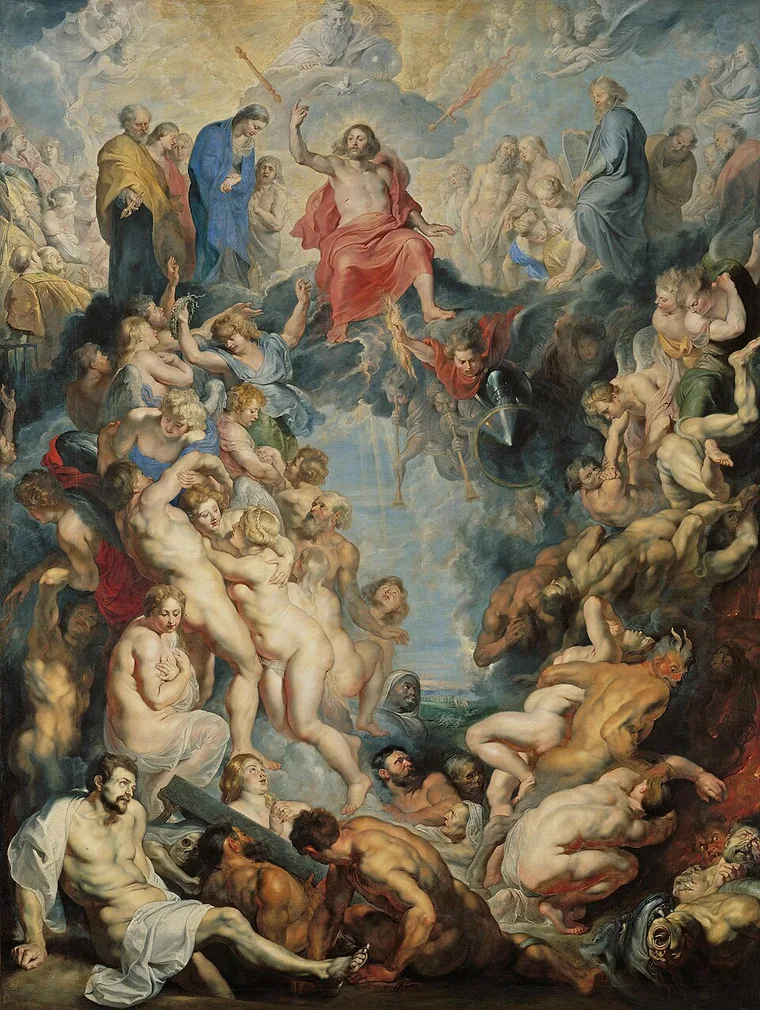
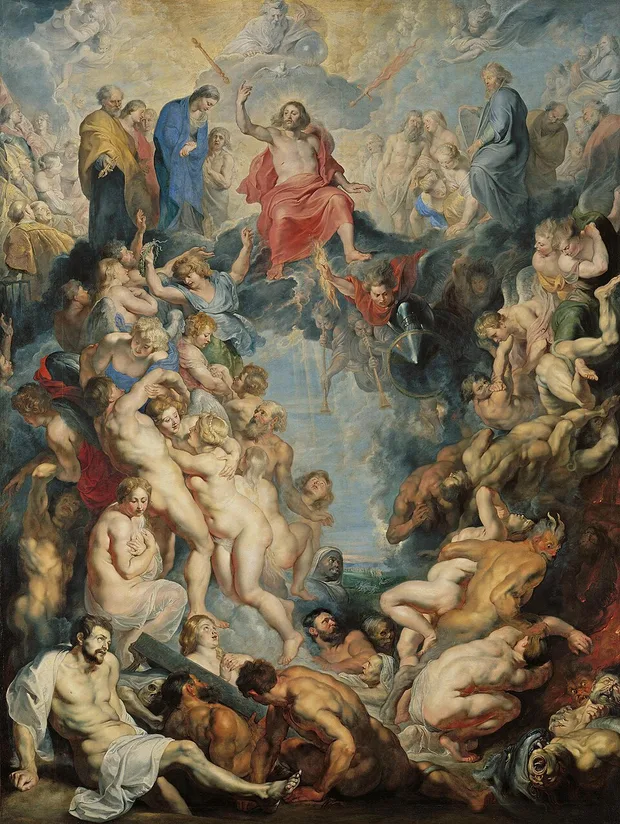
6. The Great Last Judgement — Peter Paul Rubens, c. 1617
Wolfgang Wilhelm, Count Palatine of Neuburg, converted to Catholicism in 1613, at first in secret and, as the museum puts it, out of political calculation. In the same year he gave the court church in his capital, Neuburg on the Danube, to the Catholics, in 1618 he handed it over to the Jesuits, and for its high altar he ordered a Last Judgement from Rubens.
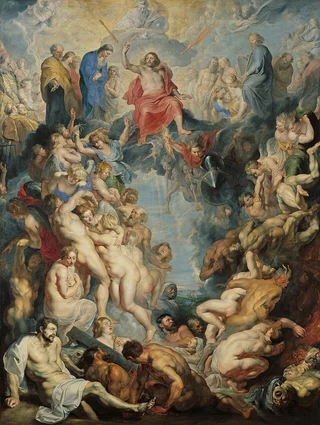
Rubens and his workshop painted a canvas more than six metres high, sewn together from several strips. Down the middle of the picture, from top to bottom, runs a gap of pale blue sky. To the left of it angels draw the pale, naked bodies of the saved upward, and to the right the dark, muscular bodies of the damned fall head first. Christ sits in the centre on a dark cloud in a pinkish-red cloak, his right hand pointing up towards God the Father and his left stretched out palm down over the side of the damned. Beneath him the archangel Michael flies head down with a fiery thunderbolt in his hand. In the lower left corner a bearded man in a white shroud rises from his grave, a skeleton beside him, and two men heave aside a heavy grey slab, while in the lower right corner a monstrous blue-grey head closes its jaws on a screaming man.
Why the painting left Neuburg is known only from later retellings. According to one of them, it was soon partly curtained off because of its “offensive nudity” and in 1653 taken down altogether. Wolfgang Wilhelm's grandson, the Elector Palatine Johann Wilhelm, took it to his gallery in Düsseldorf, and in 1806 it came to Munich with the rest of the Düsseldorf gallery.
The museum repeats the tradition that Klenze, when he was designing the Pinakothek, sized the main Rubens hall to fit this canvas. Whatever the truth of that, it is the only painting still hanging where it hung when the building opened in 1836.
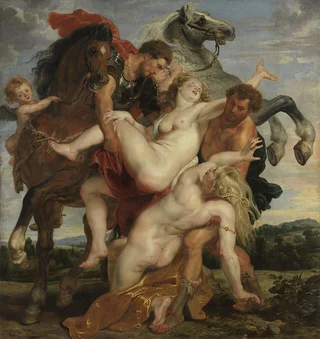
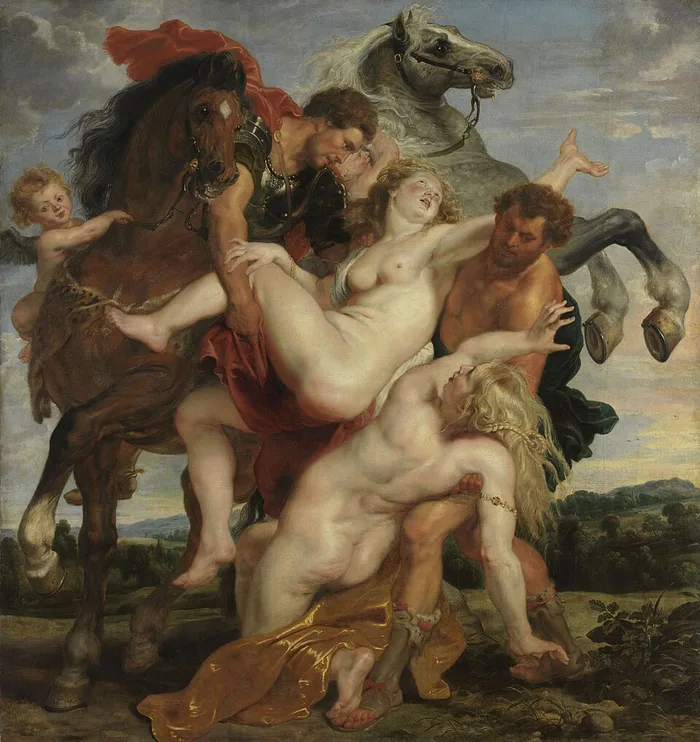
7. The Rape of the Daughters of Leucippus — Peter Paul Rubens and Jan Wildens, c. 1618
The brothers Castor and Pollux carried off Phoebe and Hilaeira, the daughters of Leucippus, who were betrothed to their cousins Idas and Lynceus. In the fight with the bridegrooms Castor, the mortal one of the two brothers, was killed. Pollux, a son of Jupiter and therefore immortal, asked not to be parted from him, and both brothers were turned into stars.
Rubens shows the abduction from below, so that the horizon with its hills and trees runs at the level of the figures' knees and the horses tower over the viewer. On the left stands a bay horse with a white blaze and a leopard skin on its back, and right at the edge of the canvas a putto with dark grey wings holds it by the bridle. On the right a riderless dapple-grey horse rears up above everyone. One brother, in dark armour with a red cloak flying out behind him, lifts one of the sisters, holding her under the thigh and the back, and she is stretched across the picture with her head thrown back and pearls in her reddish-gold hair. The other brother, tanned, bearded and naked to the waist, holds the other sister round the waist from behind. She kneels on one knee on a golden-orange cloth, and at the bottom centre her bare foot, its sole turned towards us, rests on its toes on the ground beside his sandal, which is laced with red ribbons. The landscape, according to the museum's record, was painted by Jan Wildens. The museum sees the painting as an argument in the old contest between painting and sculpture: the figures are intertwined so that the viewer seems to see the group from several sides at once.
The painting hung in the Düsseldorf gallery of Johann Wilhelm, Elector Palatine, which held 46 paintings by Rubens. The gallery was inherited by his successors of the Palatine branch of the Wittelsbachs, who in 1777 inherited Bavaria as well. In 1805, before Düsseldorf passed to Napoleon's Grand Duchy of Berg, the paintings were taken to Kirchheimbolanden and from there to Munich, and in 1806 they entered the Bavarian collection.
The museum attributes the gilded frame, with its corner ornaments and small mirrors, to Joseph Effner, the Munich court architect, who died in 1745, 60 years before the painting came to Munich.
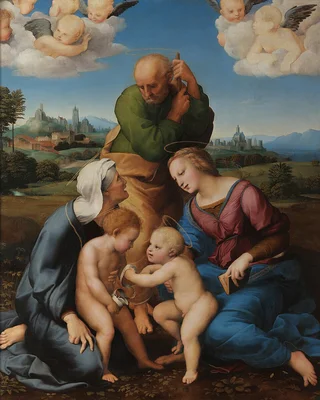
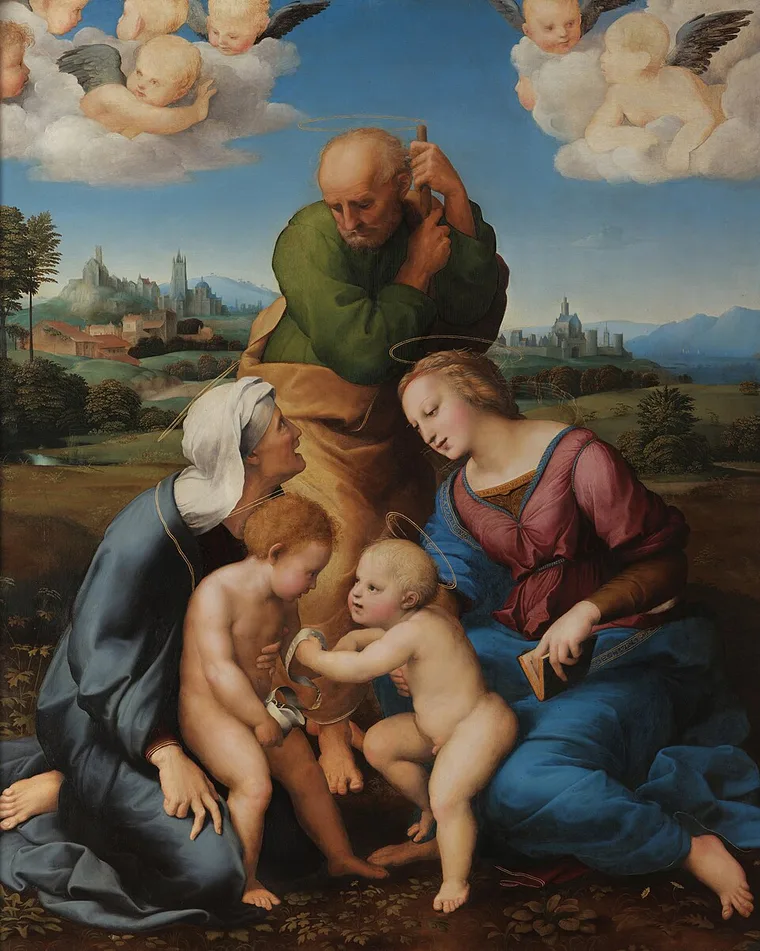
8. The Canigiani Holy Family — Raphael, c. 1505–1508
In the mid-18th century a restorer in Düsseldorf damaged the angels in the upper corners of this panel and covered them up by painting blue sky over them. Only in 1983, for Raphael's 500th anniversary, did restorers of the Bavarian collections under Hubertus von Sonnenburg remove the overpaint, and the angels on their clouds appeared again. On the left they form a close group, on the right there are two, partly cut off by the edges of the panel, and the museum counts eight in all. The right-hand pair is pale and chalky, almost like an underpainting, and the group on the left is also softer and more transparent than the figures below.
Vasari wrote that Raphael made this painting for the Florentine Domenico Canigiani, and the museum believes it was probably for his marriage to Lucrezia Frescobaldi in 1507. The young Raphael was living in Florence at the time, while Leonardo and Michelangelo were working there. He painted Madonnas for Florentine merchants, and at the end of 1508 he left for Rome.
The five figures are built into a pyramid. At the apex stands Joseph, leaning on his staff with both hands and bending his bald head towards Elizabeth. She kneels on the left holding the little John, and on the right, seated low, is Mary in a pinkish-red dress and a blue cloak. Between the children is a scroll. John holds its lower end, and the infant Christ grasps the loop at the top. On the gold border at the neckline of Mary's dress is written RAPHAEL VRBINAS, “Raphael of Urbino”.
In Vasari's day the painting was still with Canigiani's heirs. It reached Düsseldorf as a gift from Cosimo III, Grand Duke of Tuscany, to his new son-in-law, the Elector Palatine Johann Wilhelm, and in 1806 it moved to Munich with the gallery. In the subtitle of his catalogue for the 1983 exhibition Sonnenburg called it the first Raphael in Germany.
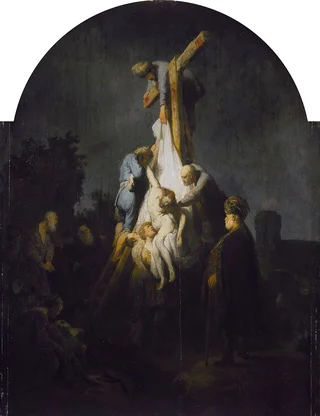
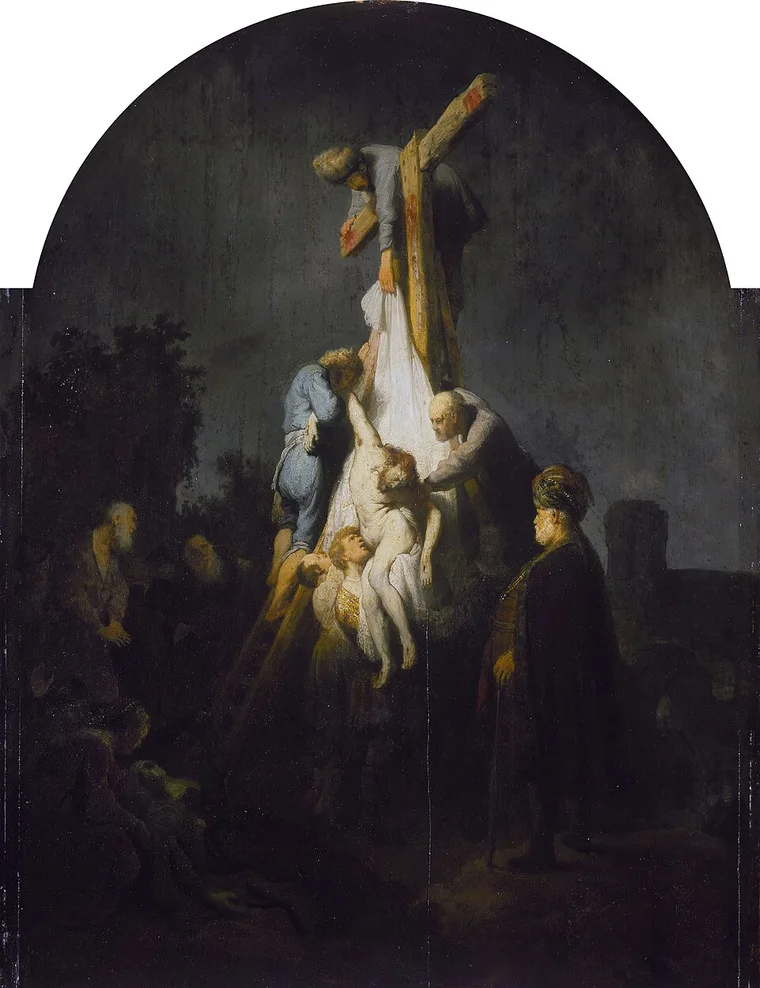
9. The Descent from the Cross — Rembrandt, 1632–1633
The Stadholder Frederik Hendrik of Orange, the military and political head of the Dutch Republic, commissioned a Descent from the Cross and a Raising of the Cross from Rembrandt. The commission came around 1631–1632, most likely through the stadholder's secretary Constantijn Huygens, who had praised the young Rembrandt some time before. The painter was about 25, and at about that time he moved from Leiden to Amsterdam.
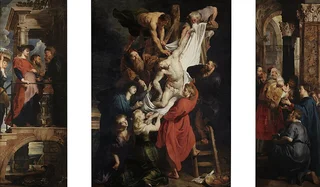
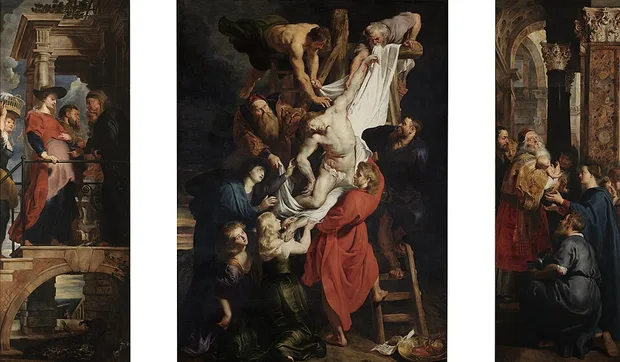
Rembrandt took the composition from Rubens, from his Descent from the Cross in Antwerp Cathedral, which he knew from Lucas Vorsterman's engraving of 1620. He kept Rubens's scheme, the white sheet let down from the cross and the man at the top holding it, and made the body of Christ heavy, thin and helpless.
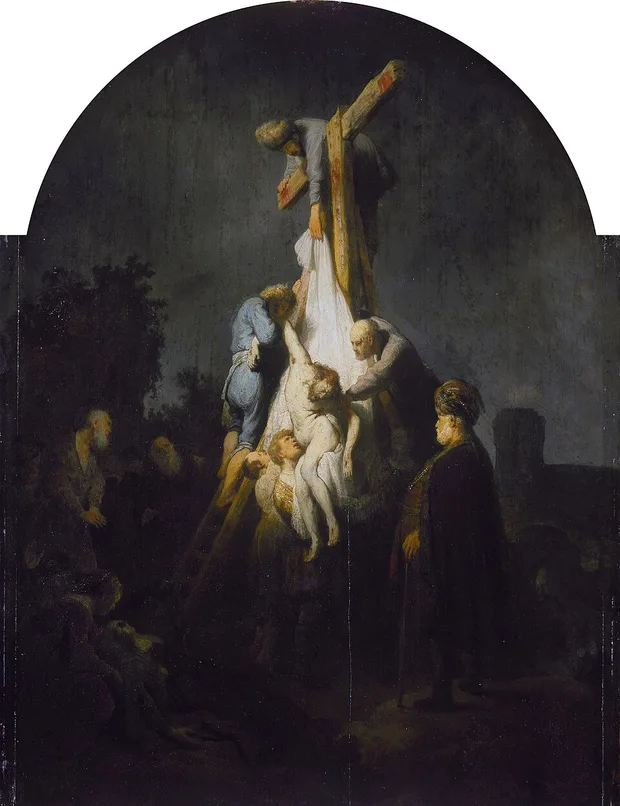
The panel is rounded at the top, and the light falls on it from the front and from the upper left, from somewhere outside the picture, lighting only the sheet and the body, while everything around them sinks into brown and black. A man in a fur cap, leaning over the crossbar, lets the sheet down, and it falls in a long white strip. Christ slides down it, his right arm still raised, his head fallen on his left shoulder, his legs hanging. On the ladder at the left a young man in a blue smock clasps Christ's raised arm and presses his cheek to the wrist, so that his face can barely be seen, and by long tradition he is identified as Rembrandt himself. At the right edge an old man stands in profile, in a turban wound with strings of pearls and a dark fur-trimmed cloak, and only watches.
In time the series for the stadholder grew to seven paintings. Rembrandt wrote to Huygens about the later ones, and these seven letters of 1636–1639 are generally taken to be the only letters by the painter that survive. In 1639 he explained that the last two paintings had been delayed because in them he had striven for “the greatest and most natural movement”.
In 1668 all seven paintings, in black frames, were recorded in the inventory of Frederik Hendrik's widow, Amalia van Solms, and in 1719 all seven appear in the printed catalogue of Johann Wilhelm's Düsseldorf gallery. Nobody has found documents showing how they got there. Between 1719 and 1756 the Circumcision disappeared, and it is known only from a copy in Braunschweig, so six paintings came to Munich in 1806. In 1755–1756 the Mannheim court painter Philipp Hieronymus Brinckmann restored all six and left a Latin inscription on the back of the Resurrection: “Rembrandt created me, Brinckmann resurrected you, 1755”.
Cities and monasteries give up their paintings (1805–1812)
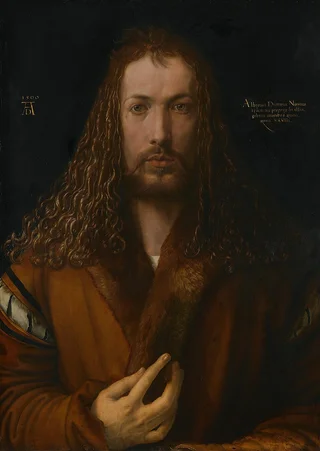
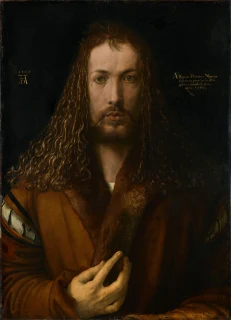
10. Self-Portrait with Fur-Trimmed Robe — Albrecht Dürer, 1500
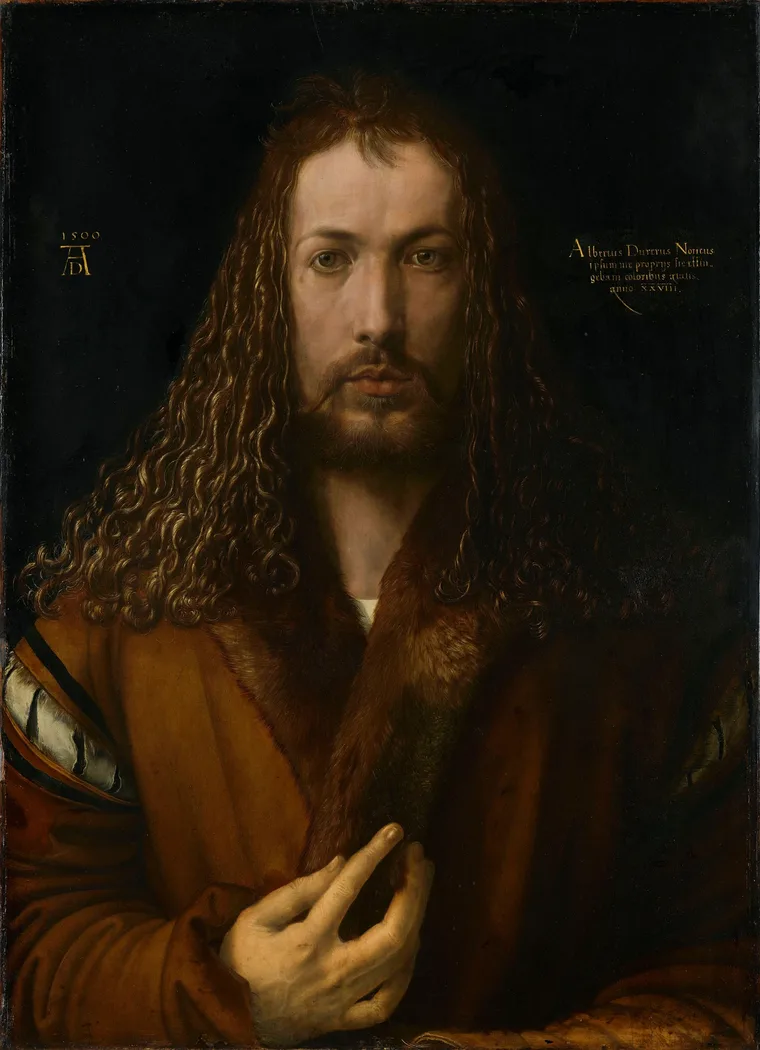
Dürer's self-portrait was hanging in Nuremberg's town hall when the French occupied the city in 1800–1801, and the commissioner Neveu requisitioned it and carried off to Paris a painting that later turned out to be a copy. In 1805 two Nurembergers, the city official Georg Gustav Petz von Lichtenhof and the picture dealer Abraham Wolfgang Küfner, sold the original to Munich for 600 gulden, shortly before Nuremberg itself became Bavarian.
Nobody knows exactly how the original left the town hall. A later legend claimed that Küfner, who was a restorer, sawed the panel in two, left the city a copy with the seals on its back and sold the original. In 2012 Thomas Schauerte, director of the Dürer House in Nuremberg, proposed another version: Petz and Küfner may have swapped the paintings on purpose so that the original would not fall to the French. Daniel Hess of the Germanisches Nationalmuseum allows for a still simpler explanation, that by the time of the occupation the original may no longer have belonged to the city, since it is missing from an inventory of 1711.
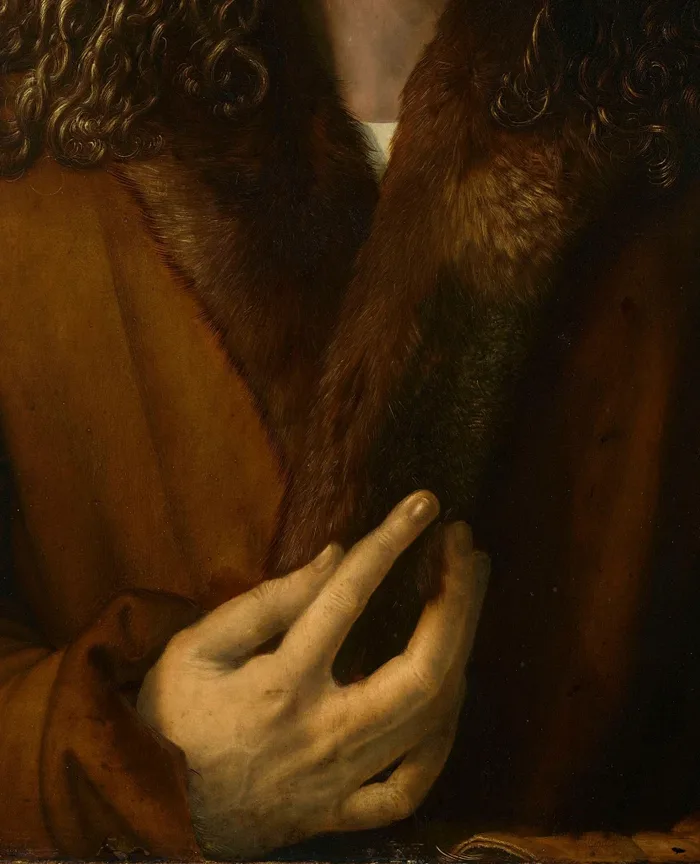
Dürer painted himself strictly frontal and symmetrical, the way the Saviour was painted on icons, and the museum names this model outright. His hair is parted and falls to his shoulders in even spiral curls, his brown coat has a broad fur collar, and his right hand is raised to his chest, the forefinger touching the fur. On the left, at eye level, the year 1500 and the AD monogram are written in gold, and on the right a four-line Latin inscription, which the museum translates as “Thus I, Albrecht Dürer of Nuremberg, painted myself in appropriate colours at the age of 28 years”. Under Nuremberg's sumptuary laws only the city's ruling families could wear marten fur, while Dürer by rank remained a craftsman and entered the Greater Council only in 1509. On this the art historian Philipp Zitzlsperger built his suggestion, in 2008, that the portrait was painted around 1509 and the dated inscription added afterwards. The museum keeps to the date 1500.
In 1815 France returned the copy that Neveu had taken, and since Nuremberg had become Bavarian by then, it was sent to Munich. The Bavarian collection holds both the original and this copy, which, according to the museum's record, was made in the 16th or 17th century.
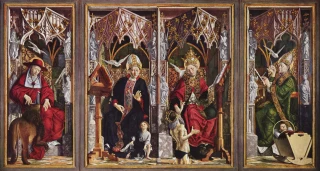
11. Altarpiece of the Church Fathers — Michael Pacher, c. 1480
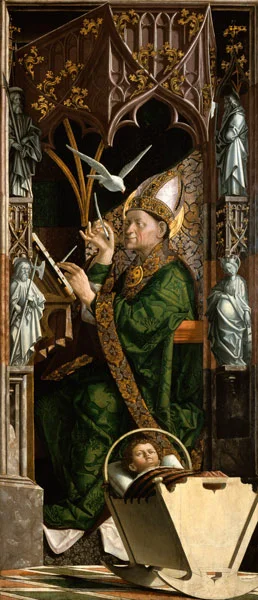
Above the four Fathers of the Church, Jerome, Augustine, Gregory and Ambrose, rise pink Gothic canopies with gilded leaves, grey stone statuettes of saints stand in niches at the sides, and all of it is painted on panels of Swiss stone pine. As the museum explains, Pacher depicted a carved altarpiece, and one carved from stone at that. He was himself both a carver and a painter, and from 1467 he ran one of the busiest altarpiece workshops of his time at Bruneck in the Tyrol. In the same years he was making the altarpiece for the church at St Wolfgang, whose centre is carved in wood and whose wings are painted.
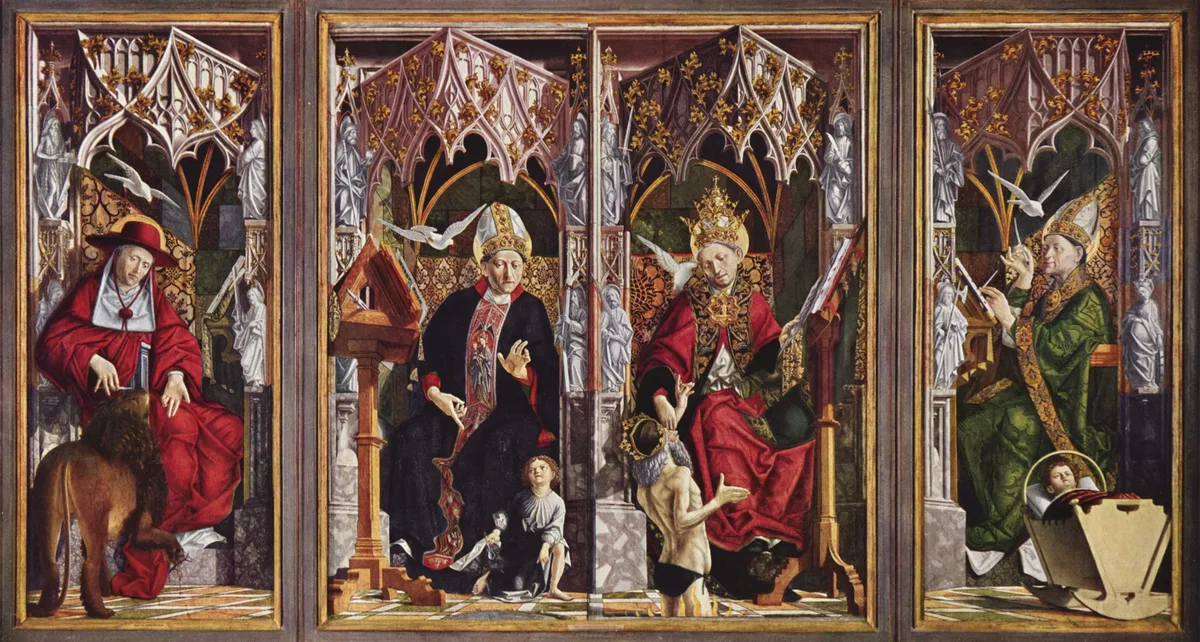
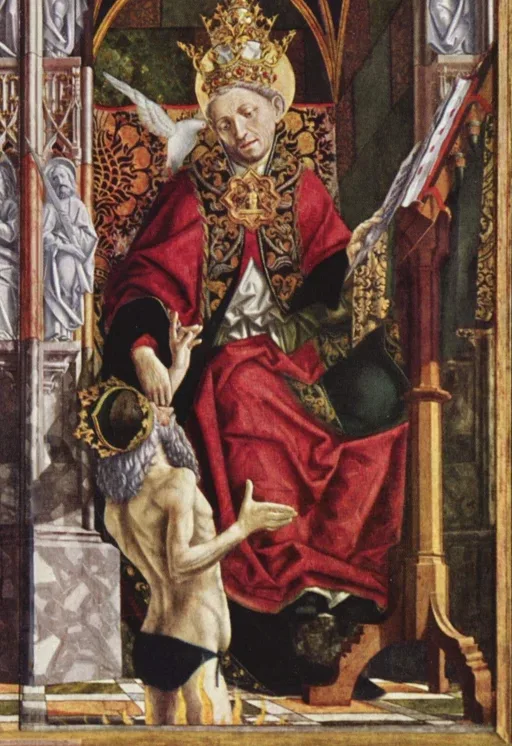
Historians believe that Pacher had seen Mantegna's work in Padua, and that this is where the steep perspective of the floor of coloured tiles comes from, along with the lecterns and the cradle pushed out towards the viewer. At Jerome's feet a lion, seen from behind, raises a paw with a thorn in it, and blood drips from it onto the tiles. On Gregory's panel an almost naked, grey-haired man wearing a crown rises from yellow tongues of flame at the bottom edge and stretches his arms upward, and the pope touches his hand. This is the emperor Trajan, who according to legend was delivered from purgatory by Gregory's prayer.
The altarpiece was painted for the church of the Augustinian canons at Neustift near Brixen, in South Tyrol, and is thought to have been commissioned by the provost Leonhard Pacher. Under the Peace of Pressburg in 1805 the Tyrol passed to Bavaria, the Bavarian government dissolved the Tyrolean monasteries, and Neustift was closed in 1807. The history that the monastery tells of itself says that the Bavarians plundered it and carried off tons of books and works of art, and names Pacher's altarpiece among them. According to the museum's record, the altarpiece came to Munich in 1812 as property of the secularised monastery.
In 1814 the Tyrol was returned to Austria, in 1816 Emperor Francis restored Neustift, and a much reduced community came back to the ransacked house, while the altarpiece stayed in Munich.
The king buys for a public museum (1820s)
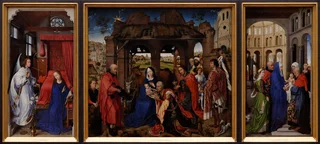
12. The St Columba Altarpiece — Rogier van der Weyden, c. 1455
In 1808 the brothers Sulpiz and Melchior Boisserée, sons of a Cologne merchant, bought the triptych that had stood in the church of St Columba in Cologne. The brothers collected the church art that French secularisation had thrown onto the Cologne market. The church itself remained a parish church under the French and stood until 1943, when bombs destroyed almost all of it. Researchers have never identified who sold the altarpiece.
The Boisserées believed the altarpiece to be by Jan van Eyck, and it was the chief painting of their collection. From 1810 to 1819 the collection was in Heidelberg, where Goethe saw it in 1814 and 1815 and admired the “van Eyck”. It was later shown in Stuttgart, and in 1827 King Ludwig I bought the entire collection for the museum he was building in Munich. The altarpiece was given to Rogier van der Weyden, the city painter of Brussels, in 1841.
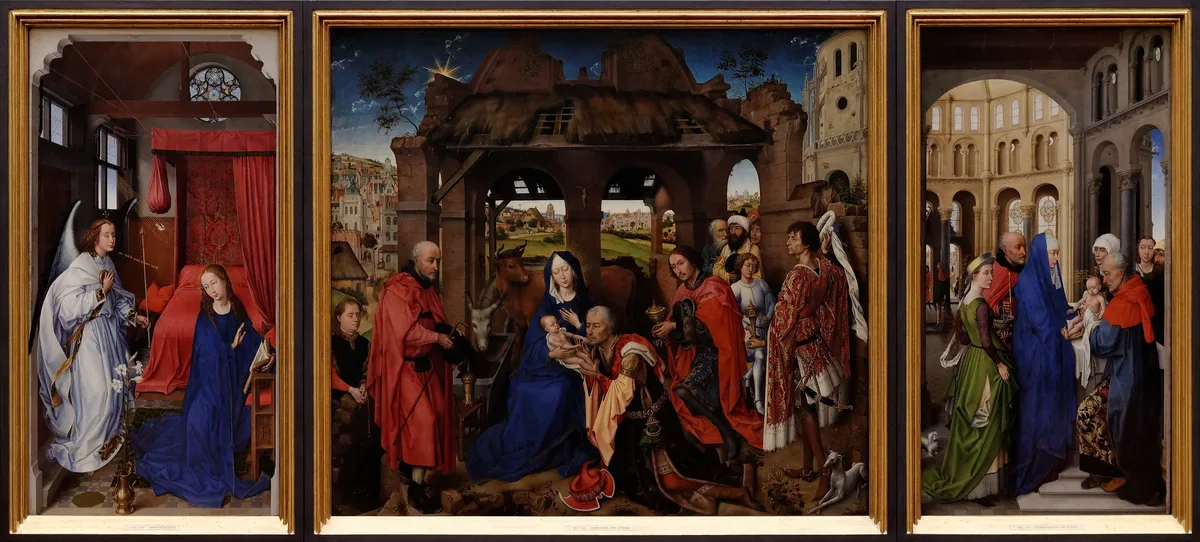
Cologne venerated the Three Magi, whose relics had been kept in its cathedral since 1164, and in the centre of the triptych Rogier painted the Adoration of the Magi. A stable with a thatched roof full of holes stands among stone ruins, Mary in dark blue sits just left of centre with the Child on her lap, and directly above her head a small crucifix hangs on the central post. The eldest king, in black and gold, kneels and raises the Child's little hand to his lips, and his red cap lies on the ground. The youngest, in red and gold brocade, stands at the right edge with his hat and its long white scarf raised high, and a white greyhound lies at his feet in the corner. On the left, behind a low broken wall, kneels the donor in black with a red rosary, and historians still argue about who he was. In the upper right corner a pale round temple can be seen outside, and inside it, on the right wing, Simeon receives the Child from Mary.
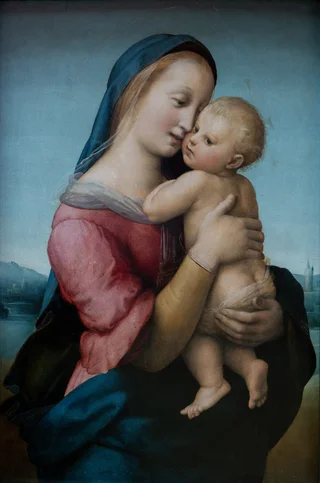
13. The Tempi Madonna — Raphael, c. 1507–1508
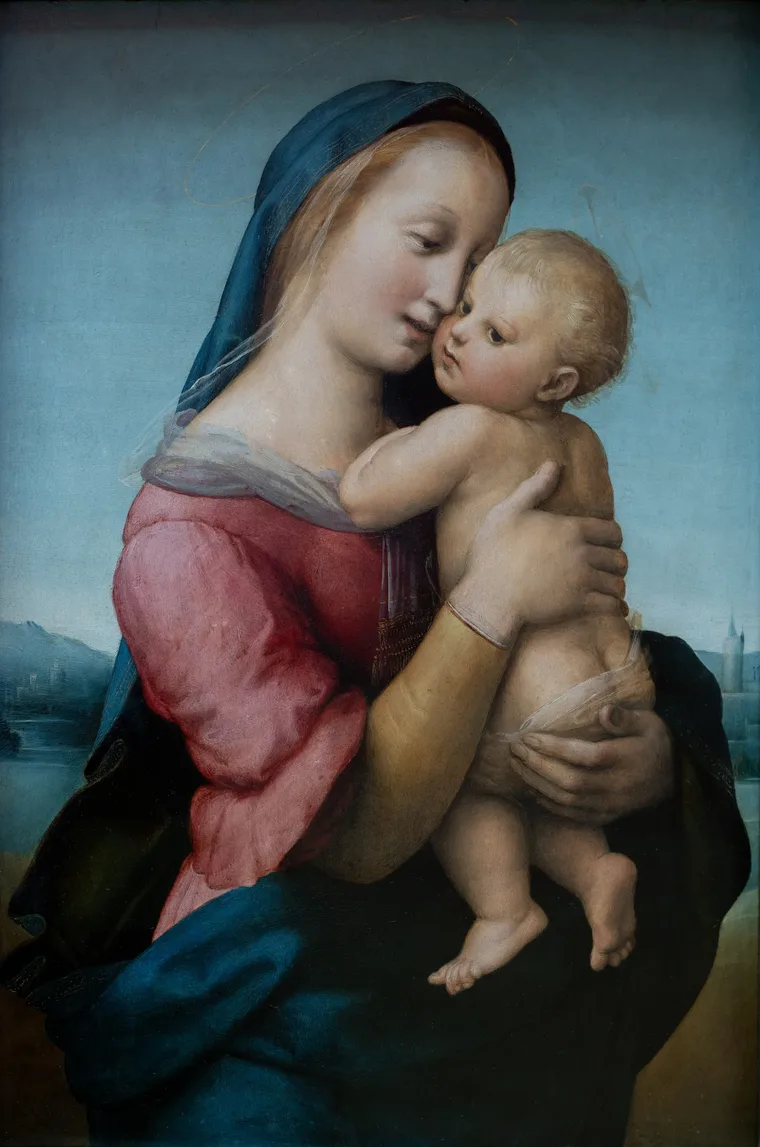
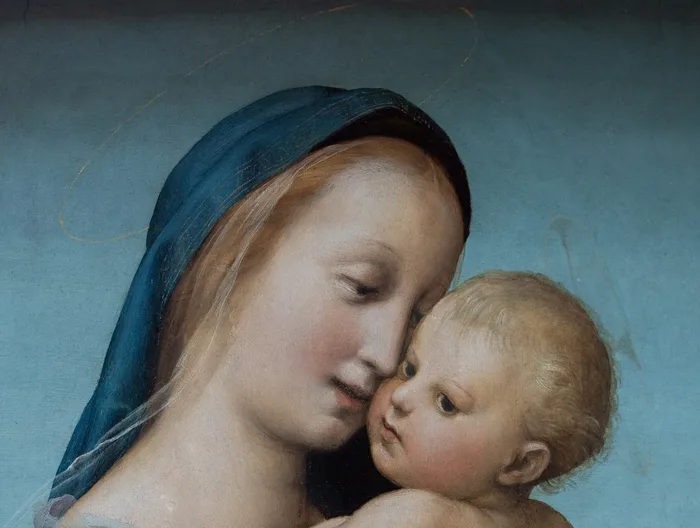
Mary holds the Child to her breast with both hands and presses her cheek to his, her eyes almost closed, a smile on her lips. The Child has buried his face against hers, yet his dark eyes glance sideways at the viewer, and of the two he alone looks out. Mary wears a pink bodice with a full sleeve and a blue-green cloak that turns almost black towards the bottom, with a thin gold border along its edge at the lower left. The haloes are drawn as hair-thin gold rings, and against the sky they are easy to miss. Pale greenish-blue sky fills almost the whole background, and only at the bottom on either side are there narrow strips of landscape with water, a small town and a tower. In the Canigiani Holy Family, painted in the same Florentine years, Raphael has five figures, and here only two.
On 20 August 1808 Johann Georg von Dillis, who was travelling in Italy on behalf of the Bavarian crown prince Ludwig, wrote to him about “a Madonna caressing the Infant Jesus, by Raphael from his best period” in the palace of the Marchese Tempi in Florence, and sent him an engraving of it. From 1809 Ludwig, fearing that letters were being opened, referred to the painting in his correspondence as “the dove”. The negotiations were conducted by Johann Metzger, Munich's agent in Florence. In 1811 Tempi refused to sell, and Metzger promised 100 zecchini to the marchese's mistress, Signora Nencini, if she could talk him round, though even that did not help. In 1824 Metzger bargained again while the marchese was taking the waters near Siena, and through a broker he tried to convince him that a famous gallery could do without a Raphael, whereas one painting would never make a gallery. Besides, he added, the painting might burn, and a week earlier lightning had struck a palace in the same street. In the late 1820s, when the Prussians too began hunting for the painting, Metzger finally bought it, almost 20 years after Dillis's first letter.
A Florentine official wanted to hold the painting back as an outstanding monument of the city, but Leopold II, Grand Duke of Tuscany, replied that he had not known of the sale and allowed its export, as he put it, only to fulfil the wish of the king of Bavaria. In Munich Ludwig placed the painting in the chapel of St Cecilia in his Residenz for private prayer, and only in 1835–1836 did he hand it over to the Pinakothek as the king's property. Since 1923, after the division of property between Bavaria and the former royal family, it has belonged to the Wittelsbacher Ausgleichsfonds, the Wittelsbach compensation fund, and is on long-term loan to the state.
The museum goes to market (1889–1917)
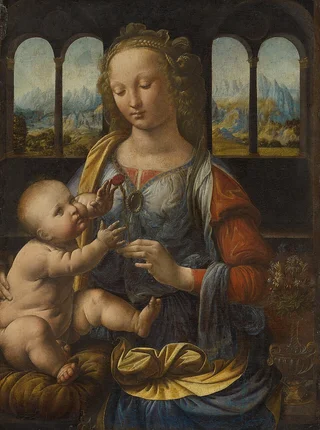
14. Madonna of the Carnation — Leonardo da Vinci, c. 1475
The pharmacist August Wetzler ran the Upper Pharmacy in Günzburg on the Danube, in Bavarian Swabia, from 1865 to 1881, and collected fossils. How this panel came into his hands has never been established. After his death in 1881 it passed to his widow, then to his unmarried sister Therese, and when Therese died in her turn, in November 1885, everything in the house was sold at auction. At the sale on 6–7 April 1886 the panel, with no attribution at all, was valued at five marks, and the physician Albert Haug, after bidding against another townsman, bought it for 47.50 marks.
In April 1889 Haug sold it to the Alte Pinakothek for 800 marks as a work from the workshop of Verrocchio, under whom Leonardo trained in Florence. That autumn the scholar Heinrich von Geymüller named Leonardo himself as the author. The argument went on for another half-century, with the panel given to Verrocchio, to Lorenzo di Credi, to the workshop, to a copyist of a lost Leonardo, until in 1937–1938 Emil Möller published a study after which Leonardo's authorship was accepted. It is the only painting by Leonardo in Germany.
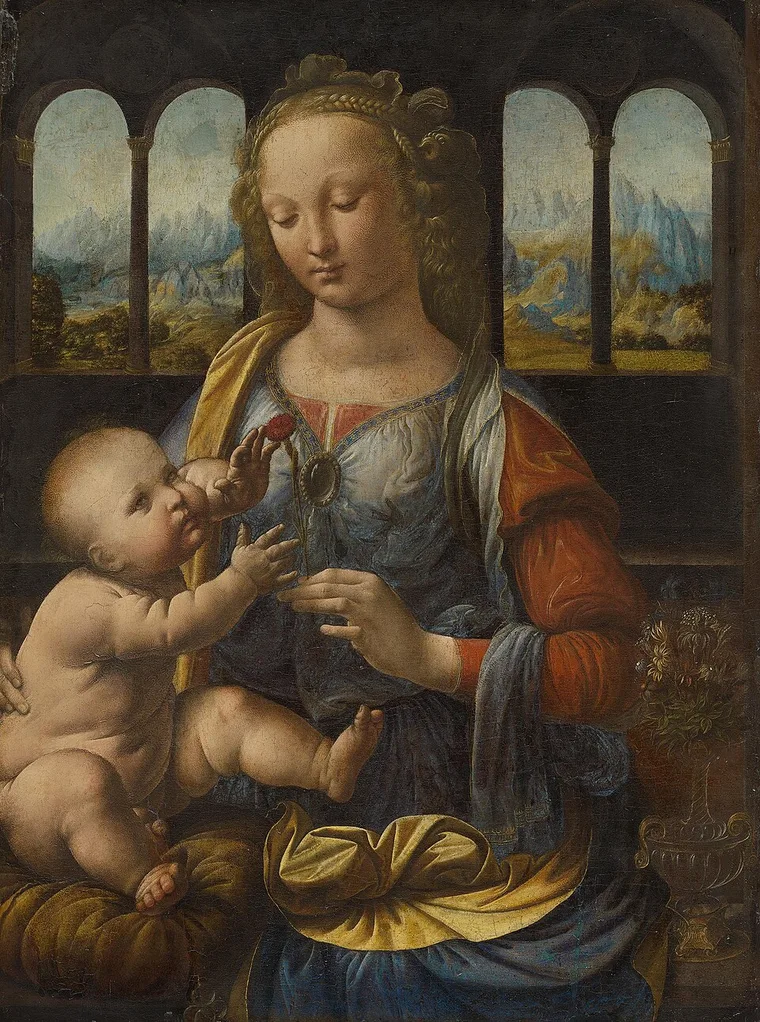
In the middle of the panel the young Mary holds a small red carnation on a thin stem by the dark brooch at her breast, and the heavy naked Child, sitting on a cushion at the lower left, reaches for the flower with both hands and kicks up a leg. The carnation is usually read as a sign of Christ's future Passion. Behind Mary, in a dark wall, are four arched windows in pairs, divided by slender columns, and through them jagged blue-grey peaks rise above golden foothills. At the lower right, on a ledge, stands a glass vase with a twisted stem in a gilt holder, full of pale flowers. Vasari praised a carafe of flowers in a Madonna by Leonardo that belonged to Pope Clement VII, and on the strength of this vase the museum connects the Munich panel with that painting, although three and a half centuries without a single document lie between the pope and the pharmacy in Günzburg.
Mary's face, neck and breast are covered with fine wrinkles, as if the paint had shrivelled. The museum calls the painting an experiment, and according to a study by the Doerner Institut in 2006 the paint wrinkled as it dried because the young Leonardo got the proportion of oil to pigment wrong.
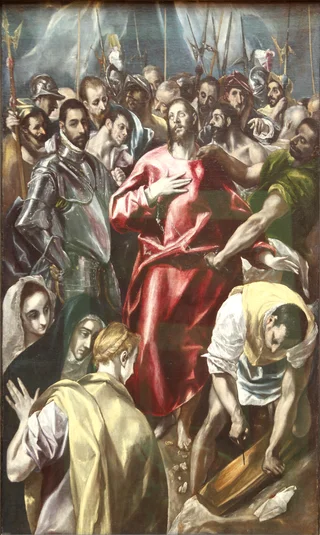
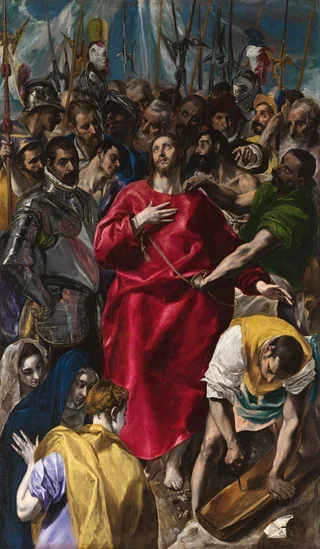
15. The Disrobing of Christ (El Espolio) — El Greco and workshop, 1580–1595
El Greco painted the large Disrobing of Christ in 1577–1579 for the sacristy of Toledo Cathedral, and it was his first major commission in the city. The cathedral chapter quarrelled with the painter over payment and objected to the three Marys at the bottom and to figures whose heads were placed higher than Christ's.
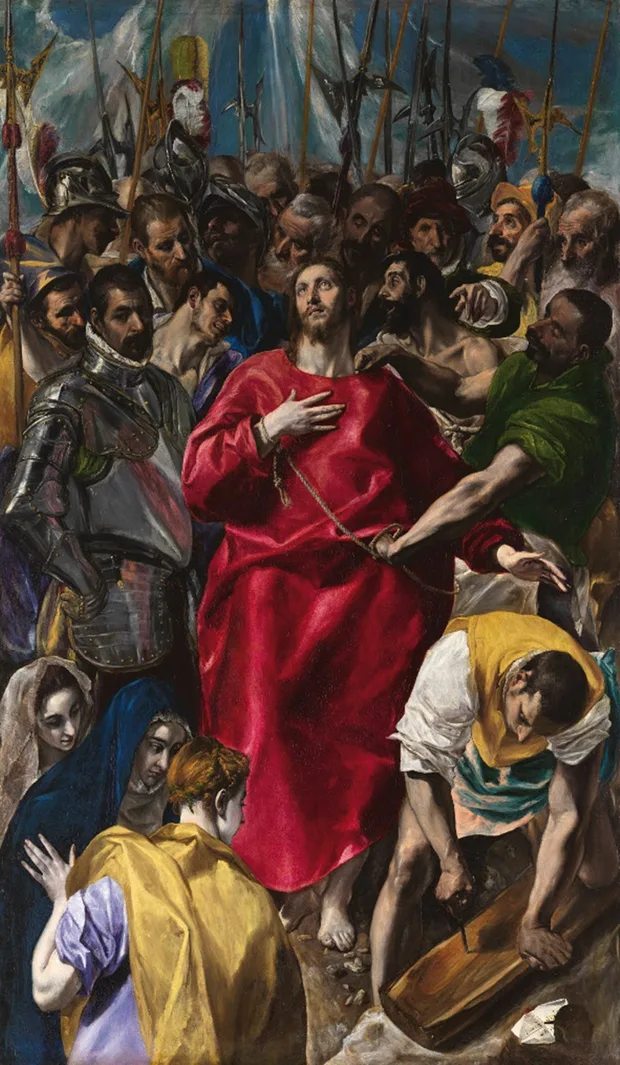
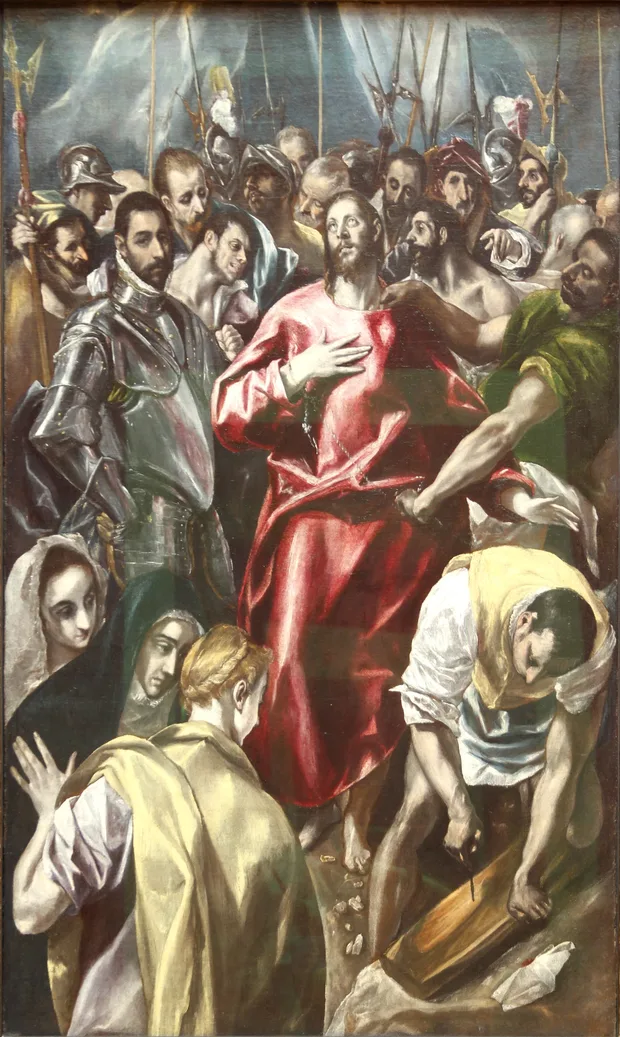
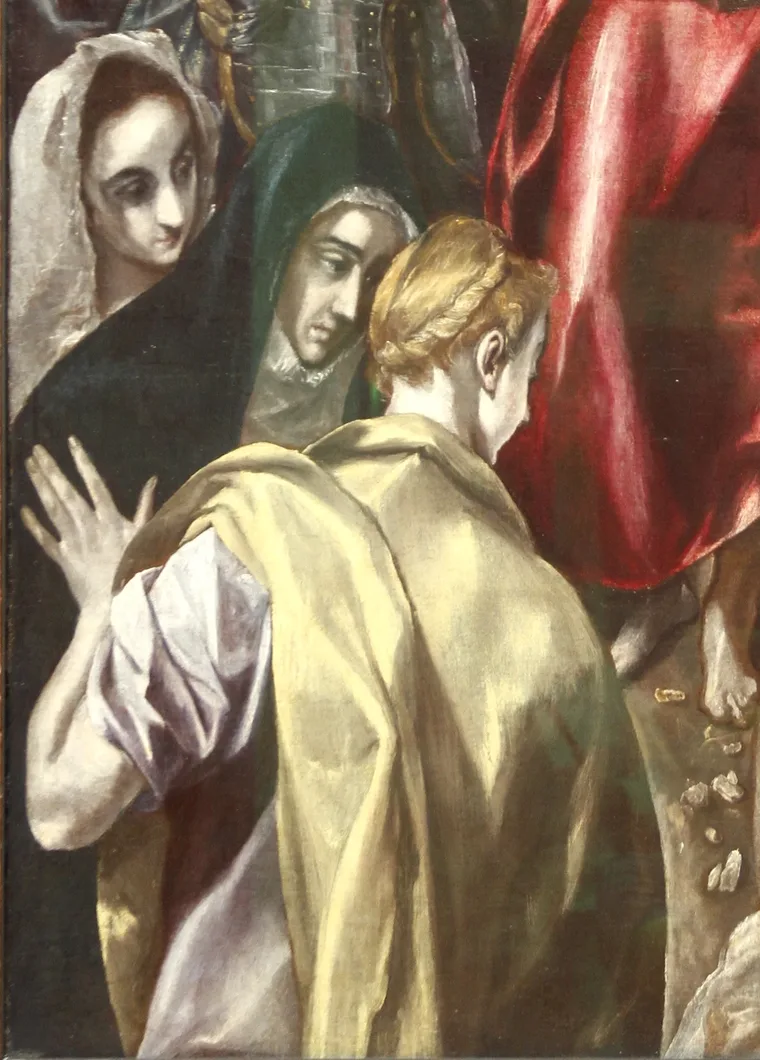
From the 1580s El Greco's workshop repeated successful compositions in a smaller size. Wethey, who compiled the catalogue of El Greco's works, counted 19 versions of the Espolio, painted in varying shares by the artist himself, his workshop and his son Jorge Manuel. The museum regards the Munich canvas as an autograph replica in which the workshop also had a hand, and it is usually ranked above the other later versions.
Christ stands in the centre in a crimson robe, the brightest patch in the picture, his right hand laid on his breast and his eyes raised, and around and above him crowd heads, helmets, a red turban, plumes and a thicket of halberds against a stormy sky. A man in a green shirt reaches across him with a bare, muscular arm and seizes the robe and the rope at his hip. On the left a bearded man in black steel armour with a white ruff stands motionless and looks past the viewer. At the lower left are the three Marys, the Magdalene turned away from us, with fair braids and a large yellow-gold cloak, and at the lower right a workman in a white shirt and a yellow jacket bends over the cross and bores a hole in it with an auger. Small pebbles lie scattered by Christ's bare feet.
In 1909 the canvas was bought from a Paris dealer by Hugo von Tschudi, the new director of the Bavarian collections, whom the Kaiser had shortly before forced out of the National Gallery in Berlin. El Greco was then being rediscovered as a forerunner of modern painting. The art historian Carl Justi called the late El Greco a case of morbid degeneration, while the critic Julius Meier-Graefe, who had travelled in Spain in 1908, placed him beside Michelangelo, Rubens and Rembrandt. From June 1911 to January 1912 the canvas hung in the Alte Pinakothek alongside eight paintings by El Greco from the collection of Marcell von Nemes, and many German artists first saw El Greco there. In the artists' almanac Der Blaue Reiter (The Blue Rider), published in 1912, El Greco was among the few old masters.
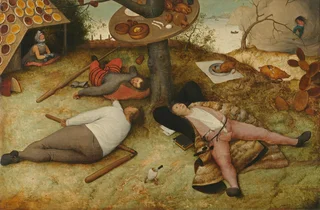
16. The Land of Cockaigne — Pieter Brueghel the Elder, 1567
On 4 December 1917, in the middle of the First World War, the collection of the late Richard von Kaufmann went under the hammer in Berlin, with Paul Cassirer and Hugo Helbing conducting the sale. The Swiss surgeon and collector Otto Lanz bid 310,000 marks for a small panel by Brueghel and secured it for the Alte Pinakothek. The money was raised jointly by Lanz himself, Cassirer, Helbing and several anonymous donors, and the collector's widow, Maria von Kaufmann, gave up part of the proceeds in favour of the museum.
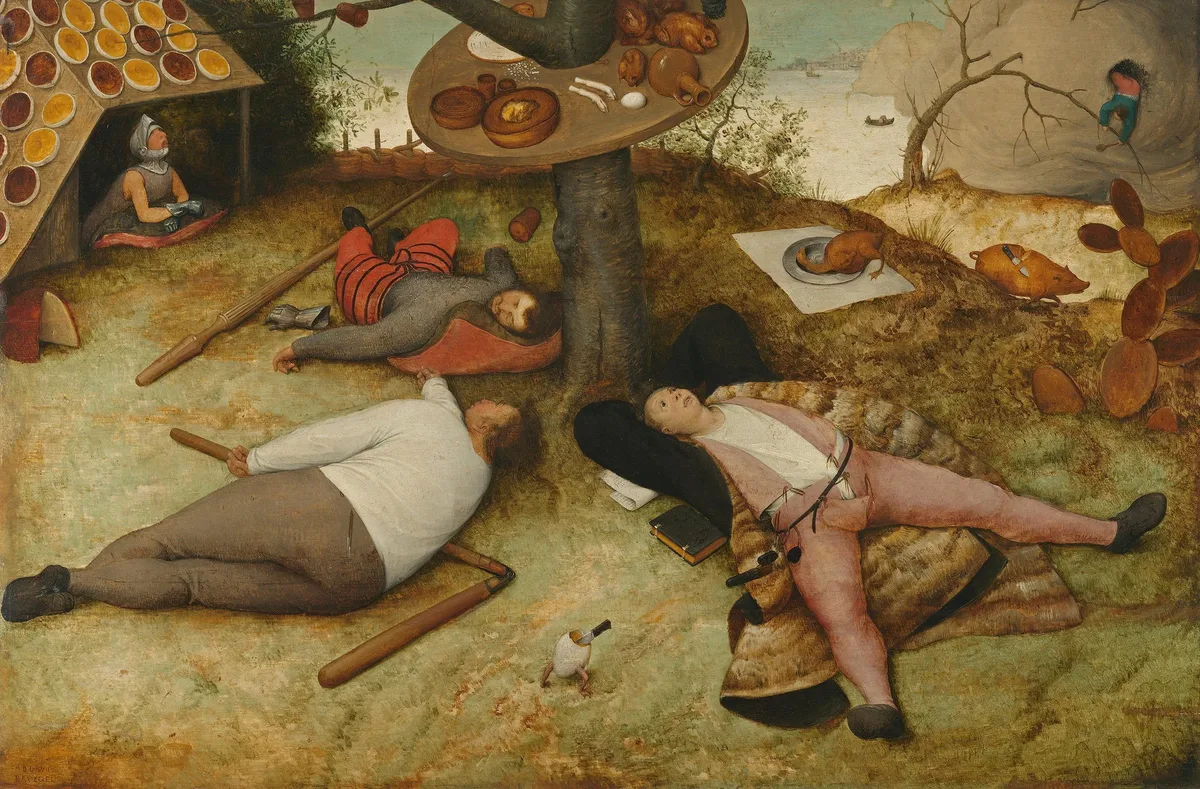
Before that the panel had belonged to Emperor Rudolf II in Prague. In 1648, at the end of the Thirty Years' War, Swedish troops carried it off, and it ended up at Skokloster Castle in Sweden. Around 1900 the painting surfaced on the Paris market, passed, in all likelihood, through the hands of the collector Henri Rossier in Vevey in Switzerland, and went on to Kaufmann.
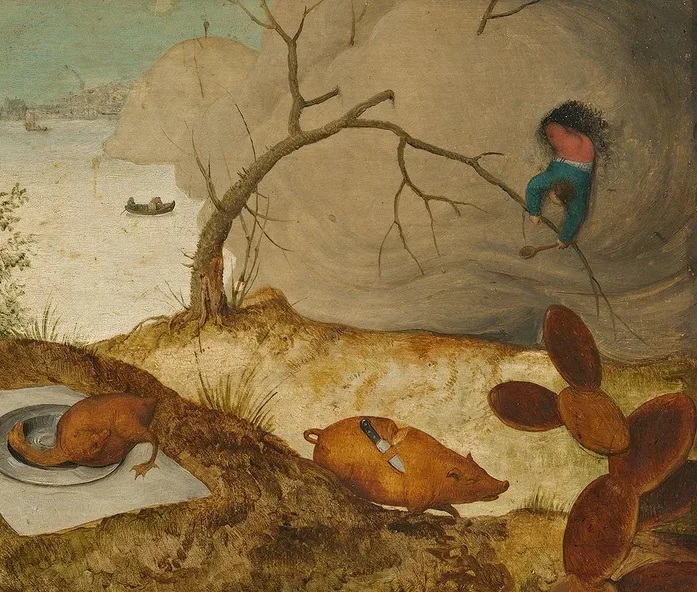
In the middle of the picture stands a tree with a round tabletop fixed around its trunk, tilted towards the viewer and crowded with pies, roast fowl and an overturned jug. Under it three men lie spread out like spokes around the trunk. A soldier in mail sleeves and red striped breeches sleeps on his back on a red cushion, his lance and iron gauntlet beside him. A peasant in a white shirt sleeps on his side on his flail, his face turned away. A scholar in pink lies on a fur-lined cloak, with a book and paper beside him and an inkwell at his belt, and his eyes are open. He is the only one awake, and he stares straight up. On the left a man in a helmet sits open-mouthed under a canopy roofed with round pies, on the right a roast piglet runs across the grass with a knife in its back, at the bottom centre a boiled egg with its top sliced off and a knife inside walks on two little legs, and behind the table runs a fence of sausages. According to a Flemish booklet of 1546, the source of these details, people reach Cockaigne by eating their way through a mountain of porridge, and in the upper right corner a man with a spoon pushes his way out, head first, from a grey billowing cloud. In the lower left corner, in small letters, is written M.D.LXVII BRVEGEL.
On a separate page about the history of the purchase, the museum tells what became of the people involved. Maria von Kaufmann's son was removed from his post as ambassador to Argentina in 1933, Lanz's widow had to sell his collection below its value, and Hugo Helbing lost his licence. In 1938 his firm was closed, in the November pogrom of that year he was beaten, and a few weeks later he died.
After the war: purchases and an attack (1953–1971)
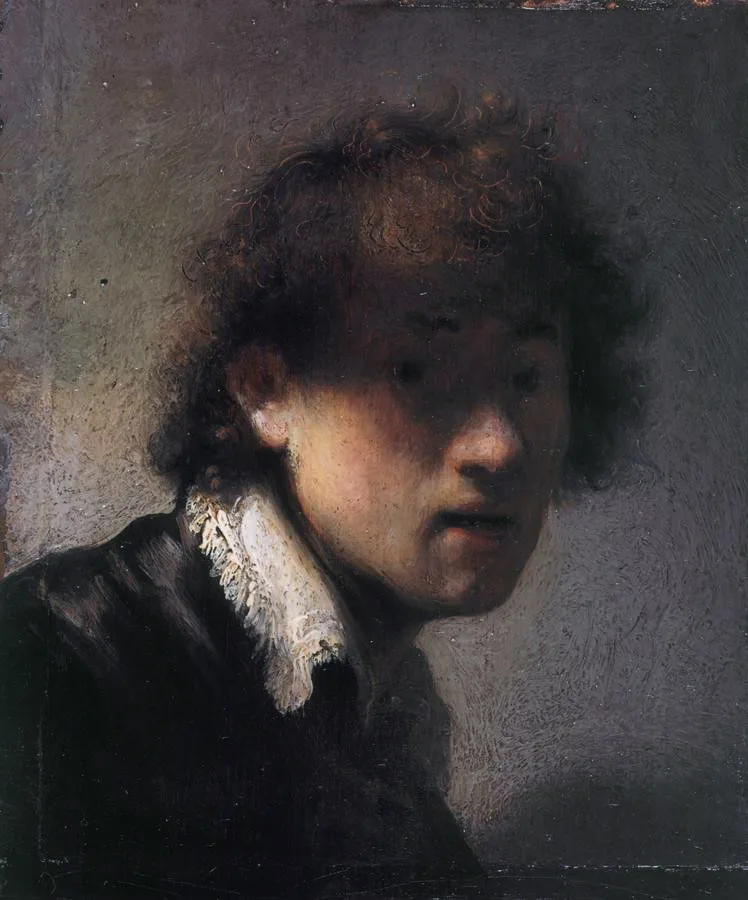
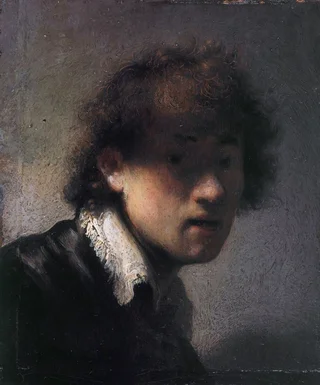
17. Self-Portrait — Rembrandt, 1629
Rembrandt scratched the curls above the forehead into the still-wet dark paint with something sharp, and in the scratches a light ochre layer shows through, so that the hair curls in thin light loops that look like wire. The panel is the size of a palm, with only the head and a shoulder on it. The 23-year-old painter leans forward and turns his head towards the viewer over his shoulder. The light falls from the left on the ear, cheek, neck and collar and catches the tip of the nose, the lips and the chin, while the eyes and forehead stay in shadow under the hair, and the mouth is slightly open. The white collar is laid on in a thick layer of paint with ragged edges, the densest in the whole picture. The museum counts the panel among the Leiden studies in which Rembrandt used his own face to try out light and shadow, expression, and techniques such as scratching into wet paint.
By 1803 the panel was in the collection of Duke Ernst II of Saxe-Gotha-Altenburg, and from 1842 it was shown at Friedenstein Castle in Gotha. During the war it was taken to Reinhardsbrunn Castle near Gotha, and in 1945 it was returned to the ducal museum. In January and February 1946 the ducal family secretly moved it from Gotha, which lay in the Soviet zone, to Coburg, in the American zone, explaining that they feared the Soviet trophy brigades. The removal was arranged by a former director of the ducal museum, without the consent of the director then in office and without the consent of the foundation that owned the collection. In 1953 the family sold the painting to the Bavarian State Painting Collections for 75,000 Deutschmarks.
The Friedenstein Foundation in Gotha calls the removal unlawful. Munich bought the painting in good faith, and under German law a former owner's claims lapse 30 years after the loss, a period that for Gotha ran out in 1976.
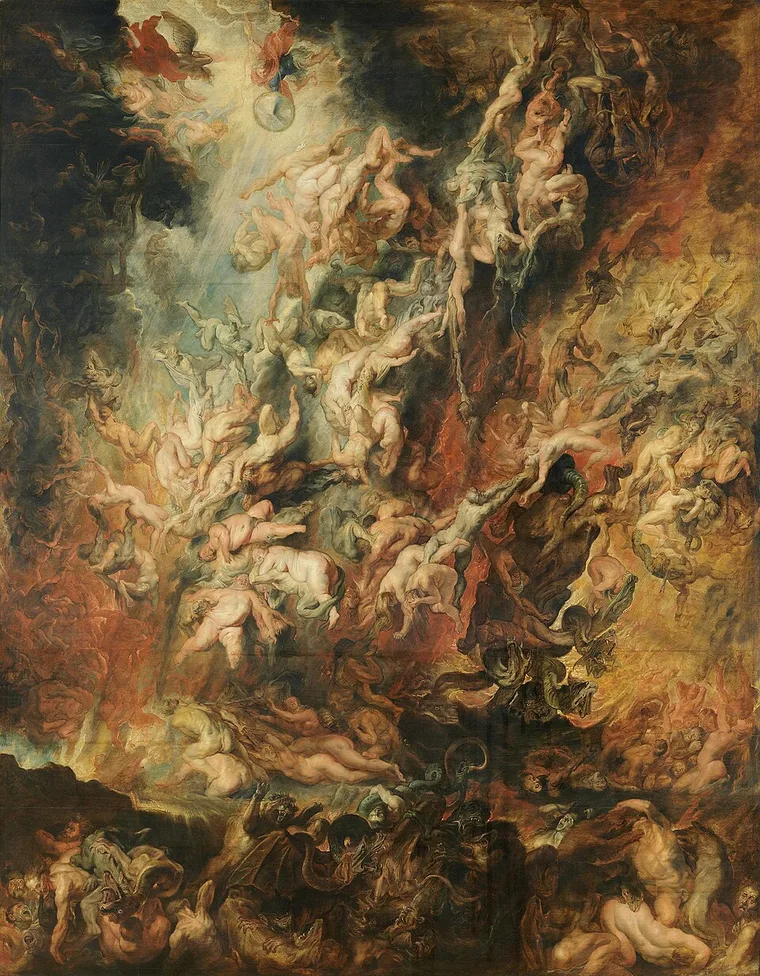
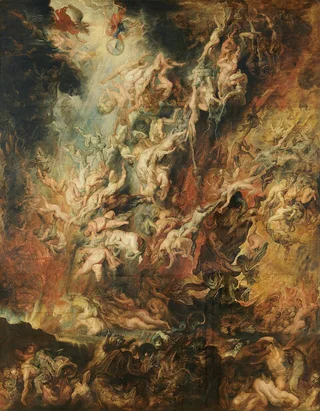
18. The Fall of the Damned — Peter Paul Rubens, c. 1620
On 26 February 1959, shortly after 11 in the morning, Walter Paul Menzl splashed a corrosive liquid over this panel, which had been in Munich since 1806, when the Düsseldorf gallery moved there. The newspapers wrote of acid, though it was most likely paint stripper. Menzl called himself a philosopher and around 1956 had founded a “philosophical academy” at Überlingen on Lake Constance, which not a single student ever attended, and with the attack he wanted to draw attention to his doctrine of universal peace. The next day he was found in a lawyer's office, and at the police station he confessed.
On 27 February the panel was taken out of the Pinakothek and driven for restoration to the building of the Central Institute for Art History. The newspapers wrote that it probably could not be saved, and it turned out that it had not been insured. It was restored by the chief restorer, Hermann Lohe, and according to his report the liquid struck just below the top edge.
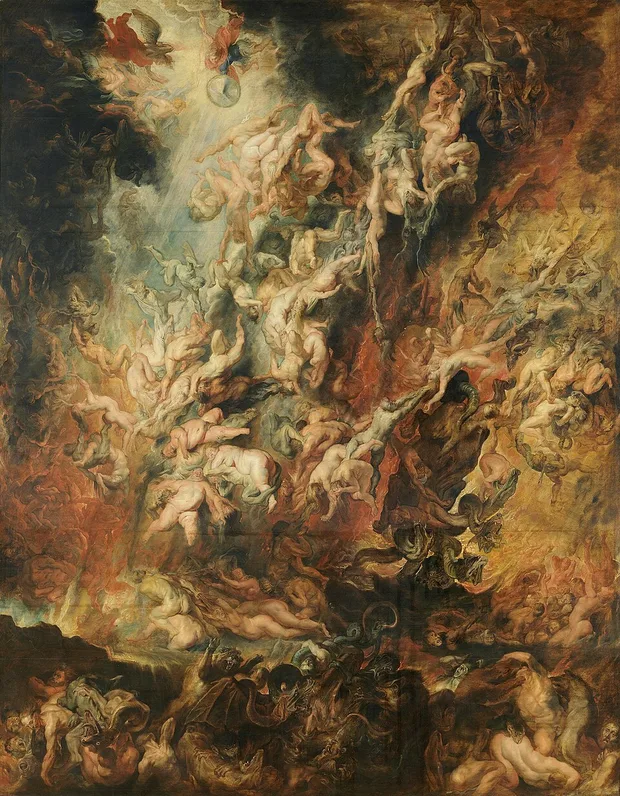
In the Great Last Judgement Rubens painted both Christ and the saved, and on this panel only the fall remains. At the top, just left of centre, the archangel Michael in red and blue, wings spread, holds a round shield that looks like clear glass, and from it a pale beam runs down to the left through black clouds. From the upper right a stream of naked bodies pours down, many of them head first, widening as it falls. Left of centre grey-green demons drag fat naked men and women, one with a round screaming face, and, as the scholar David Freedberg has observed, Rubens took these fat figures from Mantegna's engraving Bacchanal with Silenus. Right of centre the heads of dragons and serpents with gaping jaws are tangled together, and two-thirds of the way down the bodies stop falling and are dragged across the picture. At the right and along the bottom a yellow-orange fire glows.
On 15 July 1959 a Munich court sentenced Menzl to three years in prison and ordered him to pay 800,000 marks in damages, which he never paid.
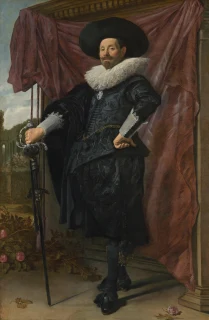
19. Portrait of Willem van Heythuysen — Frans Hals, c. 1625
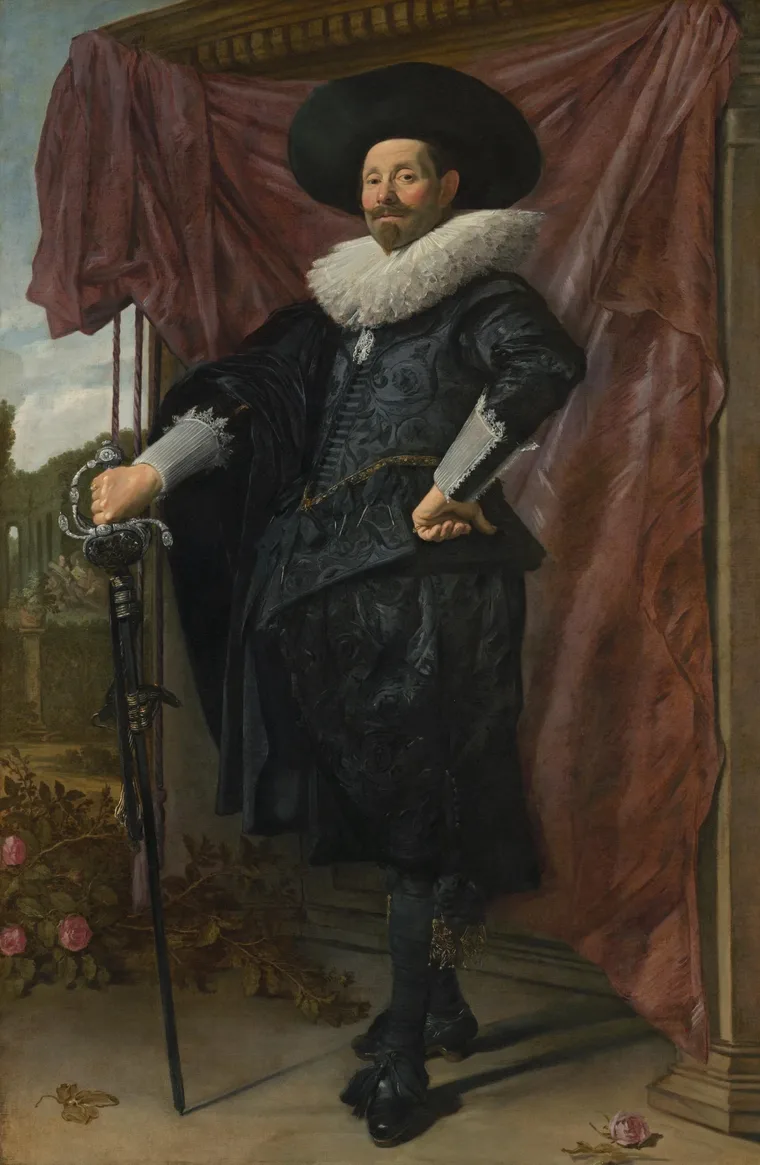
Willem van Heythuysen, a Haarlem cloth merchant, commissioned the portrait from Hals for the large room of his house, and it is listed there in the inventory of his estate after his death in 1650. It is the only known single portrait of a man by Hals that is full-length and life-size. In Holland in the 1620s it was usually princes and nobles who were painted full-length and life-size.
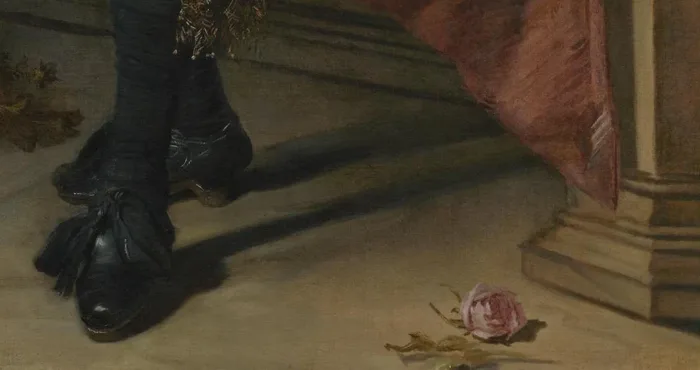
Heythuysen stands with his legs crossed, and we see him slightly from below. His left hand is on his hip, elbow out, and his right rests on the silver openwork hilt of a sword whose sheathed tip stands on the floor. He held no military rank, and the Hals scholar Grimm considers the sword a ceremonial gift. His black suit is made of patterned damask, and where the light falls the large flowers in it shimmer grey. On his head is a broad-brimmed black hat, under his chin a wide white pleated ruff, and at his wrists lace cuffs. Behind him hangs a wine-red curtain, and at the left, in the distance, is a garden with an arcade where two small figures sit, a garden that Grimm gives to Hals's Haarlem colleague Pieter de Molijn. By Heythuysen's right foot a single pink rose lies on the floor, and according to Grimm Hals painted it himself. It is one of two still-life fragments by Hals that survive.
In 1800 the portrait was sold in Haarlem for 51 gulden. In 1821 Prince Johann I of Liechtenstein bought it as a work by Bartholomeus van der Helst, and only in 1866 did the German connoisseur Gustav Waagen give it back to Hals. In 1969 Bavaria bought the portrait for the Alte Pinakothek from Prince Franz Joseph II, at a time when the princes of Liechtenstein, having lost their Czech estates, were selling paintings. Two years earlier, in 1967, Leonardo's Ginevra de' Benci had left their collection for Washington.
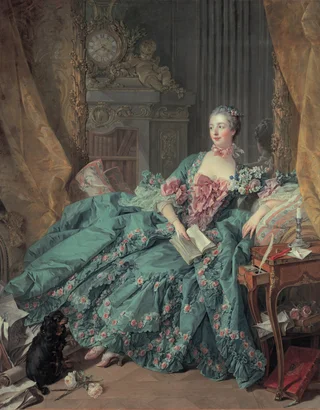
20. Madame de Pompadour — François Boucher, 1756
The Gestapo sealed the Vienna palace of Alphonse and Clarice Rothschild on 14 March 1938, two days after the Anschluss, confiscated their paintings, this portrait among them, and took them to the depot of the Kunsthistorisches Museum. In July 1939 Hans Posse, who was choosing confiscated paintings for the museum Hitler planned for Linz, assigned the Rothschilds' French paintings, the portrait of the marquise among them, to the Kunsthistorisches Museum in Vienna.
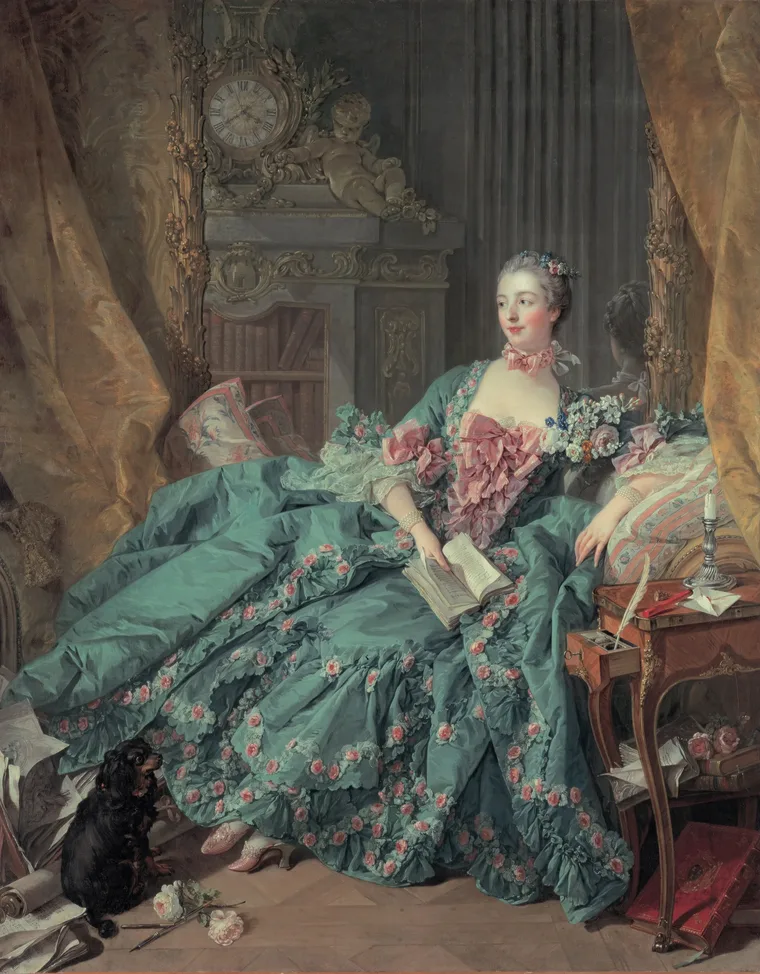
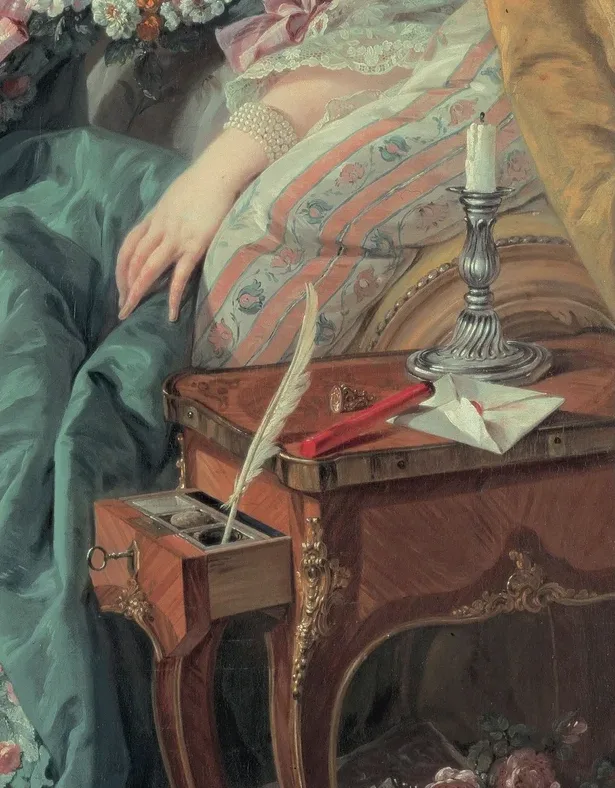
The Marquise de Pompadour, mistress of Louis XV, reclines on a couch set diagonally across the canvas, and her enormous skirt of blue-green silk, trimmed with garlands of small pink roses and with flounces, spreads over the lower half of the canvas, while a ladder of pink bows runs down her bodice. She looks to one side, past the viewer, and holds an open book on her lap. On a small writing table at the right stands a silver candlestick with a burnt-down, snuffed-out candle, beside a folded letter with a red seal, a stick of red sealing wax and a small gilt seal, and a quill in an inkwell sticks out of the pulled-out drawer. On the left, by her hem, sits a black and tan spaniel, with prints and sheet music behind it. A large mirror behind her reflects the back of her head and a bookcase of leather-bound books, on top of which stands a clock with a cupid.
Boucher was her favourite painter and taught her to draw. The museum says that the marquise commissioned the portrait herself, and in 1757 Boucher exhibited it at the Salon. In early 1756, while he was working on it, she received an official post at court as lady-in-waiting to the queen.
The portrait went to the marquise's brother, the Marquis de Marigny, later belonged to the Earl of Lonsdale, and in 1887, at the sale of the Lonsdale collection, Baron Ferdinand de Rothschild bought it and hung it in his London house in Piccadilly. After Ferdinand's death in 1898 the painting went to Vienna, to his brother Nathaniel, while its old frame stayed in England, at Waddesdon. From Nathaniel the portrait passed to Alphonse. After the war it was returned to Clarice Rothschild, widowed in 1942, and she took it to the United States. It was sold through the New York firm of Wildenstein, in 1971 the Bavarian Mortgage and Exchange Bank bought it, and since then it has been on long-term loan to the Alte Pinakothek. The bank is now called HypoVereinsbank and belongs to the UniCredit group.
What else to see
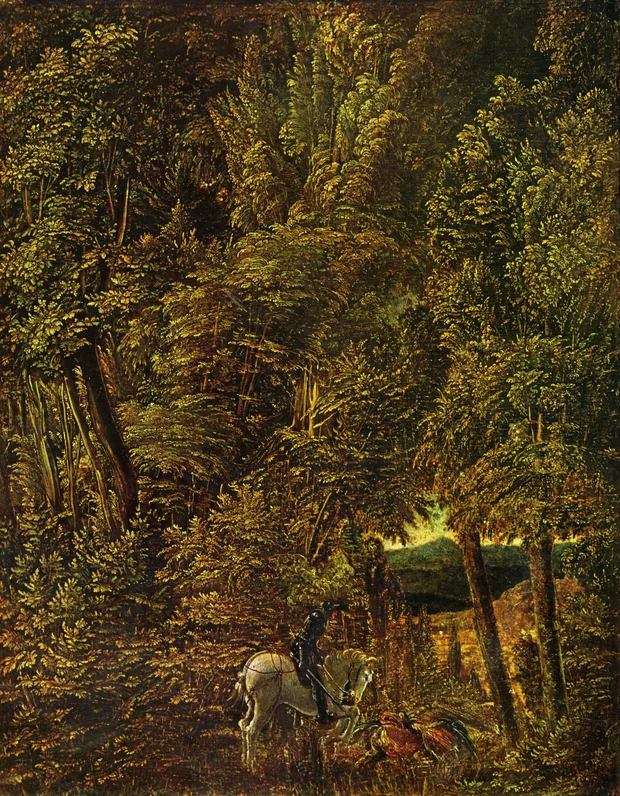
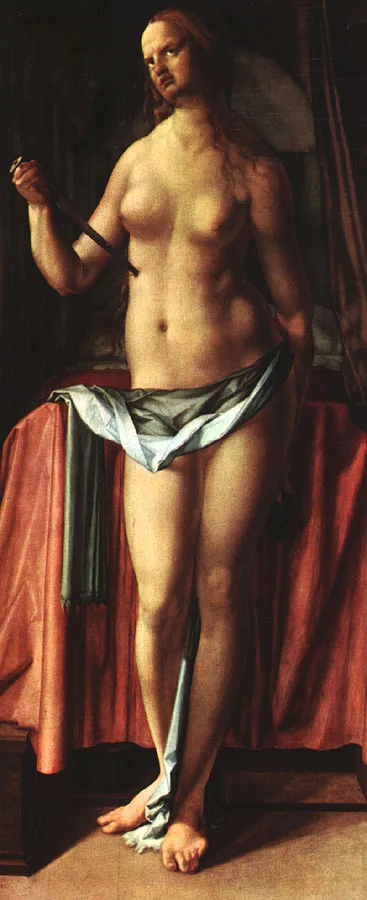
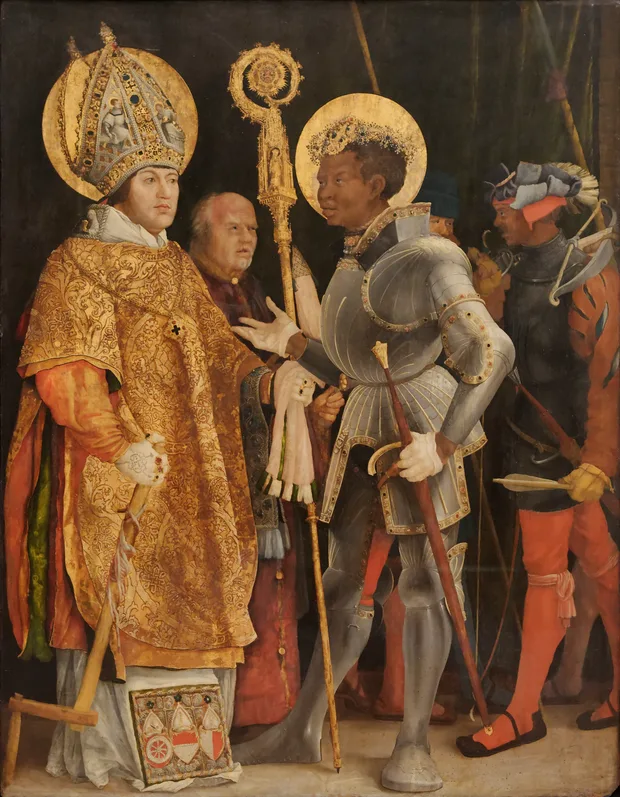
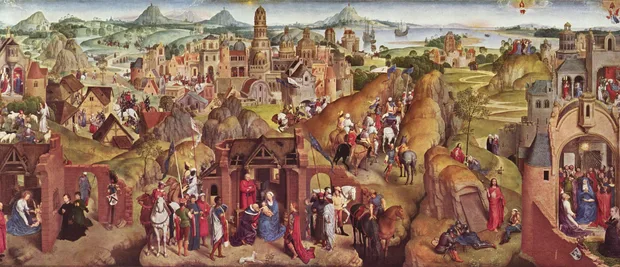
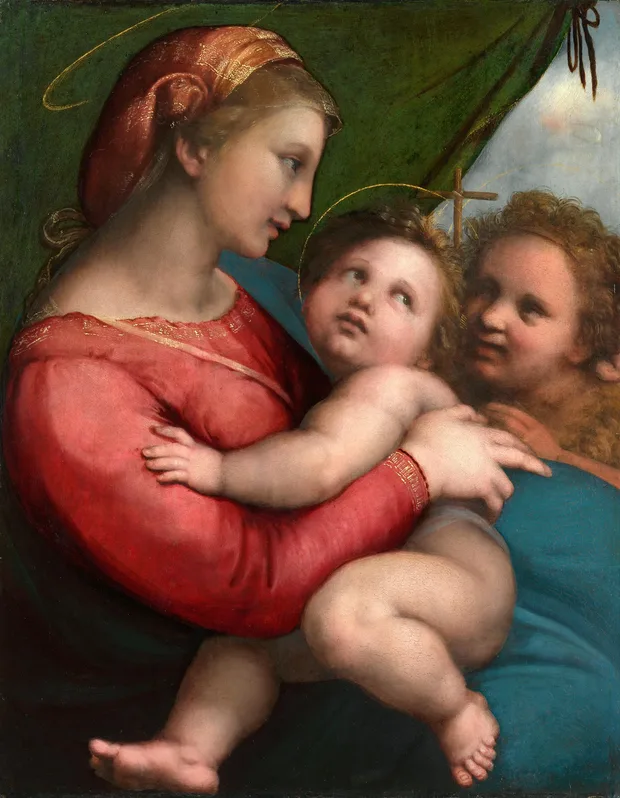
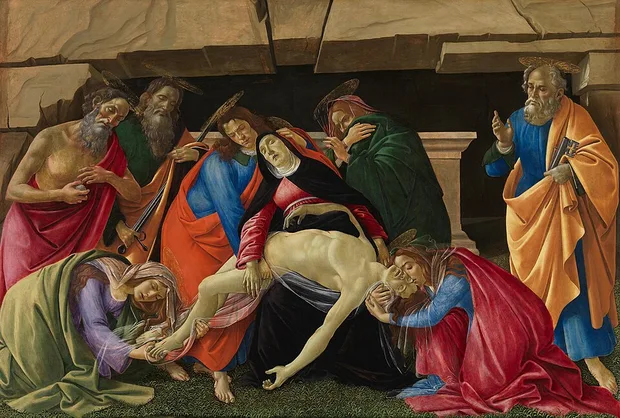
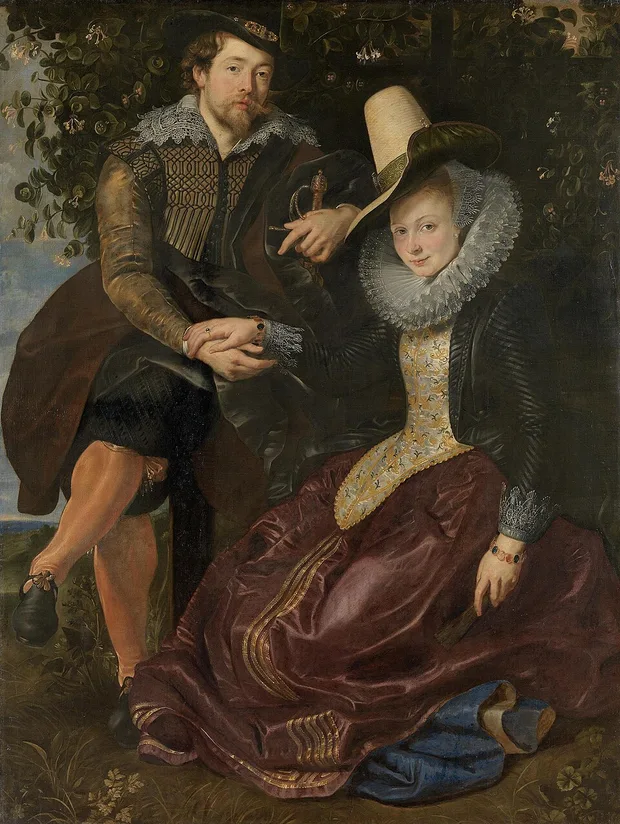
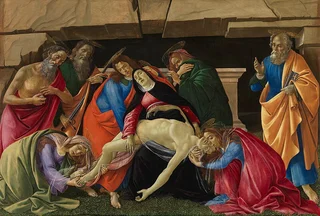
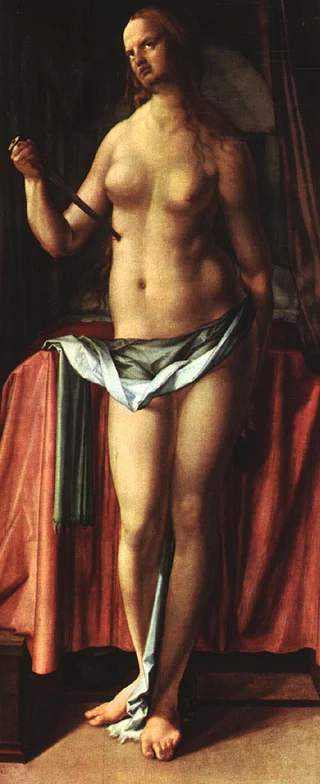
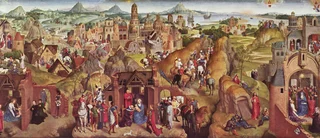
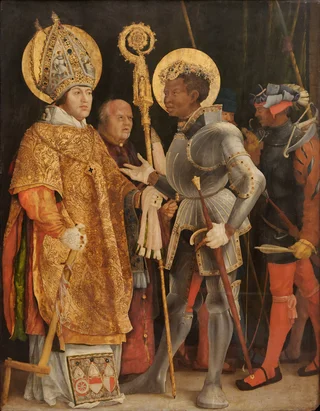
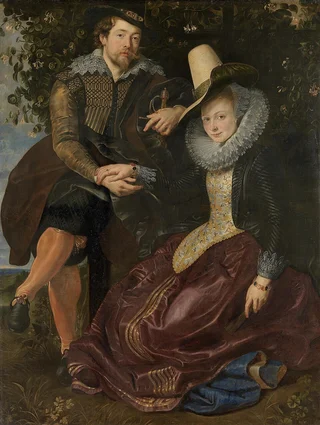
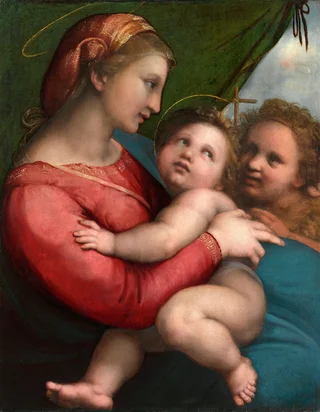
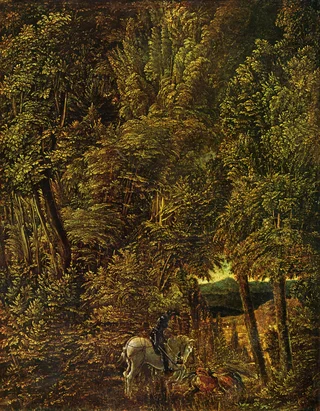
Among the German paintings, look for Altdorfer's St George in the Forest, Dürer's Lamentation of Christ, which was splashed with acid on the same day as the Paumgartner Altarpiece, his Suicide of Lucretia, and Grünewald's Saints Erasmus and Maurice. Memling's Seven Joys of Mary comes from the Boisserée collection. Among the Italians there is a third Raphael, the Madonna della Tenda, along with Botticelli's Lamentation over the Dead Christ and eight canvases by Tintoretto from the cycle painted for the Gonzaga in Mantua. Of Rubens's paintings, the one to see is his self-portrait with his first wife, Isabella Brant, in a honeysuckle bower, painted soon after their wedding in 1609.