The State Drawing School opened in Sofia on 14 October 1896. Until then Bulgarian artists had trained abroad, in Moscow and St Petersburg, in Vienna, Munich and Florence. The bill founding the school was prepared by the minister of public education, Konstantin Velichkov, the literary scholar Ivan Shishmanov and two painters, the Czech Ivan Mrkvička and the Bulgarian Anton Mitov, and Mrkvička became its first director. Bulgaria had no state of its own until 1878, so the country opened a school of painting less than 20 years after its liberation.
We have chosen 15 works that let you follow Bulgarian painting from the icon to a school of its own. The way was laid by the church, a family of icon painters from Samokov, a prince, a minister, teachers brought in from the Czech lands and, finally, the first painters trained at home.
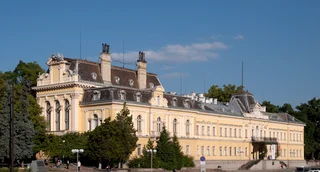
Almost all of these works belong to the permanent display at Kvadrat 500. The building went up in the 1880s as the State Printing House, later a technical school moved in, and in 2015 it opened as the gallery’s main venue. We begin with two icons from the crypt of the Alexander Nevsky Cathedral, where a branch of the gallery, the Museum of Christian Art, has been open since 1965, and we end with a watercolour Ivan Milev painted in 1926.
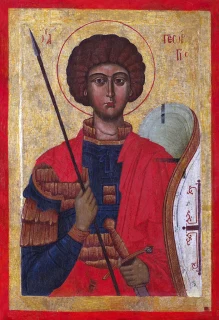
1. St George / Saints Gerontius and Polychronia, a Double-Sided Icon
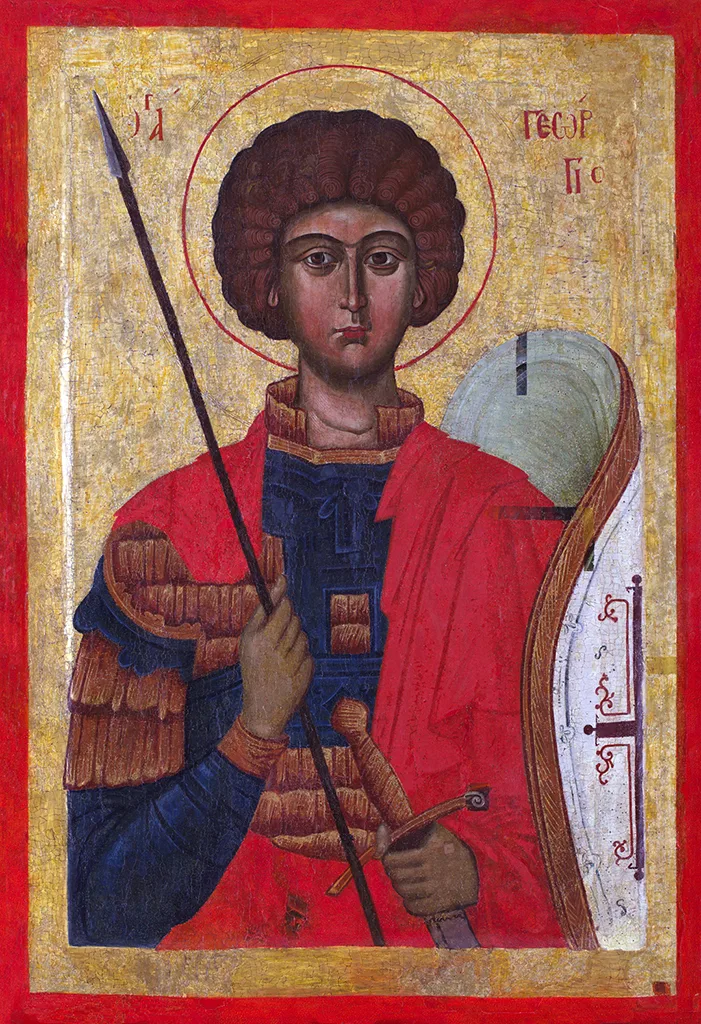
This icon was painted on both sides because it was carried out of the church in processions and people had to be able to see it from either side. One face shows St George, the other his parents, Gerontius and Polychronia. Icon painters rarely depicted George’s parents. According to his Life, Gerontius was a soldier from Cappadocia and a pagan, while Polychronia, a Christian from Lydda, brought their son up in her faith.
The icon was painted at the end of the 13th century in Nessebar, a Byzantine port on the Black Sea that changed hands between Byzantium and Bulgaria more than once in those years. The painters’ names have not survived. Their manner links them to Constantinople, and one study also finds ties to Thessaloniki. They worked in tempera on canvas glued to a wooden panel.
The two sides have come down in different condition. The George side was painted over in the 16th–17th centuries, and the saint on it belongs mostly to this later layer, laid on top of the 13th-century painting. George is shown half-length against a gold ground, in a red cloak over blue armour, a spear in his right hand and a sword in his left, with a shield behind his shoulder. No later repainting has been recorded on the parents’ side, and it is the better-preserved painting of the late 13th century. Scholars single out its faces, above all the face of Gerontius, modelled in fine transitions from light to shadow.
This was most likely the patronal icon of one of Nessebar’s two churches of St George. The gallery’s label names the church of St George the Old, also known as the Great, while the text of a 2008 exhibition in Moscow names the church of St George the Lesser. Both churches have been demolished. The Old church, rebuilt on its earlier foundations in 1704 to judge by an inscription, was pulled down in the socialist years, when Nessebar was redeveloped to a new plan, and the art historian Asen Vasiliev managed to survey it before it went.
2. The Poganovo Icon
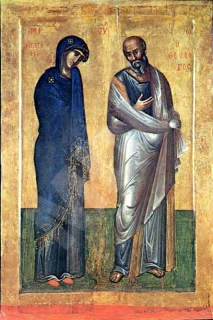
At the bottom of the front, between the two figures, red Greek letters record that the icon was given by “the basilissa faithful in Christ God”, that is, a queen. The title has survived but the name is lost, and scholars restore it as Helena. Two Helenas fit, and historians still argue over which of them commissioned the icon.
André Grabar, and later Bissera Pentcheva, read the name as that of Helena Dragaš, the Byzantine empress. Her father, Constantine Dragaš, lord of these lands, was killed at the Battle of Rovine in 1395, and on this reading the icon was painted around 1395 in his memory. The Serbian art historian Gojko Subotić and those who follow him name a different Helena, Jelena of the Mrnjavčević family, the widow of the despot Uglješa (who was killed at the Battle of the Maritsa in 1371), who later took the veil as the nun Jefimija. On this reading the icon was painted after 1371, most probably in Thessaloniki.
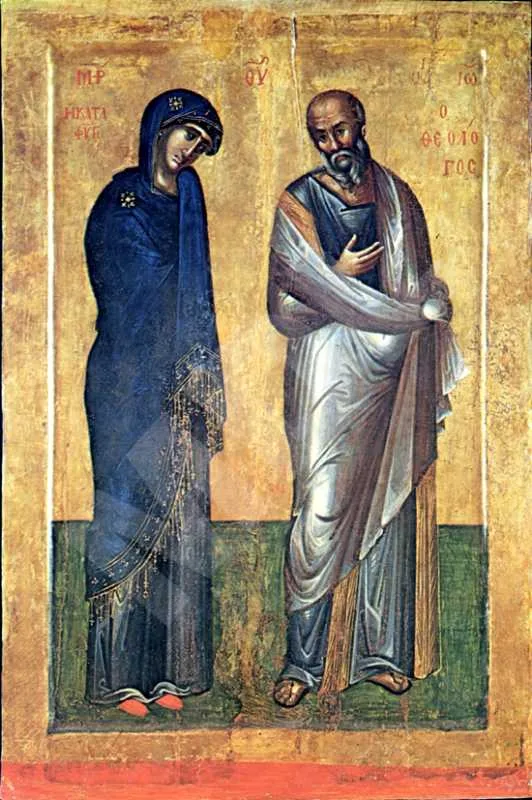
On the front the Virgin and St John stand full-length facing each other against a gold ground. The Virgin, called here Cataphyge, or Refuge, stands in the pose in which she is painted beside the cross in scenes of the Crucifixion, though the icon has no cross, and her head is bowed in grief. John is shown as an old man, the author of the Apocalypse, although beside the cross he is normally painted as a youth.
The back is inscribed “The Miracle of Latomos”. The young Christ Emmanuel, in a gold tunic, sits on a rainbow inside a mandorla of seven blue rings, and the wounds are visible on his hands and feet. Below him the four rivers of Paradise flow out of a hill, seven fish swim in the water, the prophet Ezekiel stands with both arms raised, and the prophet Habakkuk sits on the rocks, his chin propped on his hand. This composition is known three times in Byzantine art: in a 5th–6th-century mosaic in the church of Hosios David in Thessaloniki, in a 12th-century wall painting in the ossuary of the Bachkovo Monastery, and on this icon.
The icon was kept in the church of the Poganovo Monastery of St John the Theologian, in the gorge of the Erma river, in what is now Serbia. During the First World War or shortly after it, the icon was taken to the National Museum in Sofia, officially for restoration, and it never went back to the monastery. It belongs to the National Archaeological Institute with Museum of the Bulgarian Academy of Sciences, the successor of that National Museum, and for many years the gallery showed it in its crypt museum, on deposit from the institute.
3. Self-portrait — Zahari Zograf
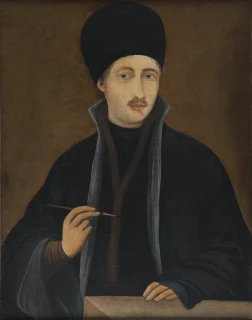
In 1838 the Samokov icon painter Zahari Zograf wrote to his mentor Neofit Rilski, the monk and teacher he had studied with since 1827, that he wanted to train at the Academy of Arts in St Petersburg. Instead of going to St Petersburg, in 1841 he took painting lessons in Plovdiv from two French painters, and he wrote to Neofit about that too. He had been trained to paint icons in tempera on panels and frescoes on walls, and these were the very years in which he was learning to paint in oil on canvas.
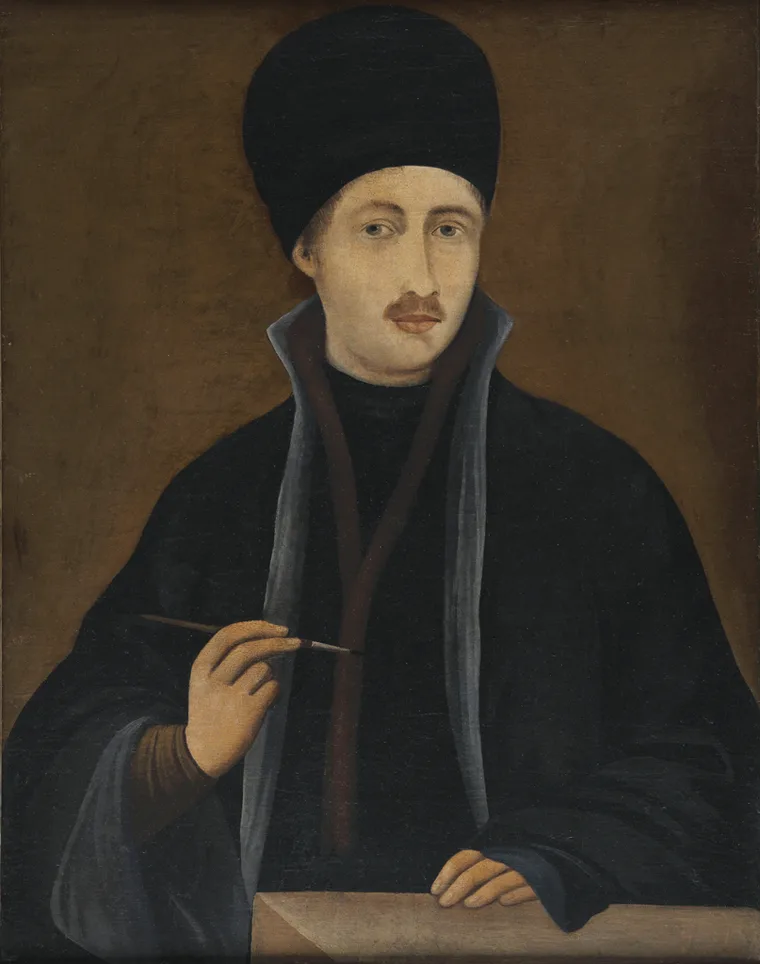
In 1838 he painted Neofit Rilski himself, his first portrait in oil, and around 1840 the self-portrait. The self-portrait is undated, and the year is approximate. In 1840 Zahari was painting the church of St Nicholas at the Bachkovo Monastery and put himself on its walls beside the abbots, and later he painted himself in the Troyan and Transfiguration monasteries as well, and of all these likenesses the self-portrait is the only one on canvas. He is shown half-length, in a tall black hat and black clothes with a raised collar, a brush in his right hand. His left hand rests on the edge of a table, the background is an even brown, and the brush is the only sign of his trade. Bulgarian art historians see in the fact that an icon painter painted and signed his own face a break with the medieval anonymity of his craft.
The canvas stayed with the painter’s heirs until 1939, when the gallery bought it together with Zahari’s archive of drawings and, according to the Bulgarian press, paid more for it than for any other painting in its collection. The archive holds about 400 drawings. When they were sorted in 2010, for the bicentenary of the painter’s birth, about 200 were securely kept as Zahari’s own, and the other 200 were given to his father, Hristo Dimitrov.
4. Portrait of Hristiyania Zografska — Zahari Zograf
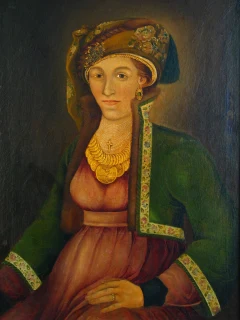
The love story told about this portrait comes from literature, and nobody has ever produced a single document to support it. Its main source, Pavel Spasov’s book The Sinful Love of Zahari Zograf, came out in 1969, and the plot was later staged as a one-person show, a play and an opera.
According to the legend, Zahari loved Hristiyania, the wife of his elder brother Dimitar. In the spring of 1853 typhus reached Samokov. Hristiyania fell ill and was shut away at home, and Zahari went to her in spite of the danger and, in one version, kissed her goodbye. Hristiyania died on 7 May. Zahari caught the disease and died on 14 June of the same year.
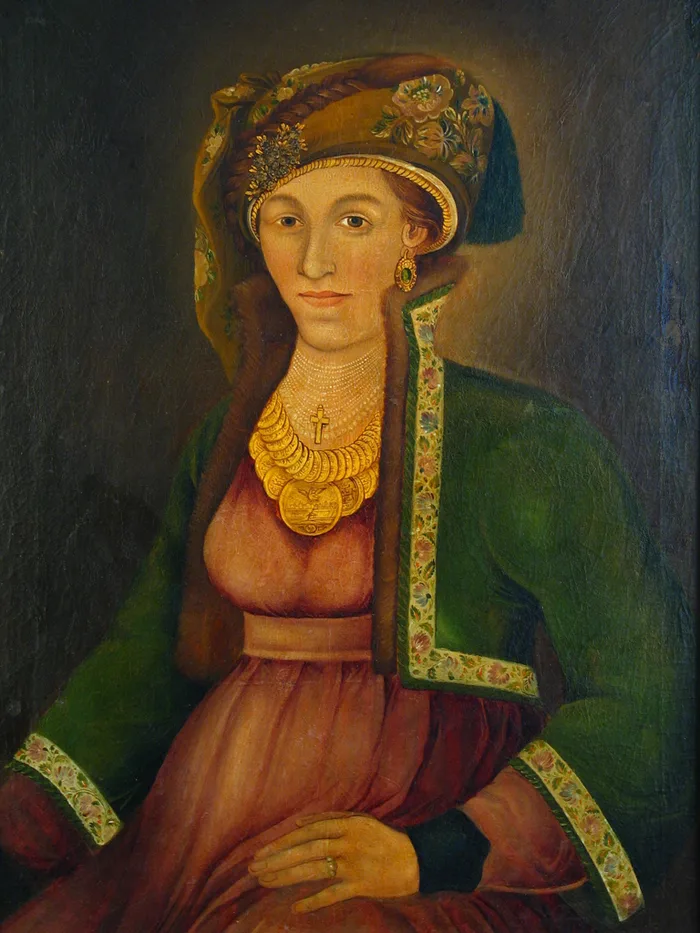
Zahari painted the portrait around 1844, by the gallery's current dating (older literature gives 1840), and it is called the first independent portrait of a woman in modern Bulgarian art. Hristiyania is shown half-length, alone, her face calm. She wears a pinkish-red dress and a long-sleeved green jacket lined with fur and edged with a band of floral embroidery, and on her head a tall headdress with embroidered flowers and a brooch. Several rows of gold coins with a large medal in the middle hang round her neck, with strings of pearls and a small cross, she has earrings with green stones, and there is a ring on her finger.
Hristiyania was the daughter of Kosto, a rich Samokov cattle dealer and chorbadzhi, as the wealthy elders of a community were called. She married Dimitar in 1822, and in December 1823 their son Zafir was born. His father recorded the birth in his hermeneia, the handwritten painter’s manual the workshop worked from. Zafir trained in Russia and became Stanislav Dospevski.
5. Portrait of Mariola Dospevska — Stanislav Dospevski
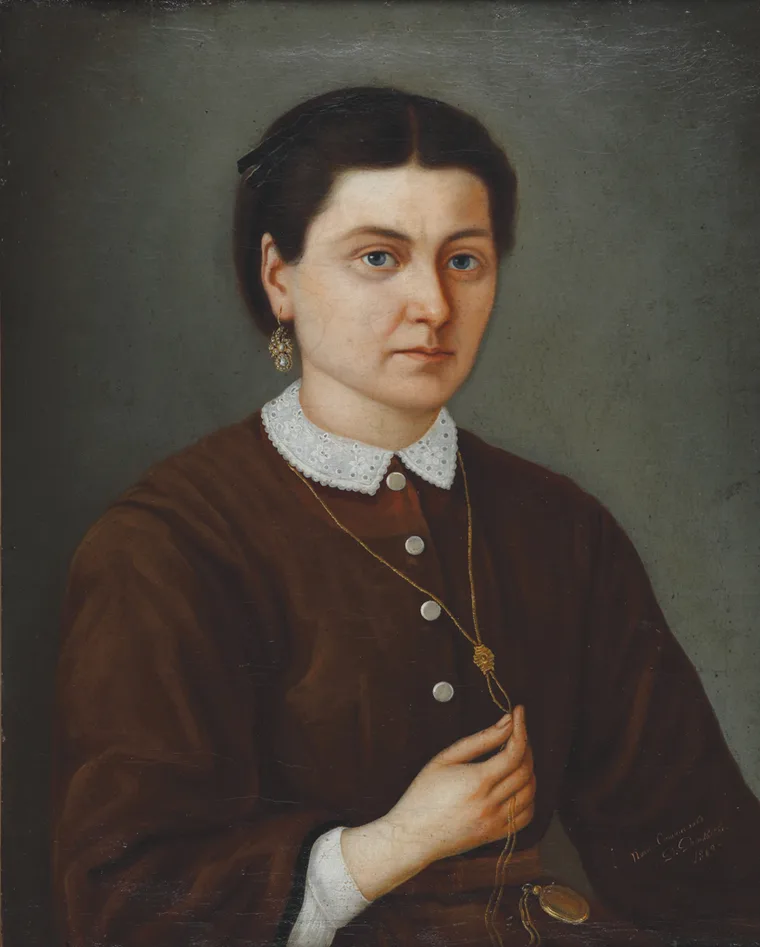
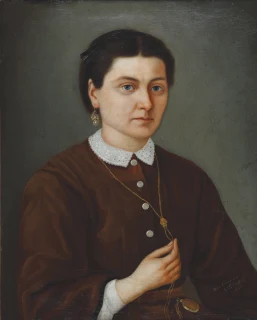
Mariola’s father, Bozhko, was a goldsmith and a leading citizen of Tatar Pazardzhik, today’s Pazardzhik, where she was born in 1837. In the late 1850s, in 1857 by some accounts and in 1858 by others, she married the painter Stanislav Dospevski, and he settled in her town. In 1869 he painted her portrait.
Dospevski was the eldest son of Hristiyania Zografska and the nephew of Zahari Zograf. He was christened Zafir and took his surname from the village of Dospey near Samokov, where his grandfather came from. From 1851 to 1853 he studied at the Moscow School of Painting and Sculpture, then until 1856 at the Academy of Arts in St Petersburg, and he is usually called the first Bulgarian painter with an academic training.
He painted his wife in oil on canvas 11 or 12 years after the wedding. Mariola sits against an even grey background in a brown dress with a white lace collar and white buttons, a gold earring in her ear, holding a long gold chain from whose end a watch hangs at her waist. Dospevski signed and dated the canvas in the lower right corner. The gallery counts it among the best works of those painters of the Bulgarian Revival (as Bulgarians call the era of national awakening before the liberation) who received an academic training in Russia, Italy and Germany. A few months after the portrait, on 2 February 1870, Mariola founded Prosveta, the first women’s society in Pazardzhik, and became its first president.
In August 1877, during the Russo-Turkish War, the Ottoman authorities arrested Dospevski in Pazardzhik on suspicion of spying for the Russians. He was held in Plovdiv, then sent to Constantinople, to the Mehterhane prison, and he died there on 6 January 1878, two months before the Treaty of San Stefano of 3 March, which created the Bulgarian state he had fought for. He was buried in the courtyard of the Bulgarian church of St Stephen in Constantinople.
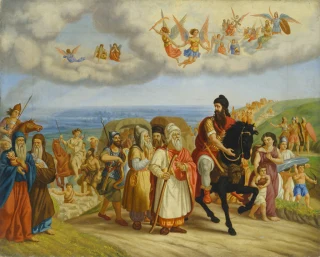
6. Khan Asparuh and his Entourage March to the Danube — Nikolai Pavlovich
Nikolai Pavlovich, a native of Svishtov on the Danube, spent the winter of 1860–1861 in Odessa selling the Bulgarians there lithographs of scenes from Bulgarian history, the first lithographs on such subjects, which he had made in Belgrade in 1860. He had studied history painting at the Munich Academy under Wilhelm von Kaulbach and Karl von Piloty. Under Ottoman rule, however, there was nobody to commission Bulgarian history in oil, and it circulated as prints, which Pavlovich sold to Bulgarians himself in Odessa, Bucharest, Belgrade and Constantinople.
He painted Khan Asparuh in oil in the late 1860s, about ten years before the liberation. In 681 Asparuh led the Bulgars across the Danube and founded the state from which Bulgarians date their history, and Pavlovich was painting the beginning of that history for a country that did not yet have a state.
Asparuh rides a black horse in the middle of the procession. Beside him walk grey-bearded elders with staffs, warriors in helmets and a woman with children, covered wagons trail behind them, and beyond the wagons a wide valley opens out. Above the army angels fly through the clouds, some with shields and swords, although Asparuh’s Bulgars were pagans and were baptised only in 864, under Prince Boris.
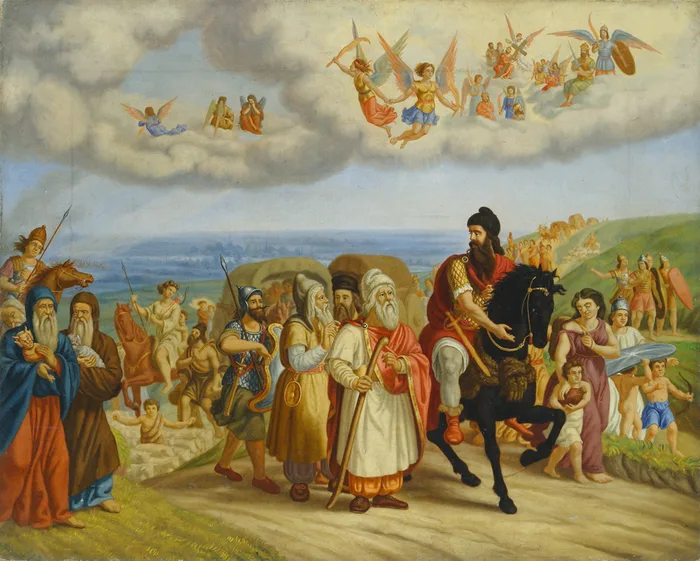
The painting is counted among the first Bulgarian history paintings in oil, although Pavlovich had been issuing history lithographs since 1860 and made his first historical composition, The Meeting of Raina and Her Brothers in Preslav, in 1865–1866.
In 1911, 17 years after the painter’s death, the Ministry of Public Education bought 23 works from his family for the National Museum, history paintings and most of the drawings for them, and Asparuh in all likelihood entered the collection then. Pavlovich had issued the subject separately in 1870, as a large lithograph titled Asparuh.
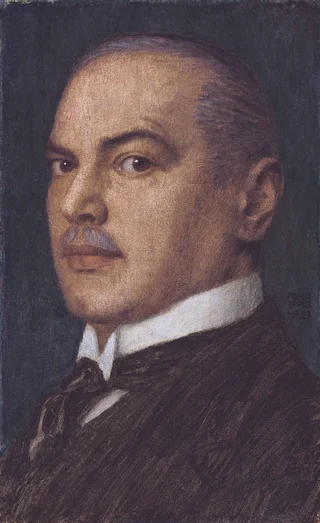
7. Lucifer — Franz von Stuck
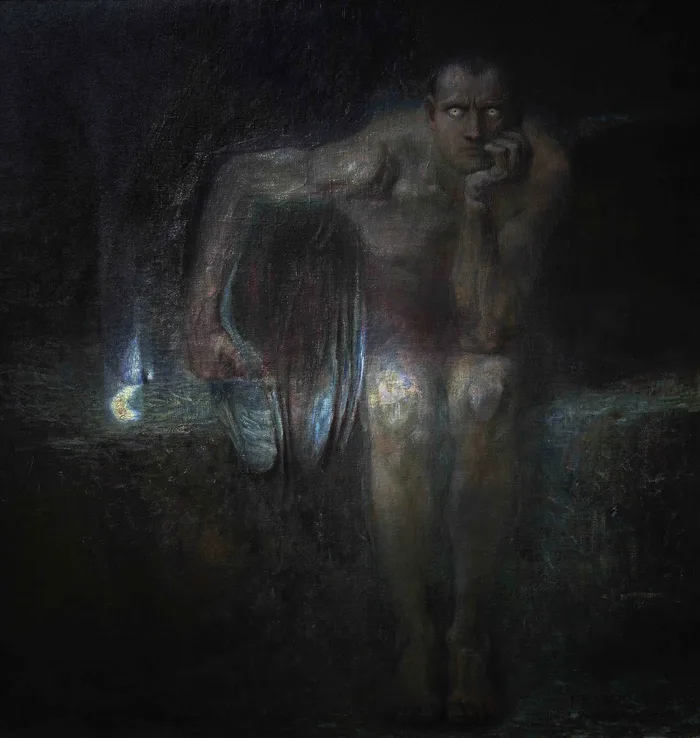
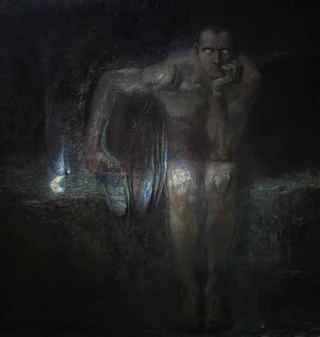
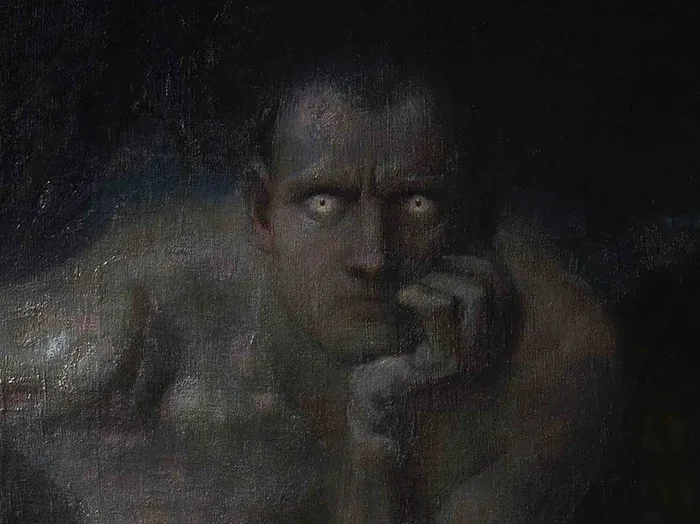
Prince Ferdinand was 30, and the great powers had not yet recognised him as ruler of Bulgaria, when he came to Munich in 1891 to meet politicians and bankers. According to the gallery, on that trip he bought Lucifer from the studio of the Munich painter Franz von Stuck for the palace collection in Sofia. In 1889 Stuck’s The Guardian of Paradise, a radiant angel at the gate of Paradise, had won a gold medal at the exhibition in Munich’s Glass Palace, and Lucifer, painted in 1890, is generally seen as the dark counterpart to that angel.
Lucifer sits alone, hunched forward, on an almost square canvas and fills nearly all of it. His body is muscular and naked, his chin rests on his hand, and a pale wing with blue glints hangs at his side. The canvas is almost black, and the brightest things on it are his eyes, white and glowing, looking straight at the viewer. On the left a small blue flame burns in the dark.
The next story is known only from Stuck himself, who liked telling it. Ferdinand supposedly complained to him that his ministers crossed themselves when they first saw the painting. In the Bulgarian retellings it is priests who cross themselves as they walk past the canvas, and ladies who faint.
Lucifer stayed in the palace collection until 25 December 1930, when Ferdinand’s son, Tsar Boris III, gave it to the National Museum. In 1948 the painting passed to the holdings of the National Art Gallery, in 1985 to the National Gallery for Foreign Art, and in 2015 to Kvadrat 500.
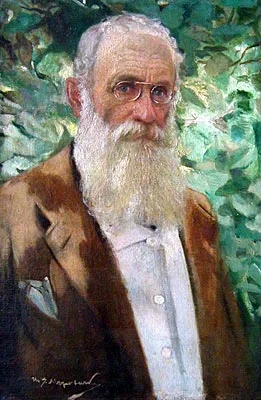
8. A Florentine — Konstantin Velichkov
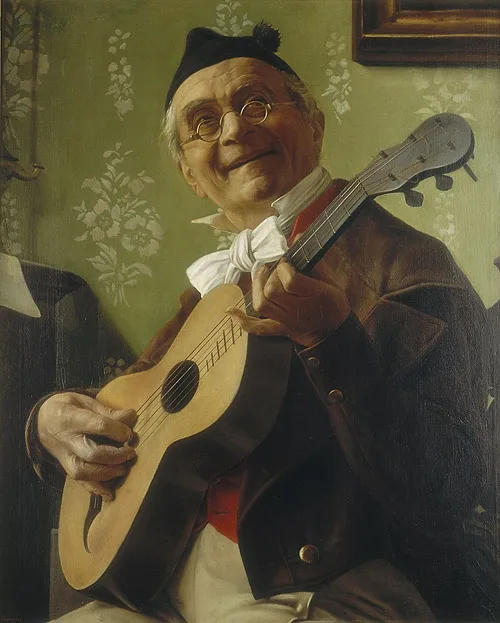
In August 1886 pro-Russian officers deposed the Bulgarian prince, Alexander of Battenberg, and the leaders of the coup appointed the writer Konstantin Velichkov minister of education. He turned the post down. When Stefan Stambolov, an opponent of the Russian party, took over the government, Velichkov, a known Russophile, left the country and spent the late 1880s in exile in Florence.
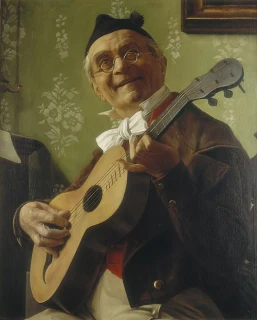
Ten years earlier, in 1876, he had taken part in the April Uprising in Pazardzhik, been sentenced to death, and been set free at the insistence of the European commission that investigated how the uprising was put down. In Florence Velichkov, by then in his thirties, began to study painting seriously for the first time, under Giuseppe Ciaranfi, a painter of history and genre scenes who taught at the city’s Academy of Fine Arts. In 1888 he painted A Florentine, a student work in oil on canvas. An elderly Florentine in round spectacles and a small black cap, with a white neckcloth and a red waistcoat, laughs as he plays the guitar against green wallpaper with a floral pattern. The sitter is absorbed in his guitar and seems to have forgotten the painter.
In 1894, after Stambolov resigned, Velichkov came back and became minister of public education in Konstantin Stoilov’s cabinet. He introduced the bill for the Drawing School in the National Assembly himself. He left the ministry in 1897 and died in Grenoble in 1907.
9. Rachenitsa — Ivan Mrkvička
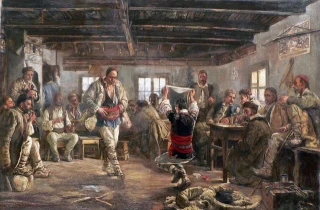
At an Apollo and Mercury auction at the Grand Hotel in Sofia in the late 2000s, Ivan Mrkvička’s Rachenitsa sold for 75,100 euros, and it was then described as the most expensive painting ever sold at auction in Bulgaria. What went under the hammer was a second, almost identical version, painted in 1906. The first, from 1894, is in the National Gallery, and the gallery calls it the most popular Bulgarian painting.
In 1881 the government of Eastern Rumelia, an autonomous province in the south of today’s Bulgaria, invited the Czech Mrkvička to teach drawing in Plovdiv, and the 25-year-old painter went on to live in the country for 40 years. From 1889 he lived in Sofia, and he painted Rachenitsa there, two years before he became the first director of the Drawing School.
Two men in peasant dress are dancing the rachenitsa, a fast Bulgarian dance, in the middle of a crowded village tavern near Sofia, under a low ceiling on dark beams. One, tall, in a white shirt and white trousers with a red sash, dances standing upright. The other has crouched down in front of him with his back to us and holds a white handkerchief above his head. Around them onlookers sit on benches and at tables, watching.
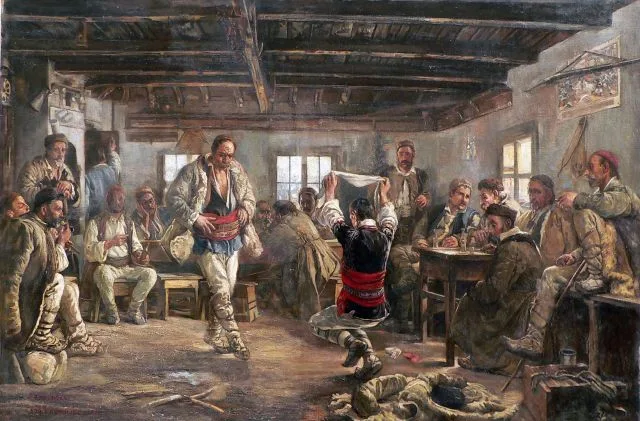
A version that spread through the Bulgarian press in the 2010s, resting on nothing more than a resemblance to portraits, identifies the dancer in white as James Bourchier, an Irish-born Balkan correspondent of The Times of London. The gallery repeats it. Bourchier visited Sofia from 1888, settled there in 1892, was a friend of Mrkvička’s and walked about the city in peasant dress.
10. The Return from the Market — Jaroslav Věšín
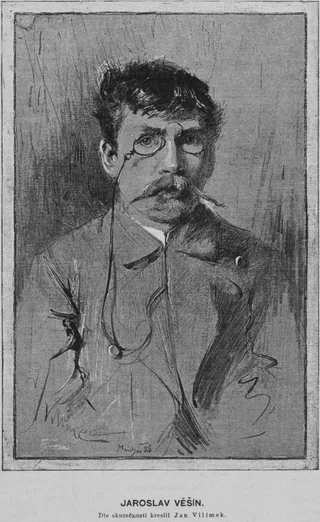
Jaroslav Věšín came to Sofia in the autumn of 1897 at the invitation of the minister of public education, Konstantin Velichkov, to teach at the newly opened Drawing School. He had studied at the Prague Academy and in Munich, and from 1884 spent many years painting Slovak village life, its weddings and its hunts, pictures that the Prague magazine Zlatá Praha reproduced, so he arrived in Bulgaria as a well-known painter of peasant life.
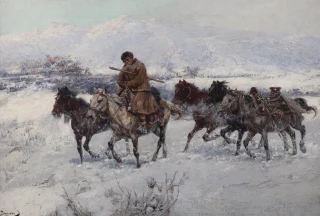
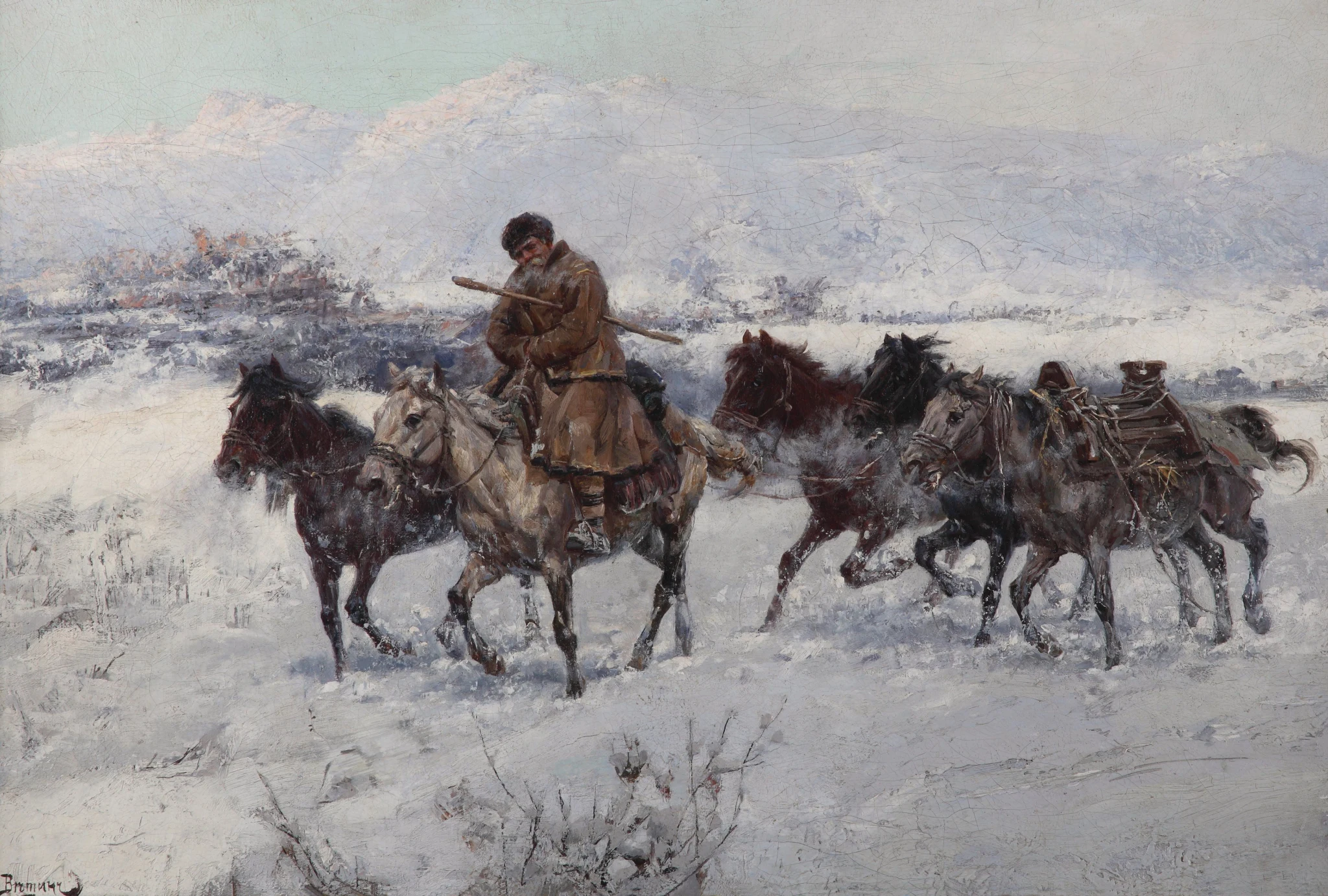
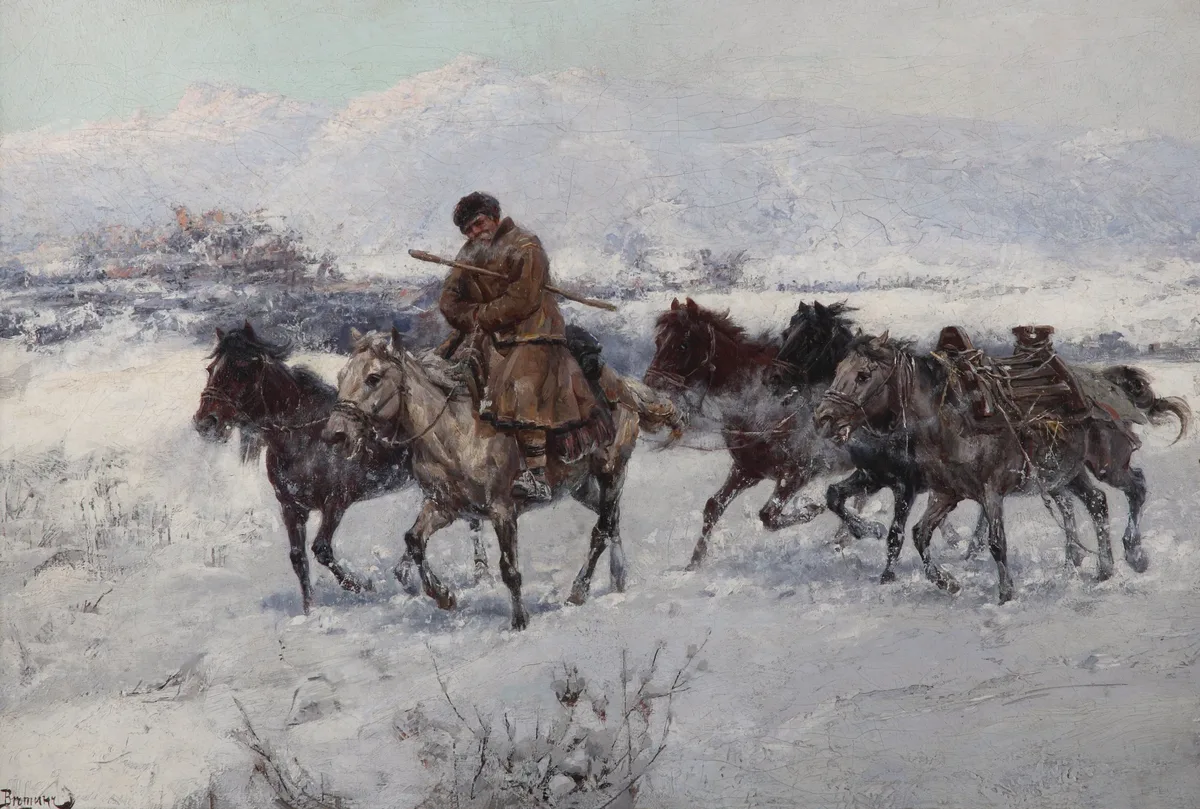
He painted The Return from the Market in 1898, a year after he arrived. It is winter in the picture. A peasant in a sheepskin coat and a fur hat, a stick across his shoulders, rides over a snowy field driving four horses with him, the last of them carrying an empty pack saddle, and beyond the field rise snow-covered mountains. In the lower left corner the Czech Věšín signed his name in Cyrillic. The painting is one of his market pictures of 1898–1899, a group that also includes the large Horse Fair in Sofia and Before the Market. His Bulgarian biographers write that it was the picturesque types and scenes that drew him to the markets.
Věšín taught at the school until 1904, and among his pupils was Nikola Petrov, whose view of the St Sofia church is also on this list. After 1904 he became painter to the Ministry of War, a post created for him on Prince Ferdinand’s suggestion, and painted official portraits and manoeuvres. In the Balkan War of 1912–1913, holding the rank of colonel, he was the only man on the roll of General Headquarters listed as “war painter”.
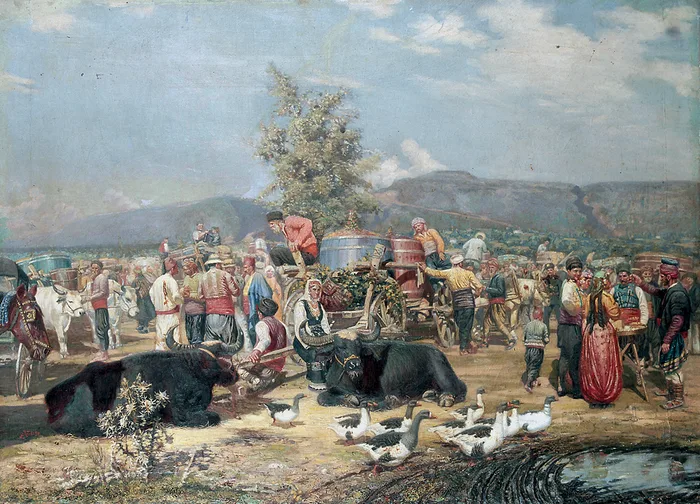
11. Grape Market at Euxinograd near Varna — Anton Mitov
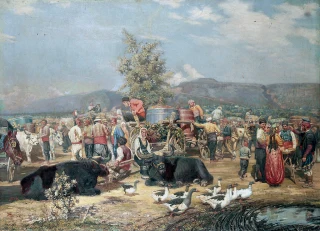
The prince’s summer palace near Varna was called Sandrovo, after Bulgaria’s first prince, Alexander of Battenberg, whom those close to him called Sandro. In 1893 Ferdinand renamed it Euxinograd, after the Pontus Euxinus, as the ancient Greeks called the Black Sea. The palace had large state vineyards and, from 1891, a wine cellar for the prince’s court. A year after the renaming Anton Mitov painted Grape Market at Euxinograd near Varna.
In Mitov’s picture the market spreads across an open field below the hills. Big barrels stand on the carts with baskets of grapes beside them, two black buffalo lie on the ground in the foreground, geese wander by a puddle, and between the carts people in fezzes and folk dress crowd together.
From 1890 Mitov taught drawing at the boys’ secondary school in Varna, and the Varna grape harvest turns up more than once in his pictures of 1893–1894. He had learned to paint in Italy. His biographers retell a story about the journey that there is no way to check: he earned the fare working as a telegraph operator, and in Florence he was arrested, because in his best clothes, a shepherd’s yamurluk cloak and leg wrappings, he looked like a local bandit. He studied at the Florence Academy of Fine Arts under Giuseppe Ciaranfi, the same teacher Velichkov later studied with, and graduated in 1885.
In 1893 Mitov was among the founders of the Society for the Support of Art in Bulgaria, the first association of Bulgarian artists, and from 1895 to 1899 he and Mrkvička published Izkustvo (Art), the first Bulgarian magazine about art. At the Drawing School he was the first to teach art history, and he ran the school in 1912–1918 and again in 1924–1927.
12. Harvest in Chepinsko — Ivan Angelov
It was Ivan Angelov, who taught at the Drawing School from 1900, who brought charcoal drawing into it, and several generations of Bulgarian artists were later trained on it. Angelov himself had studied in Munich, first at the School of Applied Arts, then at the Academy under Karl von Piloty, graduating in 1886, and for the next 14 years he taught drawing in secondary schools.
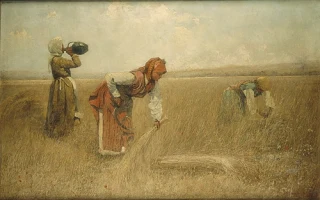
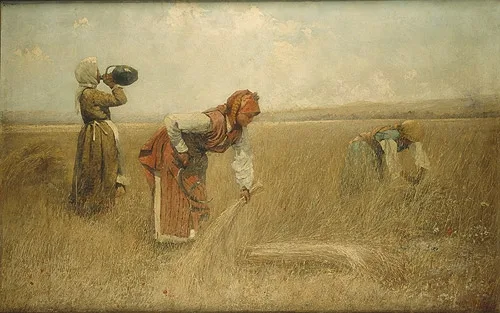
He painted the harvest from the start, and his Harvest and Woman Reaper were well liked at the Plovdiv exhibition of 1892. He painted Harvest in Chepinsko in 1905. The Chepino valley lies in the western Rhodopes, near today’s Velingrad. The picture shows three women reaping in a field of ripe grain. One, in red, is bent over cutting the ears, the second, on the right, is almost hidden in the grain, and the third has straightened up and is drinking from a dark jug. A tied sheaf lies at their feet, and poppies show among the ears. The canvas is long and low, and the gallery describes it as a landscape panorama brought to a single tone, with a precise, classically built composition.
In October 2016 the gallery chose this painting as one of four works for blind and partially sighted visitors, and gave it a tactile relief diagram and an audio description in Bulgarian and English.
13. The Church St. Sofia — Nikola Petrov
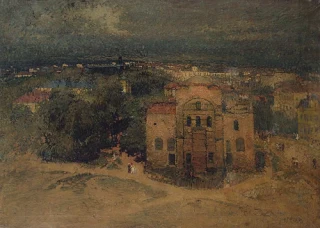
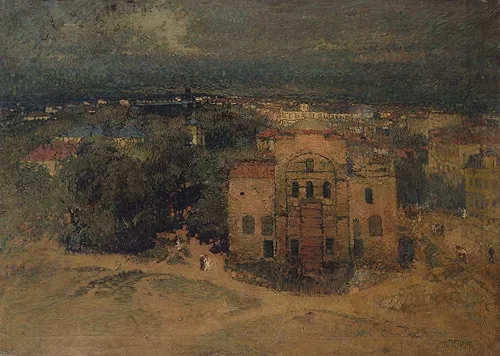
The basilica of St Sofia was built in the 6th century, under Justinian, and the city was later named after it. In the 16th century the Ottomans turned it into a mosque, the earthquakes of 1818 and 1858 damaged it, and in 1858 the minaret fell and killed several people, after which the building was abandoned. At the end of the 19th century it was used as a storehouse and as a lookout post for the city fire brigade. It was this abandoned basilica that Nikola Petrov painted in 1909. He set it on a bare yellow patch of waste ground at the edge of the town, with red roofs and green gardens stretching away behind it and a heavy dark sky hanging over everything. The people by its walls are tiny.
Petrov was born in Vidin in 1881 and entered the Drawing School in September 1898, where he studied under Věšín, though illness kept him from receiving his diploma until 1913. He painted Sofia, the Lions’ Bridge, the National Theatre and Banski Square, and he is called the founder of the Bulgarian urban landscape. Of his Sofia views the gallery writes that his expressive brushstrokes brought them close to a painted mosaic. Vladimir Dimitrov-Maistora, whom Bulgarians revere as their foremost national painter, called Petrov the most gifted of them all and the only Bulgarian born to be a painter.
In 1911 the state bought this painting, and it became the first of his works in the state collection. Petrov died poor, of tuberculosis, on 10 December 1916, at the age of 35. In that same year of 1911 the basilica was studied by the archaeologist Bogdan Filov, who was pressing for it to be restored. From 1926 the church board demanded the full restoration of the building, and the work was directed by the architect Rashenov.
14. Decorative Landscape — Nikolay Raynov
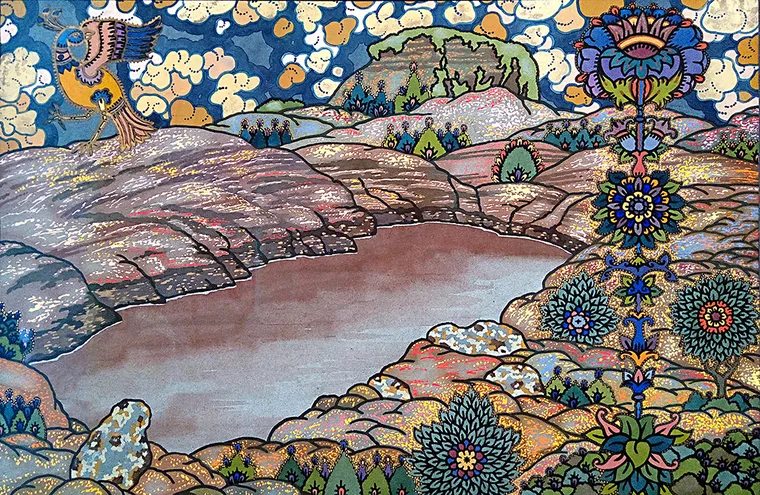
The society Rodno Izkustvo, “Native Art”, was founded in Sofia in 1919, and its founders wrote into its programme the aim of giving Bulgarian art a national character. Among them was Nikolay Raynov, whom the Bulgarian public knew above all as a writer, the author of fairy tales and Symbolist prose, and as a theosophist.
Around 1910 he studied decorative art at the State School of Art and Industry in Sofia, as the Drawing School had been called since 1909, under Haralampi Tachev and Stefan Badzhov, and became one of the first trained decorative artists in Bulgaria. Ornament, he said, is to the visual arts what language is to literature. In 1925 his book Ornament and Letter in the Slavonic Manuscripts of the National Library in Plovdiv came out, and for it he had redrawn the headpieces, initials and ornaments from the medieval manuscripts himself.
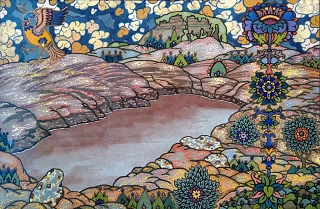
Decorative Landscape was painted in those same 1920s, in tempera and ink on a sheet of paper the size of an open book. In his decorative landscapes of those years Raynov built the picture from flat patches of even colour and a clear line, and turned the details of nature into ornament. Here a brown lake lies among rounded rocks outlined in black, the clouds in the blue sky look like curls of embroidery, on the right rises a tree made of flowers stacked one on top of another, and on the left a fairy-tale bird is in flight. The whole sheet is scattered with tiny gold dots.
From 1925 to 1927 he studied art history in Paris, and afterwards, until 1950, he taught it at the Academy of Arts in Sofia.
15. Our Mothers Always Wear Black — Ivan Milev
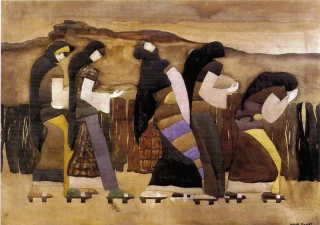
Five women with long black veils over their heads walk one behind another along a dark board fence, all in profile. Two carry something round in their hands, a bowl or a loaf, one has thrown her head back towards the sky, and the last is bent over with a hand over her face. Stripes of yellow, lilac and brown show through the black. Ivan Milev painted this watercolour in 1926, and the gallery gives it a second title, Zadushnitsa (All Souls’ Day), the name Bulgarians give to the days of remembrance when food is carried to the cemetery for the dead. Milev also made a separate work titled Zadushnitsa, and that is a different picture.
The watercolour was painted after three wars, the two Balkan Wars and the First World War, and Milev fought in the last of them himself. In 1916 the 19-year-old from Kazanlak was called up and sent as an artist to the headquarters of an aeronautical unit, and in 1917 he was a soldier on the Romanian front.
From 1920 to 1925 he studied in the decorative department of the Academy of Arts in Sofia under Stefan Badzhov, who had earlier taught Raynov too, and designed productions for the National Theatre. In December 1926 he fell ill, and he died on 25 January 1927, a few weeks short of his 30th birthday. Three years before his death, in 1923, Milev wrote a question in his diary, “Is there art in Bulgaria?”, addressed to the Rodno Izkustvo society, and in the spring of 1926 he joined the society himself.
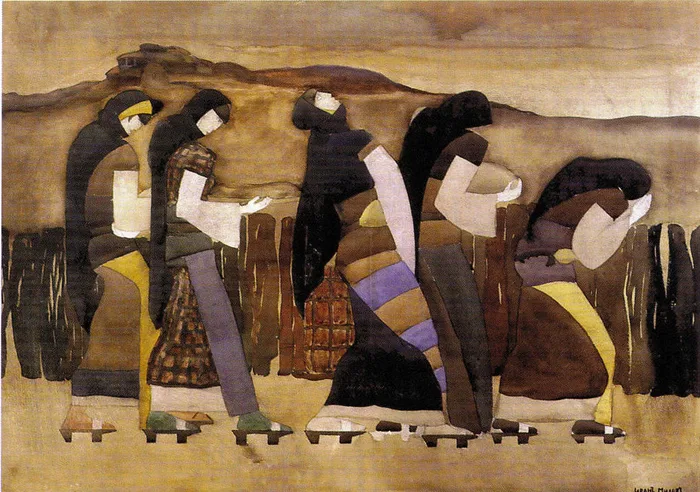
More than 600 years separate the Nessebar icon, whose painters left no names, from Milev’s watercolour, and the road from the icon workshop to a school of its own took less than a century of that time. Milev wrote down his question as a student at the Academy of Arts in Sofia, which Mrkvička’s Drawing School had grown into by then. The diary holds no answer. It can be put together in the gallery’s rooms, from the self-portrait of the icon painter who painted and signed his own face to the works of those who were already trained at home.
What else to see
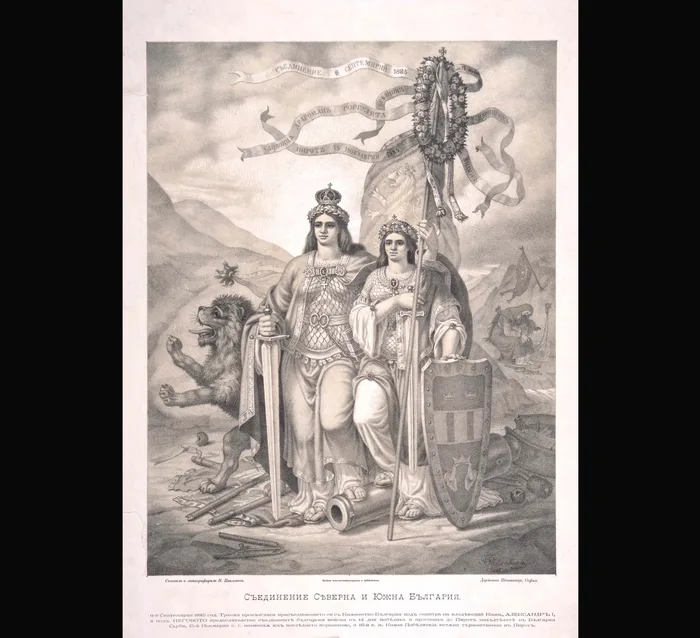
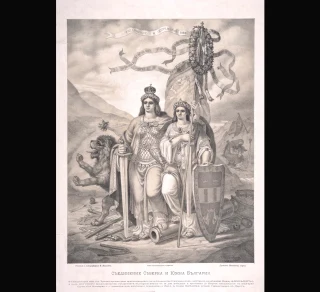
We followed a single line, from the icon to a school of its own, and many of the gallery’s strong paintings did not make the list. The painter best represented in the collection is Vladimir Dimitrov-Maistora, and a second visit is worth beginning with him. The gallery also holds Nikolai Pavlovich’s The Unification of Northern and Southern Bulgaria of 1886, and Zahari Zograf’s graphic archive contains his drawings and the Western European engravings he collected. The foreign department, created in 1985, acquired Japanese prints, Indian miniatures and Asian sculpture, and its European paintings include Cézanne’s Landscape in Auvergne and Delacroix’s The Death of Lara.