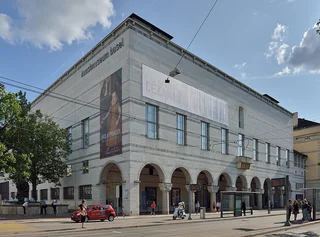
In 1661 the heirs of the Basel Amerbach family were preparing to sell the family collection to Amsterdam. It held about 50 paintings, 15 of them by Hans Holbein the Younger, along with drawings, prints, coins, letters and a library. On the advice of Mayor Johann Rudolf Wettstein, the city and the university decided to buy the collection themselves for 9,000 Reichstaler. The city council paid two thirds of the sum and the university the rest, and the university took the collection into its keeping. In 1671 it was opened to the public. The museum calls it the oldest public art collection in the world to be owned by a city.
A Family's Pictures Become the City's (1519–1661)
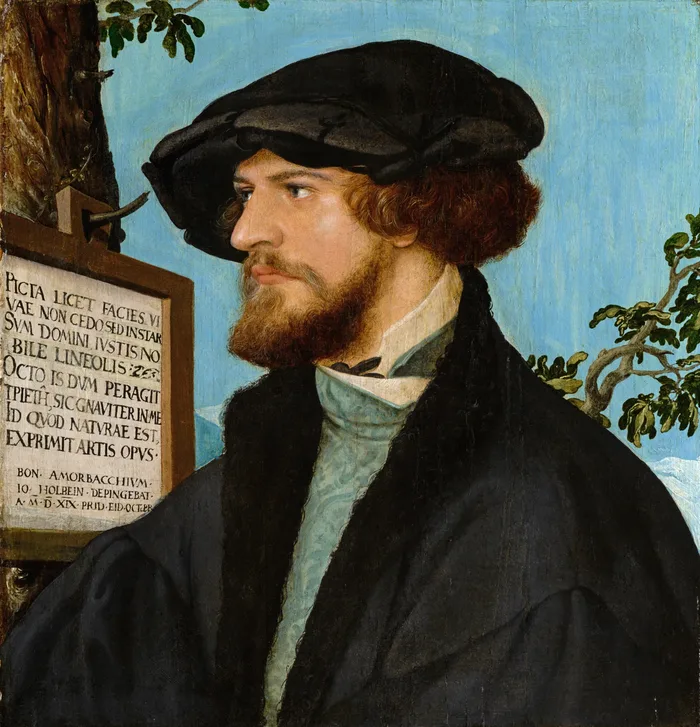
1. Portrait of Bonifacius Amerbach — Hans Holbein the Younger
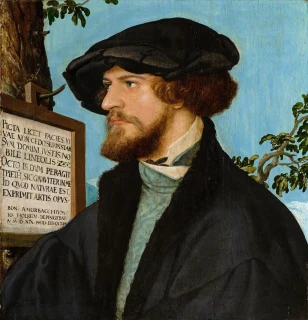
Bonifacius Amerbach, the younger son of the Basel printer Johann Amerbach, was about to leave for Avignon in the autumn of 1519 to continue his law studies. It was a long journey and plague was going round in the south of France, and that, the museum writes, is why he commissioned the portrait, so that his family would still have his face if he died on the way. Amerbach wrote the Latin verses for the portrait himself.
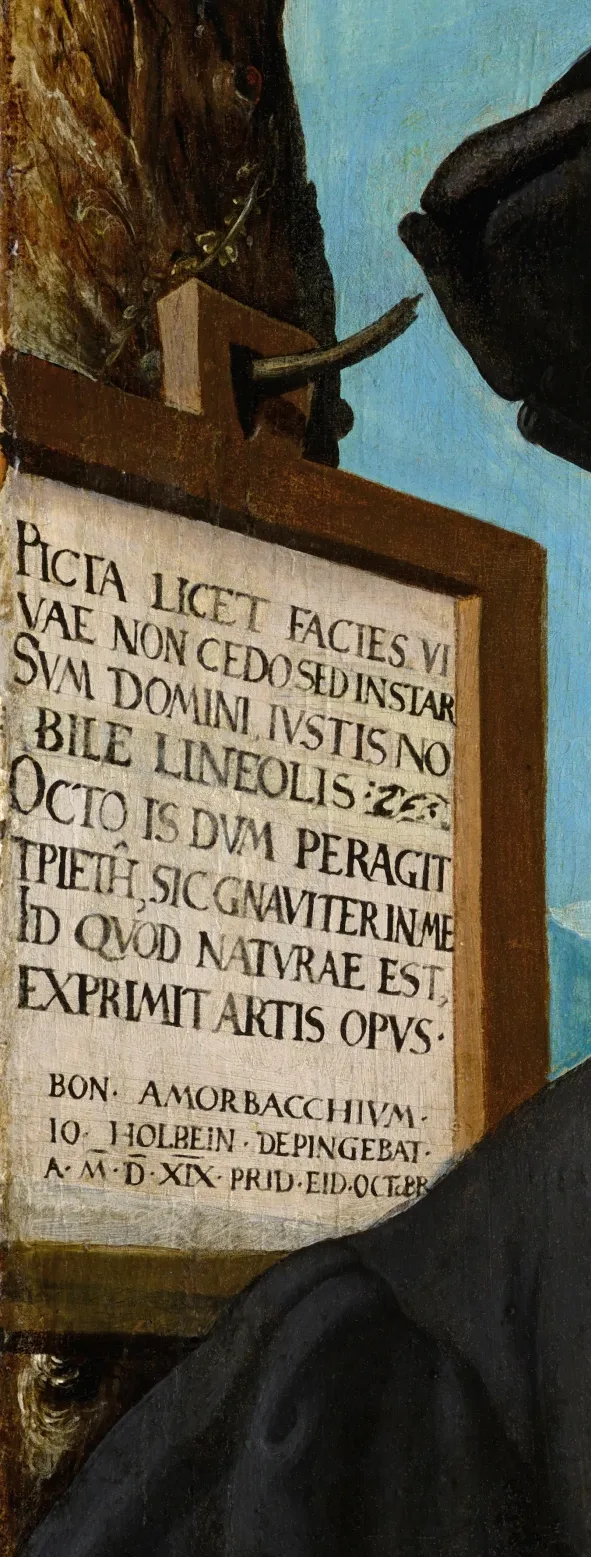
Holbein painted them on a wooden tablet that hangs from a tree trunk at the left edge of the picture. The verses speak in the voice of the portrait itself: the painted face is no less than the living one and is the equal of its master, and while he lives through eight spans of three years, that is, 24 years, art renders in the portrait what nature gave him. Below are the names of Amerbach and Holbein and the date, “the day before the Ides of October” 1519, that is, 14 October, a few days after Amerbach turned 24. Infrared imaging has shown that the verses were revised on the panel itself. The second line first ended with the words “painted in colours”, and in the final version the portrait is called “noble in its lines”.
Amerbach himself is turned almost in profile towards the tablet and looks past it, beyond the edge of the picture. His black cap and black gown stand out against a cold blue sky, the warmest things in the picture are his face and his reddish-brown beard, and at lower right, beneath a branch, small snow-covered peaks can be seen.
Holbein was about 22 at the time. He had been working in Basel for several years, drawing title pages and illustrations for the city's printers, and on 25 September 1519, less than three weeks before the date on the portrait, he was admitted to the Basel painters' guild Zum Himmel, which meant he could now run a workshop of his own. In 1526 he left for England, came back two years later, and in 1532 moved to London for good.
Amerbach took his doctorate in Avignon, taught Roman law in Basel and became the closest confidant of Erasmus, who made him his heir in 1536. The portrait stayed in the family, and Bonifacius's son Basilius built a real collection around his father's pictures and drawings, the one the city bought in 1661. The sheet on which Bonifacius wrote out and corrected the opening of his verses about 20 times is kept in the University Library in Basel, together with books and letters from the same collection.
2. The Body of the Dead Christ in the Tomb — Hans Holbein the Younger

In August 1867 Fyodor Dostoevsky and his wife Anna Grigoryevna, who had married that February, broke their journey to Geneva for a day in Basel to see a painting he had heard about. It hung in the building on Augustinergasse that had opened in 1849 to house Basel's public collection. Anna Grigoryevna wrote in her diary: “Wishing to see it more closely, he climbed on a chair, so that I was in great fear that he would have to pay a fine.” In reminiscences written much later, she said the painting had “a crushing impact” on her husband. She herself could not bear to look at it and went into the other rooms, and when she came back 15 or 20 minutes later she found him “still riveted to the same spot”, with the frightened look she knew from the first moments of his epileptic seizures. She took him by the arm and sat him down on a bench in the next room. No seizure came, and as they were leaving he insisted on going back to look at the picture once more.
The most famous painting in the Basel collection is on a very long, low panel, and the body on it is life-size. It lies alone in a cramped stone niche, on a white sheet that hangs over the edge of the slab. The head, at the left end, is thrown back, the mouth is open, the visible eye has rolled upward, the face is grey-green in the shadows, and long dark hair hangs down from the slab. The ribs show under the skin, and below the wound in the side there is a dark bruise. The right hand lies along the thigh with its back to the viewer, with a dark red wound from the nail, and the middle finger reaches out to the very edge of the slab. On the end wall above the feet, “M.D.XXI” and “H.H” are painted as if carved in the stone.
The museum believes the painting was probably commissioned by Bonifacius Amerbach (on him and on Holbein, see no. 1), and it stayed in his family until the purchase of 1661. A study in 2021 showed that the niche was at first smaller and vaulted, and that Holbein turned it into a rectangular box and painted the signature and date again on the new wall. The date first read MDXXII, and as he finished the work he painted out the last numeral I in the colour of the stone.
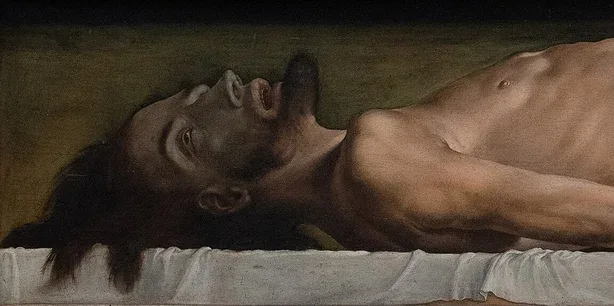
Dostoevsky carried the painting into The Idiot, which came out in instalments in 1868–1869. A copy of it hangs in Rogozhin's dark house, and Prince Myshkin, looking at it, remarks that some people may lose their faith from a picture like that. Later another character in the novel, Ippolit, describes it at length and asks how people who had seen such a corpse could have believed in the resurrection. By the museum's count, the painting appears in the novel five times.
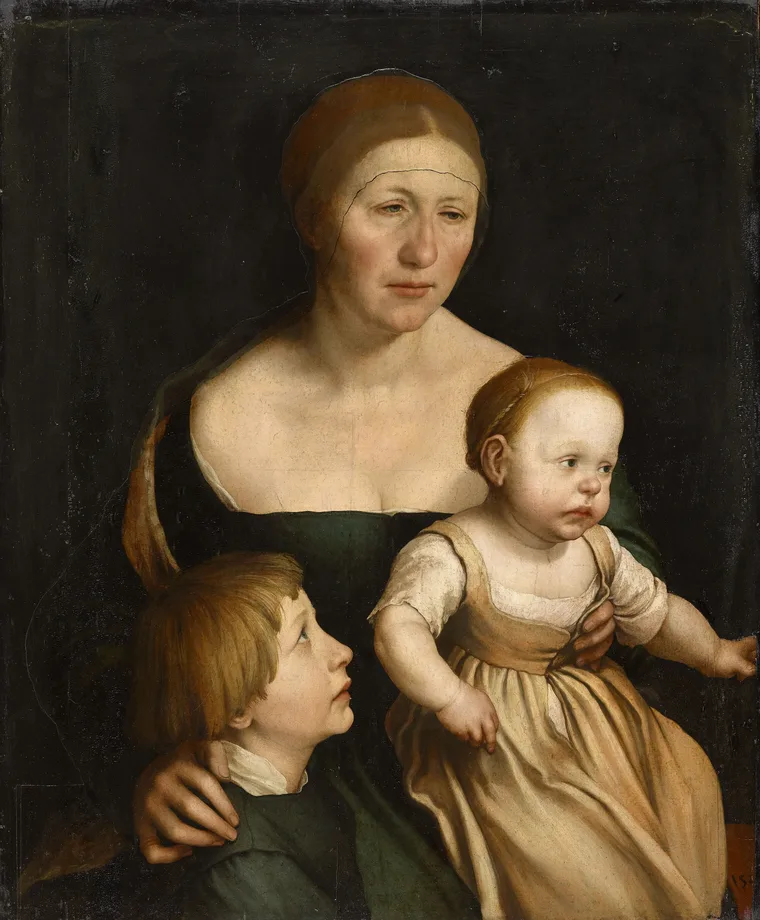
3. Portrait of the Artist's Family — Hans Holbein the Younger
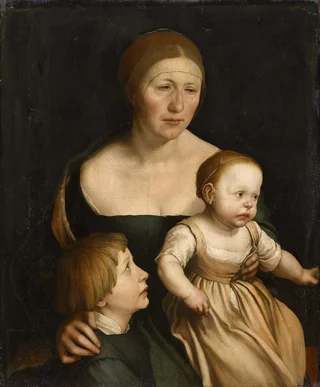
The Zurich painter Hans Asper already owned this picture in 1543, when Holbein died in London, and would not sell it to anyone, not even to Basilius Amerbach. Holbein's wife Elsbeth had parted with the picture, but historians have found no documents showing how it came to Asper. Basilius got it only after Asper's death in 1571, for six crowns, through the Zurich apothecary Georg Clauser, and according to the museum it entered the Amerbach collection in 1579.
Holbein painted Elsbeth with their two elder children, Philipp and Katharina, around 1528, after he came back from his first stay in England (on him, see no. 1). He painted on paper, and later the figures were cut out along their outlines and pasted onto a limewood panel. Elsbeth looks down, past the children, her eyelids heavy and reddened and the corners of her mouth turned down, and her right hand, large and heavy, rests on her son's shoulder. Philipp, in strict profile, has tipped his head back and looks up and to the right, and little Katharina on her mother's lap also looks to the right, beyond the edge of the picture.
Some scholars think the picture was once larger and that Holbein himself may have been shown on the right, at his easel. They point to the way both children look to the right, and to infrared imaging which shows that Philipp's head was first painted in a different place. The edge of the cut paper can be seen along the outlines: a thin pale line runs around Elsbeth's bonnet, and the fingers of Katharina's outstretched hand end in a straight cut at the right edge. On the reddish bench in the lower right corner “152” remains, and the last digit of the year went with the trimmed-off strip.
4. Lais of Corinth — Hans Holbein the Younger
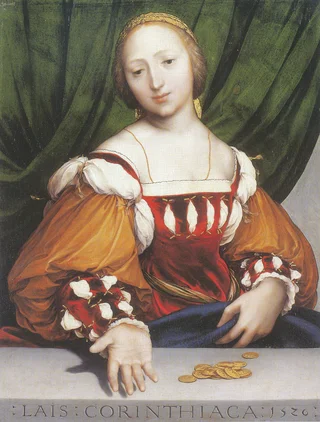
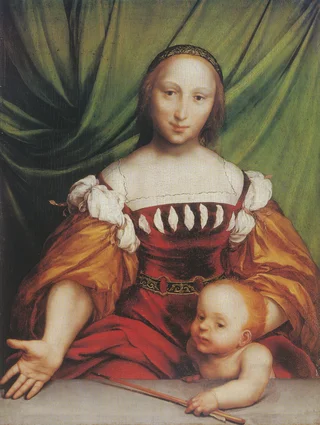
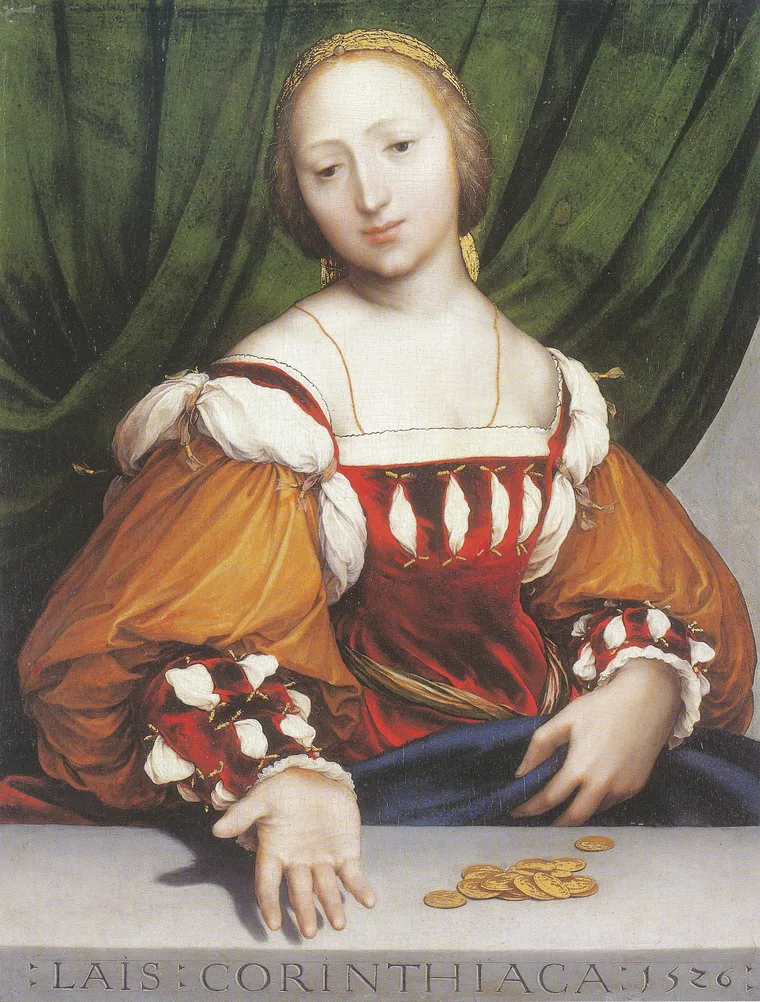
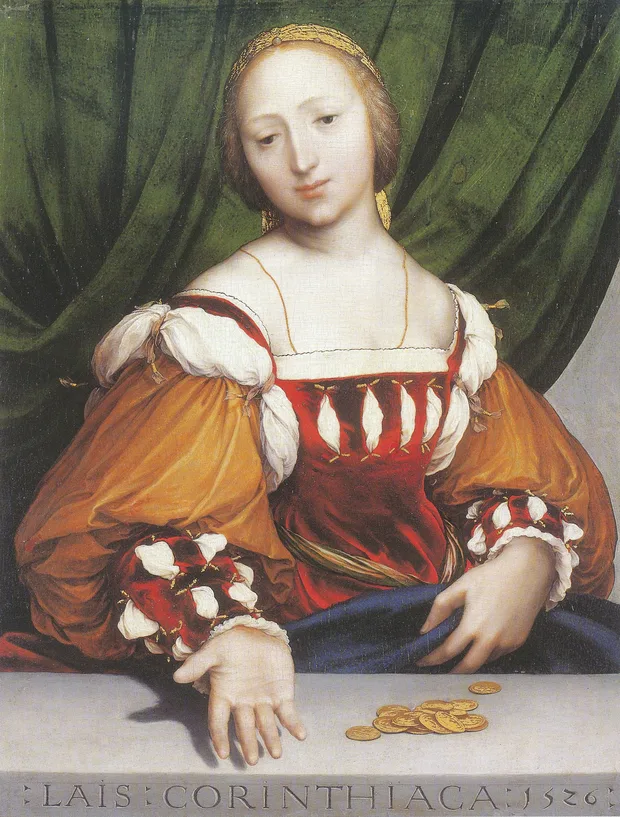
Along the front edge of the grey stone parapet runs the inscription “LAIS CORINTHIACA 1526”, the name of the famous Greek courtesan Lais of Corinth and the year. The young woman's right hand rests on the parapet palm up, its fingers relaxed, beside a small heap of gold coins, with one coin lying apart. She looks down, towards her open palm. She wears a red velvet bodice with slashes through which white linen is pulled, and enormous ochre-orange silk sleeves, a gold net covers her hair, and behind her hangs a heavy green curtain. Holbein painted the panel in Basel in 1526, the year he left for England (on him, see no. 1).
According to tradition, Lais was loved by Apelles, the most famous painter of antiquity, and the Basel humanists called Holbein “Apelles”. Hence a reading that some art historians hold to: the picture is about painting itself, and about beauty having to be paid for generously.
Who sat for Holbein is known from a single line. In the 1580s, about 60 years after the panel was painted, Basilius Amerbach noted in the inventory of the collection that two small panels showed a woman of the Offenburg family and that one of them was inscribed “Lais Corinthiaca”. The Offenburgs were a Basel family, and ever since, the model has been taken to be either the widow Magdalena Offenburg or her daughter Dorothea, although nothing but this note connects either of them with the picture. Later a legend arose, with nothing to support it, that Magdalena was Holbein's mistress.
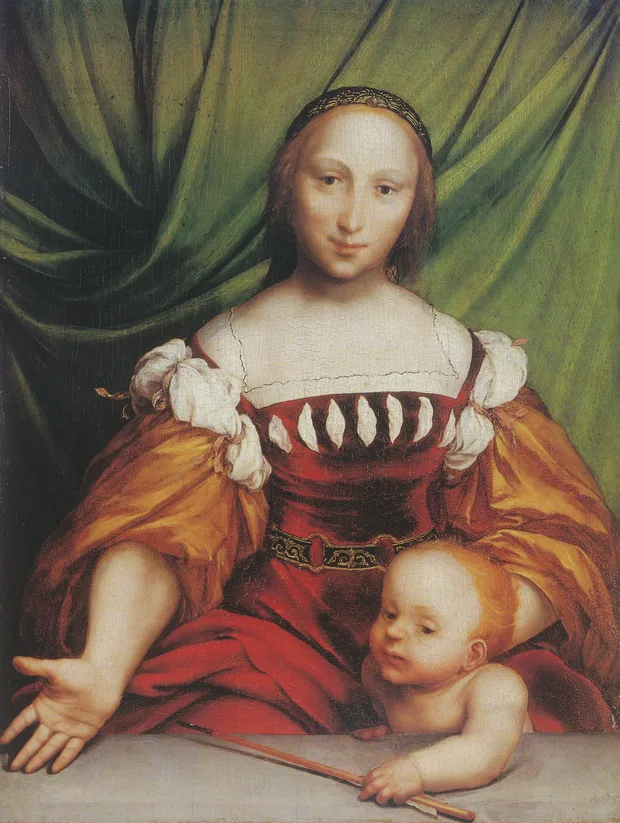
The second small panel from the same note, Venus and Cupid, is also in Basel. The art historian Jochen Sander concluded from a technical study that it is a repeat of the Lais painted by a workshop assistant, who transferred its outlines in mirror image and changed the position of the hand.
The Council Turns Down an Elector (1529–1771)
5. The Passion of Christ — Hans Holbein the Younger
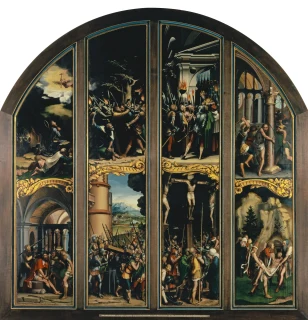
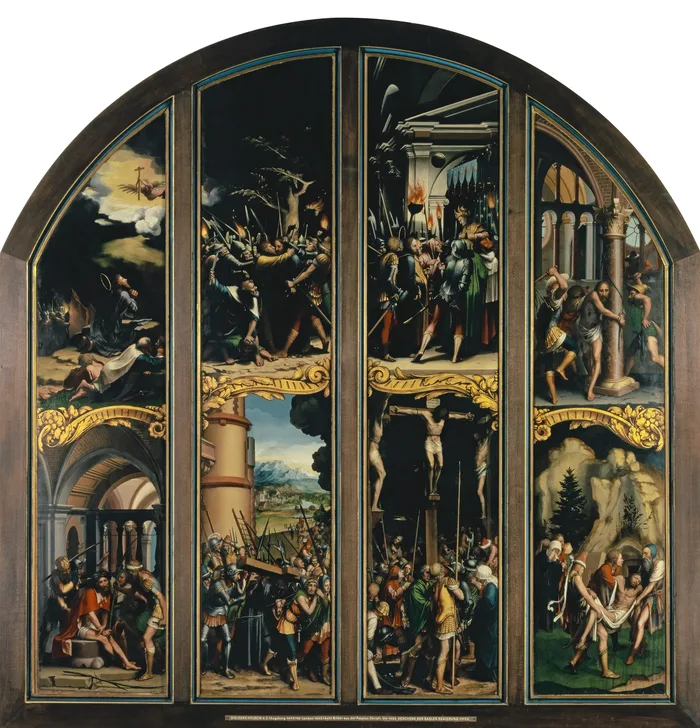
On 4 October 1641 the Small Council of Basel turned away the envoy of Maximilian I, Elector of Bavaria, who had come to buy eight scenes of the Passion of Christ by Holbein from the city. According to the minutes, the envoy was seen off “with every courtesy”, given wine and provided with an escort. The French traveller Charles Patin later wrote, in 1673, that the Elector had offered 30,000 florins for the panels. The painter Joachim von Sandrart, who painted Maximilian's portrait, said in his book of 1675 that he himself had praised the panels to the Elector during the sittings, that the envoy had gone about the business clumsily, and that after the refusal the city was only more convinced of their worth.
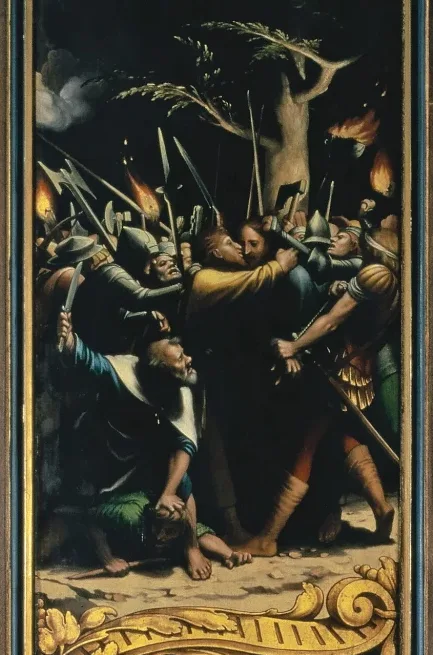
Holbein (on him, see no. 1) painted them in the mid-1520s as the outer faces of the wings of a carved altarpiece, probably for Basel Minster. The carving that the wings covered has not survived, and the wings themselves most likely went to the town hall in 1529, when church images were being smashed in Basel. The middle panels are taller than the outer ones, so the top of the shared frame rises towards the centre in steps, following the outline of the lost altarpiece. Each panel holds two scenes, one above the other, with a band of gilded ornament between them. The first three scenes of the upper row take place at night: the Agony in the Garden, the Arrest and Christ before Caiaphas, and the light in them comes from torches and fires inside the picture. In the second of them Judas, in yellow, kisses Christ amid a crowd with torches and halberds, and at lower left the grey-bearded Peter raises his blade over the fallen Malchus. The soldiers wear armour and slashed hose of the kind worn in the 1520s, and the architecture around them is Italian. Sandrart praised these panels for their understanding of “daylight and night light”.
In 1770 the council handed the wings over to the public collection, which the university was then in charge of, as a gift from the Basel government. In 1771 the university engaged Johann Nikolaus Grooth, a Stuttgart-born painter who worked in Basel as a portraitist, to clean the panels and repair the damage, and the eight scenes have apparently been in a single frame ever since. From the middle of the 19th century Grooth was accused of having ruined the painting. In 1997 the art historian Bernd Lindemann examined the panels and found no trace of later overpainting, so the even, smooth surface Grooth was blamed for is Holbein's own.
The Heirs Lose in Court (1667–1823)
6. Death and the Maiden — Hans Baldung Grien
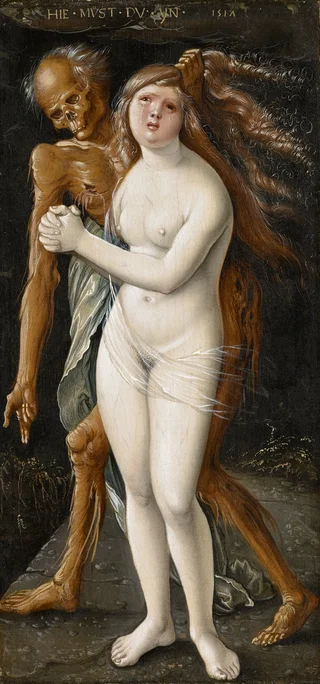
The Basel jurist Remigius Faesch, a professor of law and three times rector of the university, assembled the second great private cabinet in Basel, with paintings, coins, books, prints and drawings, and this panel by Baldung was already his during his lifetime. He died unmarried in 1667 and left a will requiring the collection to stay in the family for as long as a descendant with a doctorate in law could manage it.
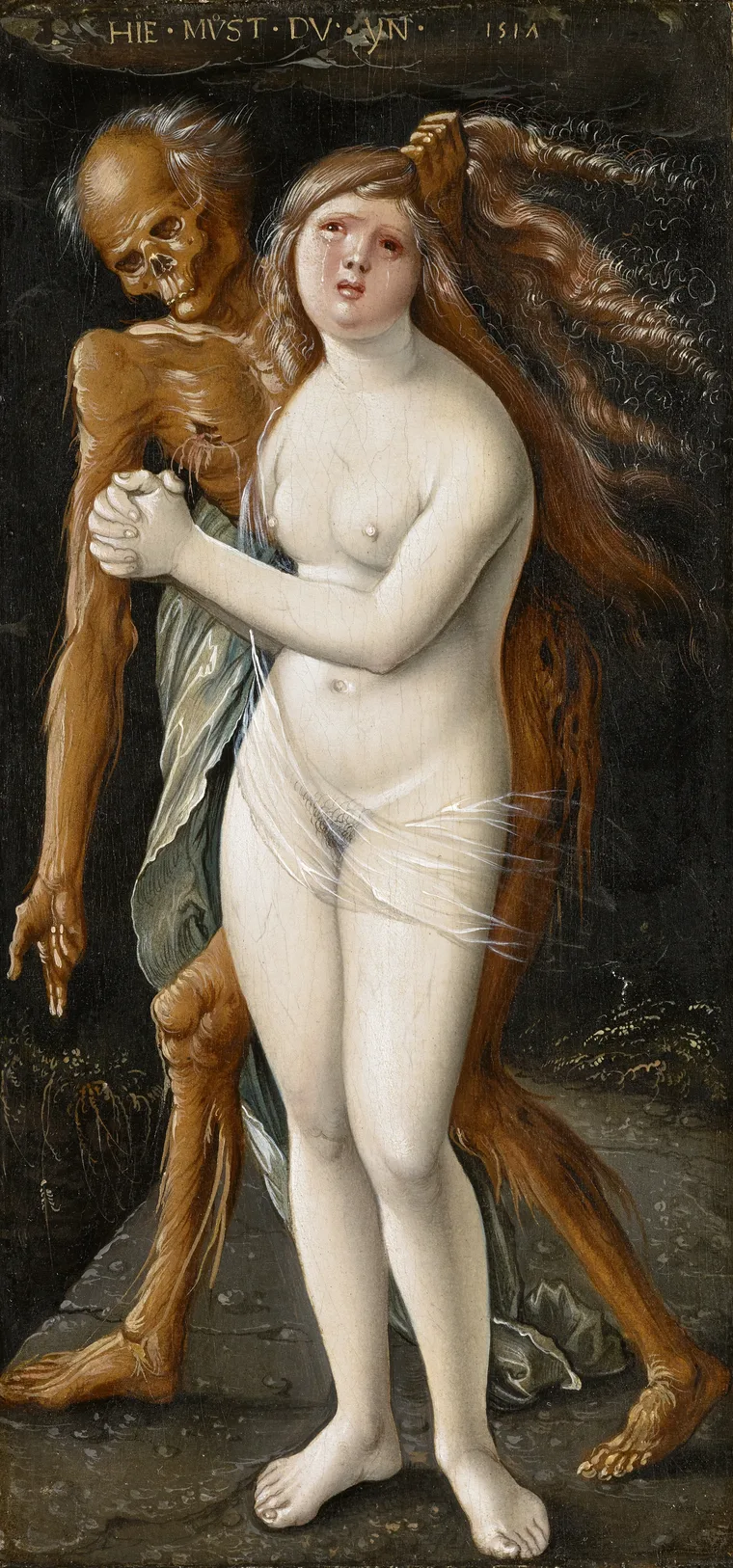
Baldung, who as a young man had been a journeyman in Dürer's workshop in Nuremberg, put the year 1517 on the panel, the year he returned to Strasbourg after almost five years' work on the high altar of Freiburg Minster. At the top, in gold letters, is written “HIE MVST DV YN”, “Here you must go in”. Death here is a brown, leathery, half-rotted corpse with a bare skull, empty eye sockets and a ragged hole in the ribs. The dead man stands behind the girl's right shoulder with a lock of her reddish hair in his fist, and the hair runs down and merges with the shreds of flesh on his leg. The pale, naked girl is weeping, her eyes rolled upward and tears running down her cheeks, and she presses her clasped hands against his bony forearm, as if pleading with the dead man himself. With his other hand he points downward, into an open grave, as the museum describes it. The transparent veil over her hips is painted with a few white lines and covers nothing.
The university tried more than once to get hold of the Faesch collection, and its chance came when the administrator turned out to be Johann Jakob Faesch, a lawyer without a doctorate. He could not obtain one in Basel, because the chair of law there was vacant. The court of first instance found for the family. In 1823 the court of appeal took the collection from the Faesches and gave it to the university, disregarding the fact that the heir had meanwhile become a doctor of law at Freiburg.
The Museum Finds the Painter's Name (1890s)
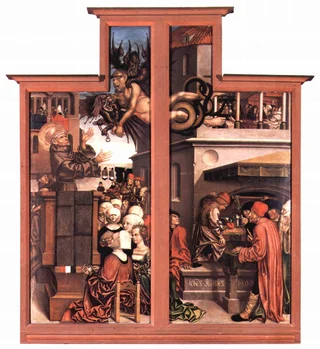
7. Synagogue (Mirror of Salvation Altarpiece) — Konrad Witz
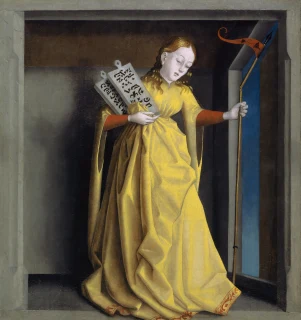
Until the mid-1890s the Basel panels of this altarpiece were attributed to the “school of Geertgen tot Sint Jans”, a Netherlandish painter from Haarlem. The name of their real author had already been read by then, though in Geneva: the frame of the Geneva altarpiece of 1444 bears the words “Conradus Sapientis de Basilea”, the Latin form of the name of Konrad Witz of Basel, and in 1845 the Genevan scholar Blavignac read the inscription and suggested that it gave the painter's name. Nobody connected it with Basel. In the mid-1890s Daniel Burckhardt, curator of the Basel collection, and the Genevan Jaques Mayor noticed that the Geneva wings and the Basel panels were by the same hand. Mayor published the finding in 1896, Burckhardt in 1901. The Basel altarpiece carries no signature, and because of its likeness to the Geneva one the museum considers Witz's authorship very probable.
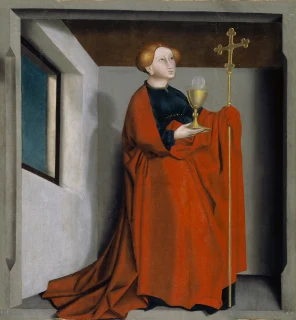
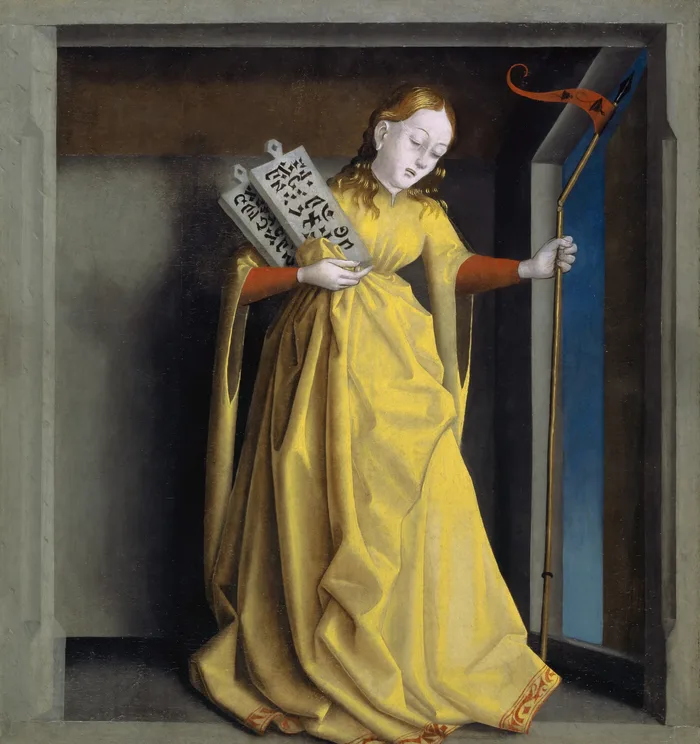
The altarpiece is thought to have been painted around 1435 for the church of St Leonhard in Basel, and the Synagogue was part of the outer face of the right wing. A young woman stands in an empty stone room with grey walls, in a huge acid-yellow dress that falls to the floor in broken folds. Her eyes are closed, and across them runs a transparent blindfold painted with a few thin white lines, easy to miss. Her face is chalk-white, her head bowed. Two grey stone tablets of the Law lean against her right shoulder, and she holds them from below, at her waist, with her right hand. The letters on the tablets look like Hebrew, but the museum calls them “fantasy Hebrew”. In her left hand she holds a thin gold lance, broken near the top, with a small red pennant, and at the right edge a strip of bright blue shows through an opening.
The blindfold, the broken lance and the slipping tablets were the usual attributes of Synagogue in medieval art, which paired her with Ecclesia, the Church, and in this way represented the Jews who had not accepted Christ. Witz kept all these attributes and painted a graceful young woman of the same height and bearing as the figure of Ecclesia on the companion panel, who stands in a red cloak with her eyes open, holding a chalice and a cross.
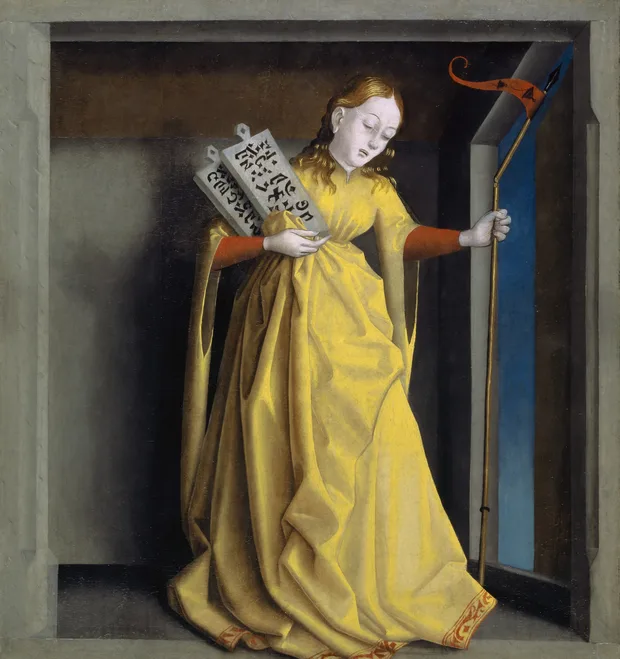
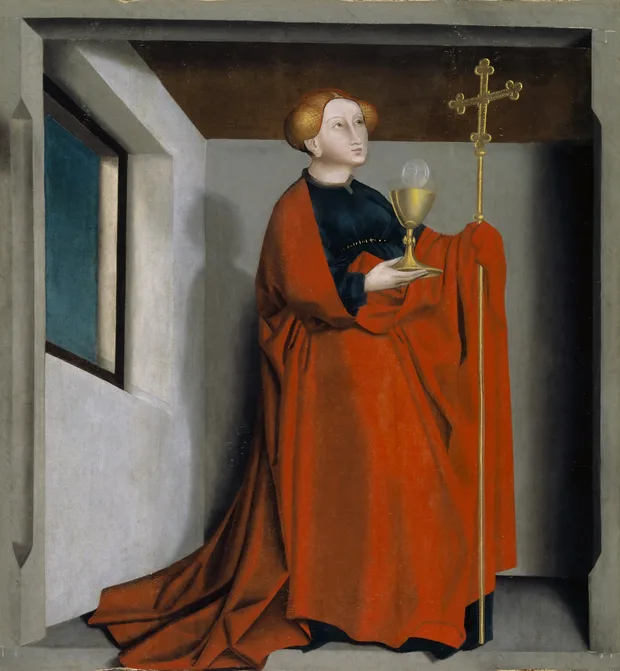
The Synagogue was given to the museum in 1843 by the Basel collector Peter Vischer-Passavant, and the other panels also came in as gifts from Basel families during the 19th century. The museum bought Ecclesia in 1928 with money from the government, two foundations and many art lovers, and since the same year the angel of the Annunciation has been kept here on deposit from the Gottfried Keller Foundation (on the foundation, see no. 8). Of the 14 surviving parts of the altarpiece, nine are in Basel. At some point the altarpiece was taken apart and its panels were sawn through their thickness, separating the fronts from the backs, and the back of the Synagogue became a picture in its own right, The Queen of Sheba before Solomon, which is in Berlin.
The Confederation Buys a Basel Painter's Picture (1920)
8. Isle of the Dead (first version) — Arnold Böcklin
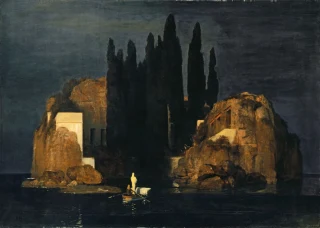
Böcklin, who was born in Basel and was then living in Florence, painted this picture in the spring of 1880 for his patron Alexander Günther, but did not hand it over to Günther. While the canvas stood unfinished in the studio, Marie Berna, the widow of a financier, came in and asked for the picture “to dream by”, and for her Böcklin painted a second version, which is in the Metropolitan Museum of Art in New York. There are five versions in all.
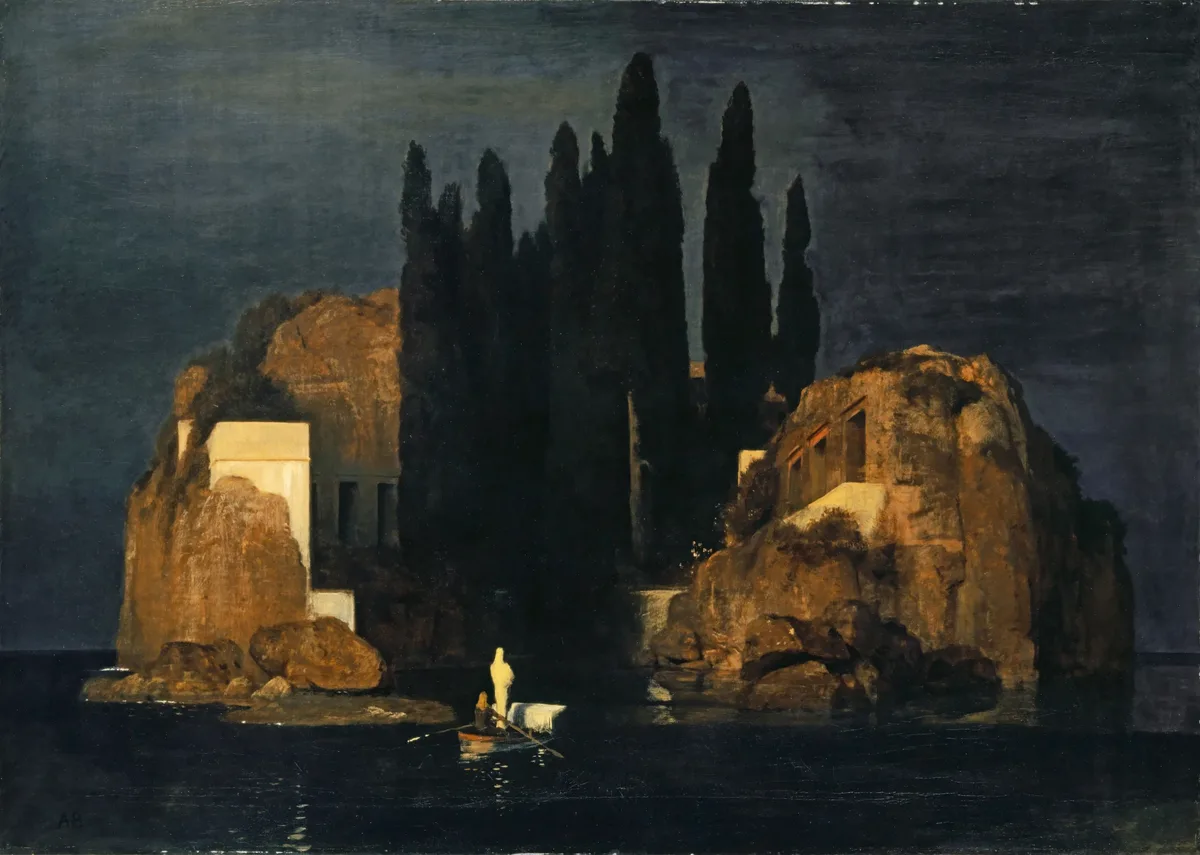
The island takes up the middle band of the wide canvas, with an empty dark night sky above it and almost black, smooth water below. Two cliffs lit by a warm golden-brown light open out to either side, tall black cypresses rise between them, and rectangular entrances to burial chambers are cut into the rock. A small boat is making for a white landing stage between the cliffs. At one end sits an oarsman in dark clothes, behind him stands a figure wrapped from head to foot in glowing white, its back to the viewer, and at the other end, on the right, lies a coffin under a white cloth. In the lower left corner, in the dark water, the monogram “AB” can just be made out.
In 1920 the picture was bought by the Gottfried Keller Foundation. The foundation was set up in 1890 with money that Lydia Welti-Escher gave to the Swiss Confederation, and was named after the poet Gottfried Keller. Its purchases are decided by a commission appointed by the Federal Council, and it places the works it buys on deposit in Swiss museums, often in the places they come from. The Isle of the Dead belongs to the foundation, which is to say to the Confederation, and the Kunstmuseum Basel has held it on deposit since 1920.
The First Modern Pictures (1931–1937)
9. Senecio — Paul Klee
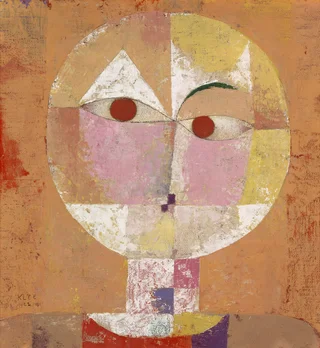
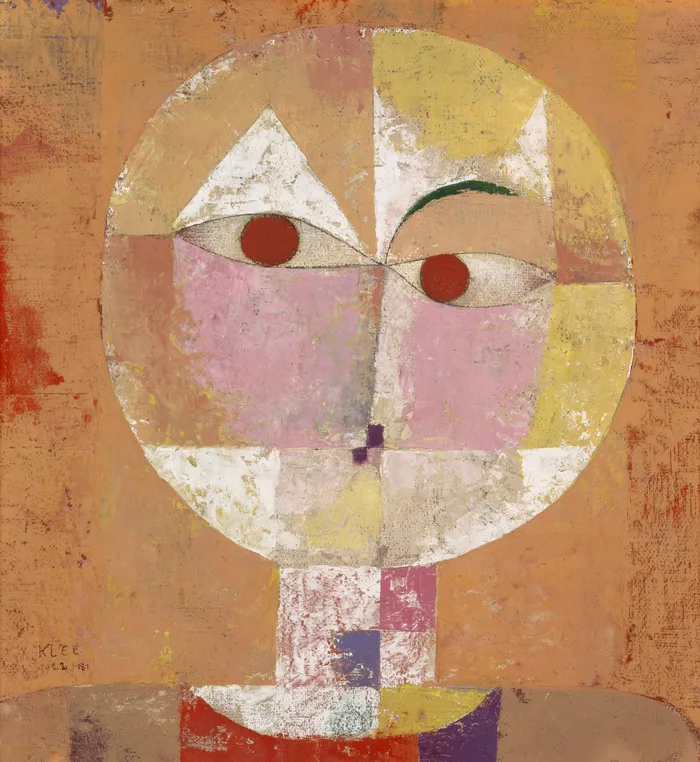
Almost the whole picture is taken up by a round head on a short neck, and the face on it is broken into flat areas of colour: the pale yellow right half of the skull, a pink band across both cheeks, white, cream and yellow squares on the chin. The eyes are outlined by a single thin line that crosses over the bridge of the nose in a figure of eight, the pupils are flat dark red discs, and the left eye sits higher than the right. Above the left eye is a white triangle with a sharp point, above the right a dark green arc, so that one eyebrow seems raised. The mouth is two small dark violet squares set one step apart. The paint is thin, and the chalk ground and the weave of the gauze glued onto the card show through it, most clearly in the whites of the eyes.
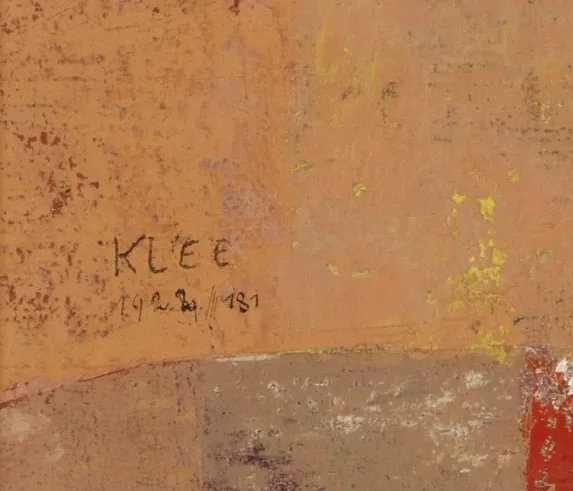
Senecio is the Latin name for groundsel, a weed whose white, fluffy seed heads look like a grey-haired head, and the plant's name itself comes from the Latin word for “old man”. In his catalogue Klee also gave the picture a German title, Baldgreis, which means roughly “soon to be old”. At the left edge he wrote “KLEE” and below it “1922 /// 181”, the year and the number in his own catalogue.
Klee was born in 1879 near Bern, but through his German father he remained a German citizen all his life. From 1921 he taught at the Bauhaus, and he painted Senecio in Weimar, in his second year there. In 1933 the Nazis dismissed him from the Düsseldorf Academy, and at the end of that year he moved to Bern. In 1937 his works were confiscated from German museums (one of them, Villa R, is described in no. 13). In 1939 Klee applied for Swiss citizenship, and he died on 29 June 1940 without having become Swiss.
The museum bought Senecio in 1931 from the Munich dealers Günther and Sophie Franke. Together with Emil Nolde's Blue Iris I it was among the first modern pictures in the collection, and when the museum's new main building opened in 1936 it held almost no modern art apart from these two and a few other works.
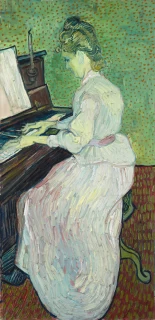
10. Marguerite Gachet at the Piano — Vincent van Gogh
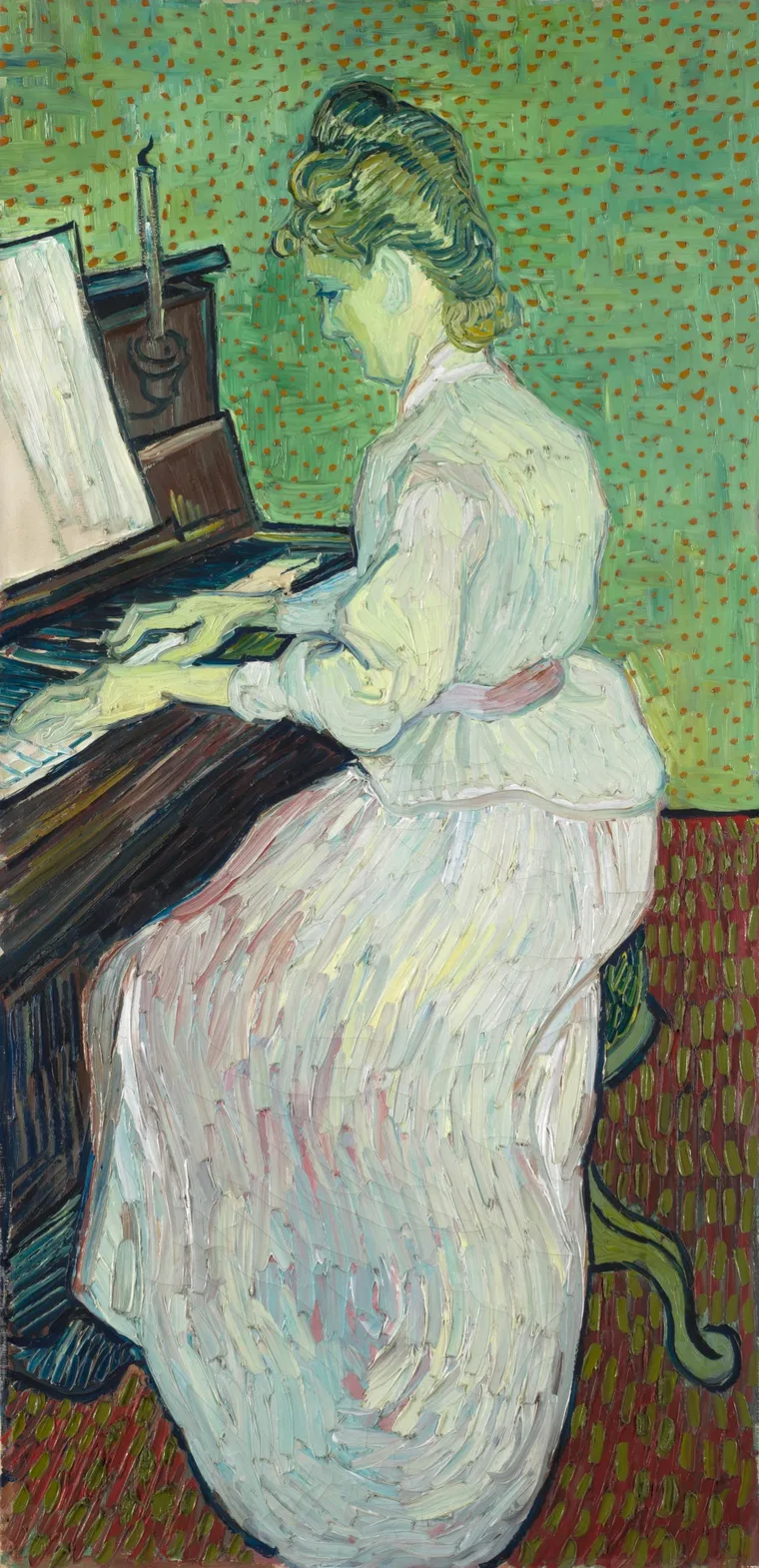
For more than 40 years this picture hung in Marguerite Gachet's bedroom, in the house of her father, Dr Paul Gachet, in Auvers-sur-Oise. In 1934 two members of the Basel museum's Art Commission, the director Otto Fischer and the collector Rudolf Staechelin, travelled to Auvers to look at it in the Gachet house, and the museum bought it that same year.
Van Gogh came to Auvers in May 1890 to live near Dr Gachet, painted his daughter that summer, and died at the end of July. In a letter to his brother Theo he listed the colours: “The dress is pink. The wall in the background green with orange spots, the carpet red with green spots, the piano dark violet.” The canvas is narrow, twice as high as it is wide. Marguerite sits in profile, bent over the keys, her hair gathered up in a bun, the piano is cut off by the left edge, and on it stand sheet music and an unlit candle. Orange spots cover the wall down to the middle of the canvas, and at lower right lies the red carpet with short green strokes.
The red pigment in the dress has faded over time, and the pink dress now looks almost white, with pale green and yellow strokes, among which pinkish-red streaks show here and there.
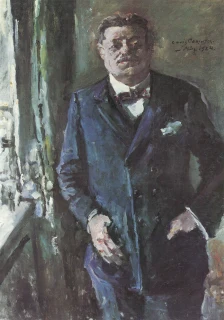
11. Portrait of the Reich President, Friedrich Ebert — Lovis Corinth
The money for this portrait came in 1937 from the trade unions and the education department of the canton of Basel-Stadt, and the museum's director, Otto Fischer, bought it from Lovis Corinth's widow. In the Art Commission, the museum writes, the purchase met with “strong disapproval”, and Fischer's own vote was needed to push it through. That same year paintings by Corinth began to be confiscated from German museums (more on this in no. 15).
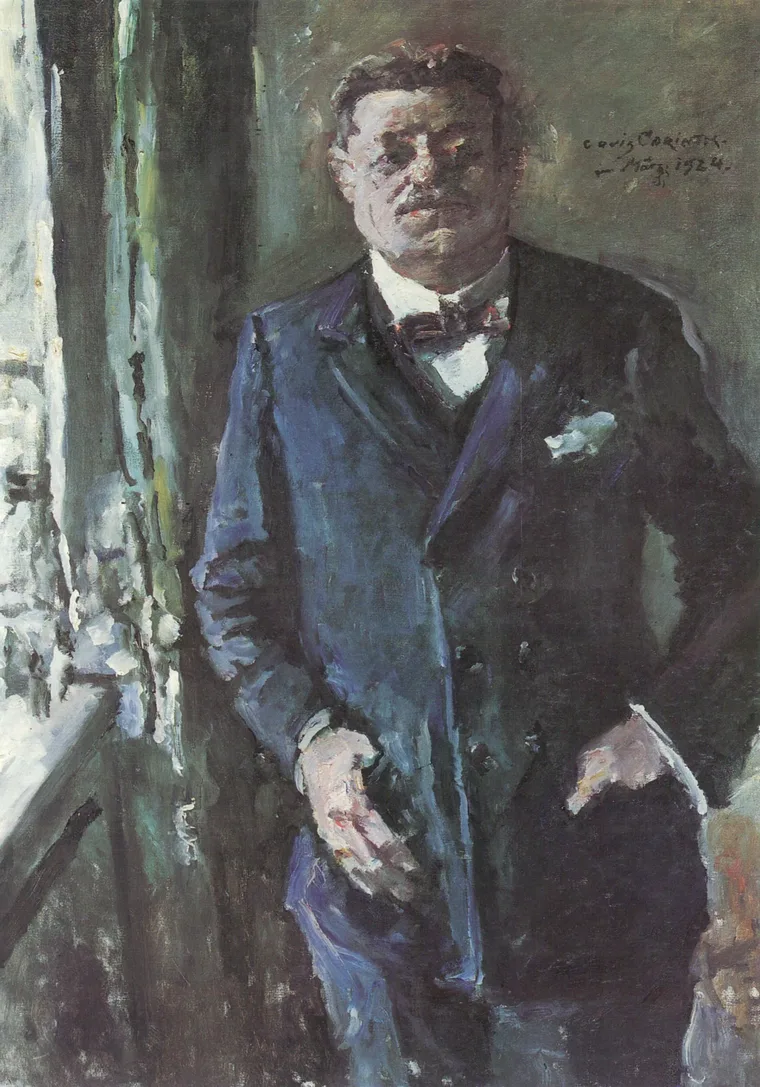
Ebert, a Social Democrat, was then President of the German Reich, and Corinth painted him in March 1924 in his Berlin apartment. The painter wanted the President seated, but Ebert refused, saying he had had a bad experience with that pose, and Corinth painted him standing. In his autobiography Corinth recalled that Ebert's head attracted him by its “interesting ugliness”. Ebert stands almost full face and looks straight at the viewer. Light from a window with net curtains at the left edge falls on half of his face, and the other half sinks into brown shadow. On the lit side his dark double-breasted suit is painted in bright stripes of ultramarine and blue-violet, his right hand hangs in front of the jacket, his left rests on his hip, and the legs in the lower third of the canvas are only sketched in. In the upper right corner “Lovis Corinth / im März 1924” is written on the wall.
Corinth was 65 at the time. A stroke in December 1911 had left him partly paralysed, but he went on painting. He died in July 1925.
Summer 1939: Buying from the Reich's Depots
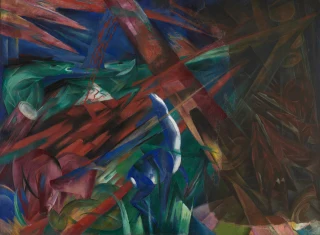
12. The Fate of the Animals — Franz Marc
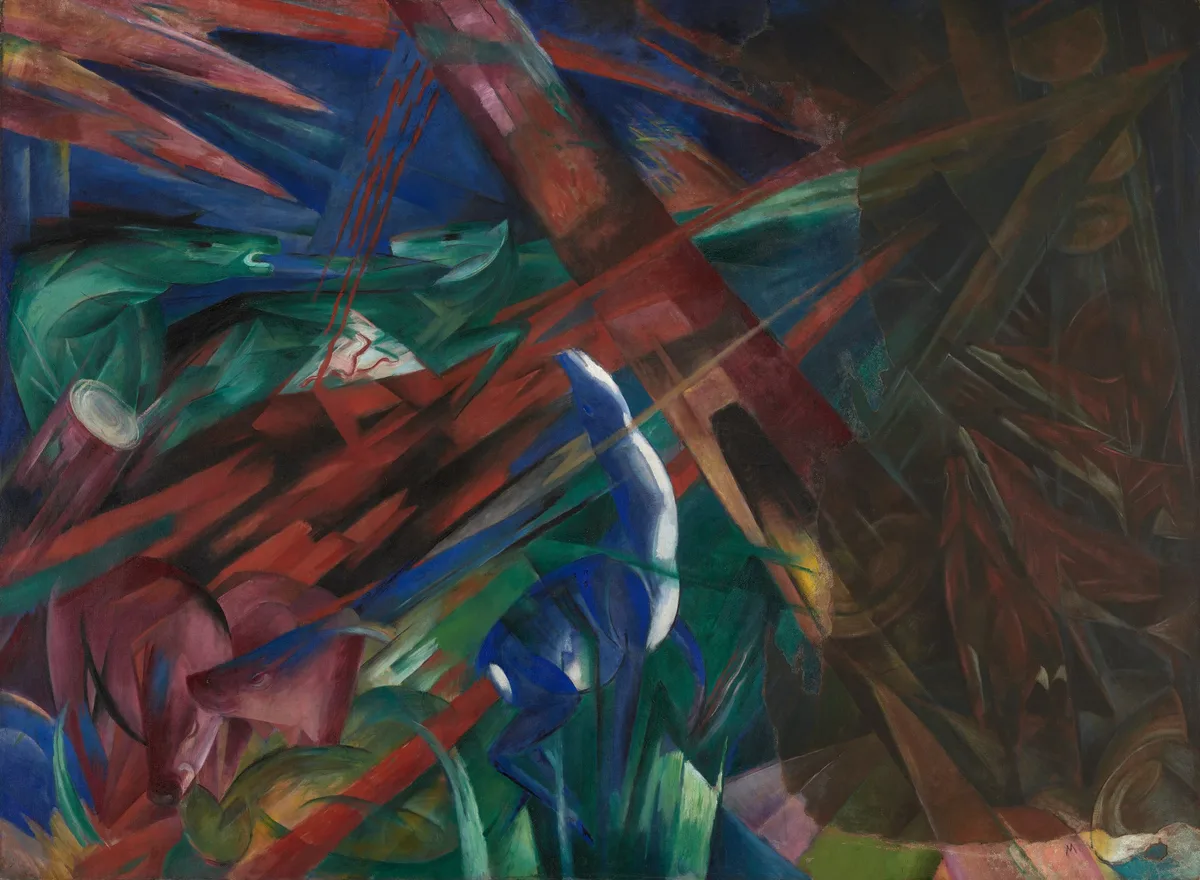
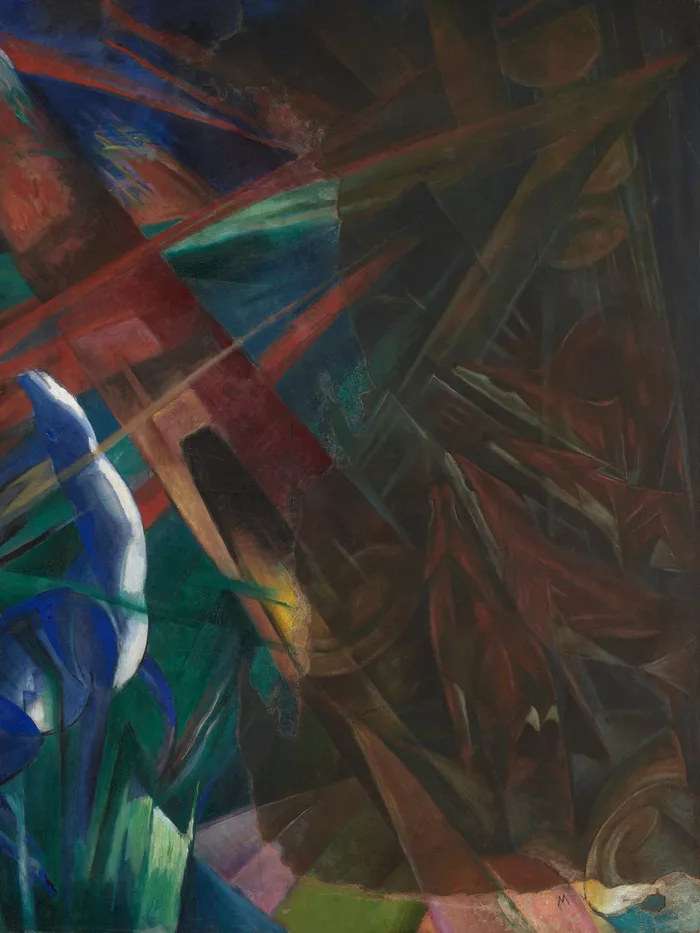
The right third of this canvas burned in the winter of 1916–1917 in the storeroom of a Berlin art shipping firm, where the picture was kept after Marc's memorial exhibition at the Sturm gallery in Berlin. Marc himself had been killed at Verdun on 4 March 1916. A year before his death, when a postcard with a reproduction of the picture reached him at the front, he wrote to his wife Maria: “It is like a premonition of this war, horrible and shattering. I can hardly believe that I painted it!”
Marc painted the picture in the spring of 1913 and first called it The Trees Showed Their Rings, the Animals Their Veins. Before its first exhibition he renamed it on the advice of a friend, Paul Klee (on him, see no. 9), and in 1919 Klee restored the burned part from a preparatory watercolour and photographs. The museum writes that by using markedly darker tones he left the loss visible. In the left two thirds, painted by Marc, diagonals cut across the canvas, a huge red-brown trunk falls from the top towards the right edge, in the centre a blue deer rears with its head thrown back, and further left are two green horses' heads with open mouths. Below them is a white triangle with thin red veins, the “veins” of the first title, and at the left edge the sawn end of a log with its growth rings. The right third, painted by Klee, is murky, brown-olive, with pale red and grey-green lines, and the border between it and Marc's saturated colours is ragged, like a burnt edge.
After Marc's death the picture stayed with his widow. In 1930 it was bought by the municipal museum in Halle, in 1937 the Reich Ministry of Propaganda confiscated it as “degenerate art”, and in 1938 it was sent to the depot at Schönhausen Palace in Berlin, where works the authorities considered fit for sale abroad were gathered. In the summer of 1939 Basel bought 21 works from German museums, eight at the Galerie Theodor Fischer auction in Lucerne on 30 June and 13 through the dealers Karl Buchholz and Hildebrand Gurlitt in Berlin, and paid for them out of a special credit of 50,000 francs from the canton. In July the museum's new director, Georg Schmidt, wrote to the critic Paul Westheim that it all felt like a fairy tale to him, “if only the circumstances that led to it weren't so harrowingly real and brutal”. The Fate of the Animals was the first of these purchases. Schmidt saw the picture in the Schönhausen depot in May and arranged to buy it before the canton had even approved the credit. In a telegram of 10 May 1939 he offered Gurlitt, who was selling it on behalf of the ministry, 6,000 francs, and in the end he paid 6,900.
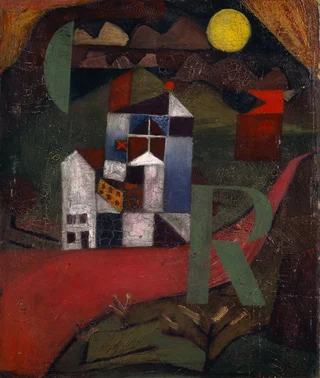
13. Villa R — Paul Klee
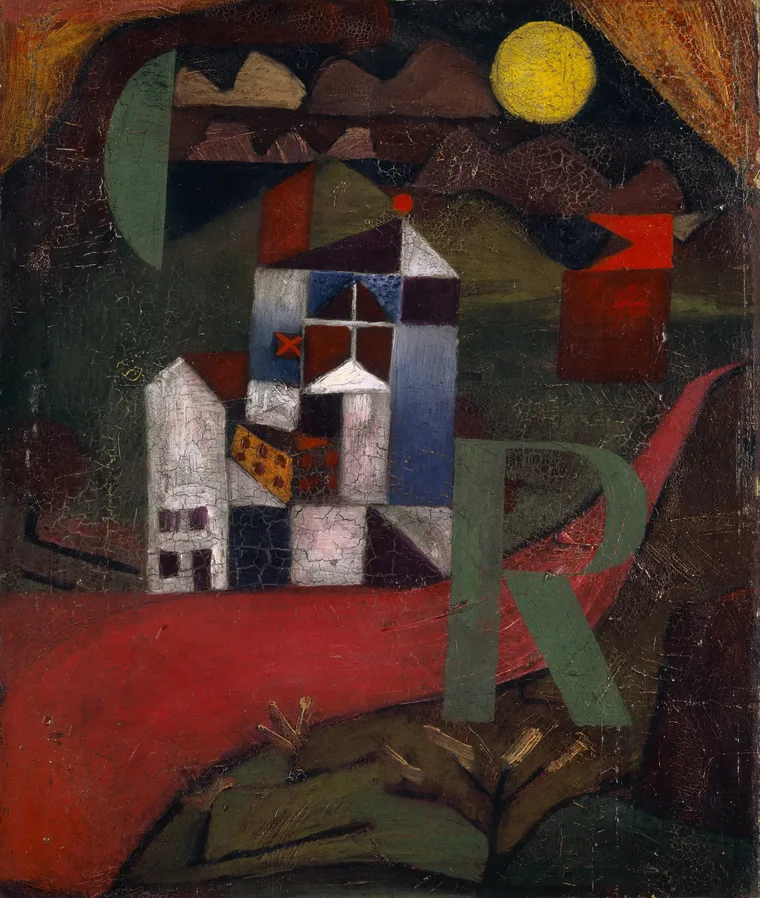
Pauline Kowarzik, a Frankfurt painter and collector, bought this picture in November 1919, the same year Klee painted it. From 1916 she sat on the purchasing committee of Frankfurt's municipal gallery, the first woman to do so. In 1926, ruined by inflation, Kowarzik sold almost her entire collection of modern art, 34 works, to that gallery, which was housed in the Städel, in exchange for a life annuity. In August 1937 Villa R was confiscated from the Städel.
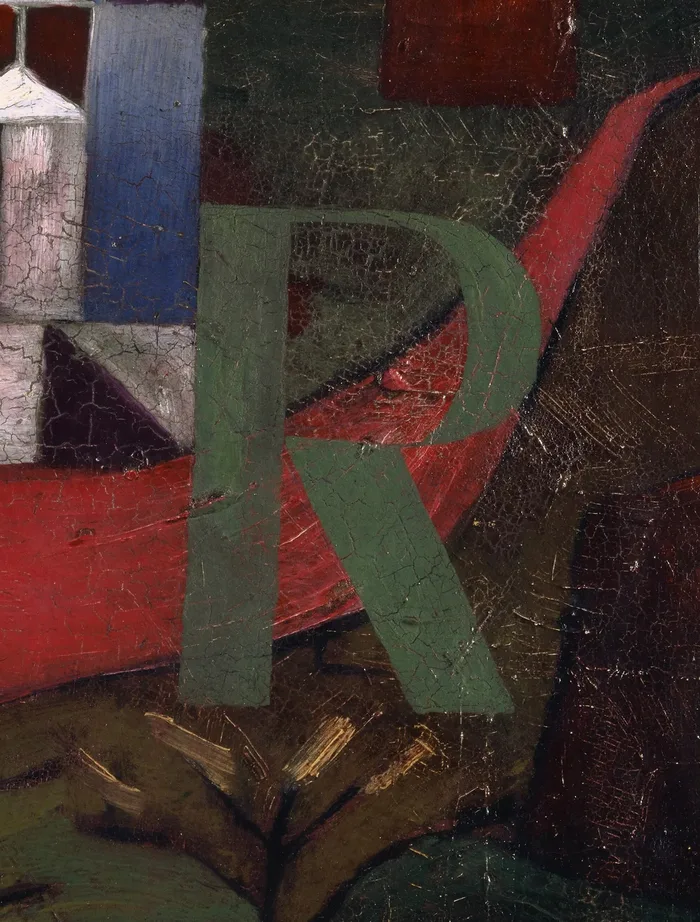
The picture is small and nocturnal, on an almost black ground. Left of centre stands the villa, built of flat blocks in white, pinkish, cold blue and violet, with a large window divided into dark red squares. A wide red road comes in at lower left, passes in front of the house and, narrowing, climbs towards the right edge. On the road to the right of the house stands a large grey-green letter R with serifs, the same dull green as the hills. In the upper left corner is a green semicircle, in the upper right a full yellow moon. According to the museum, this is one of Klee's first oil paintings, made after a long period of working only on paper. That same year he painted Town R with a large black letter, and the Lenbachhaus in Munich, which owns that picture, calls the meaning of the letter encrypted.
On 30 June 1939 the Galerie Theodor Fischer in Lucerne put 125 works confiscated from German museums up for auction, and 86 of them went to collections outside Germany. The Basel delegation had not meant to bid for Villa R, which was listed in the catalogue as lot 59 under the title House at the Roadside, and bought it with the money left over after its planned purchases. Only two of Klee's oil paintings came up at this auction, Villa R and Monastery Garden, and Monastery Garden burned in 1940.
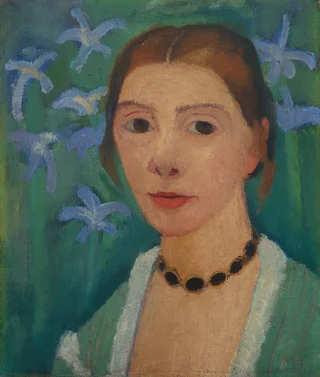
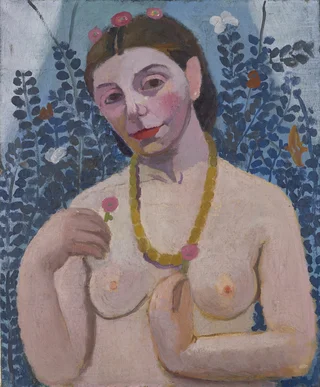
14. Self-Portrait as a Half-Length Nude with Amber Necklace II — Paula Modersohn-Becker
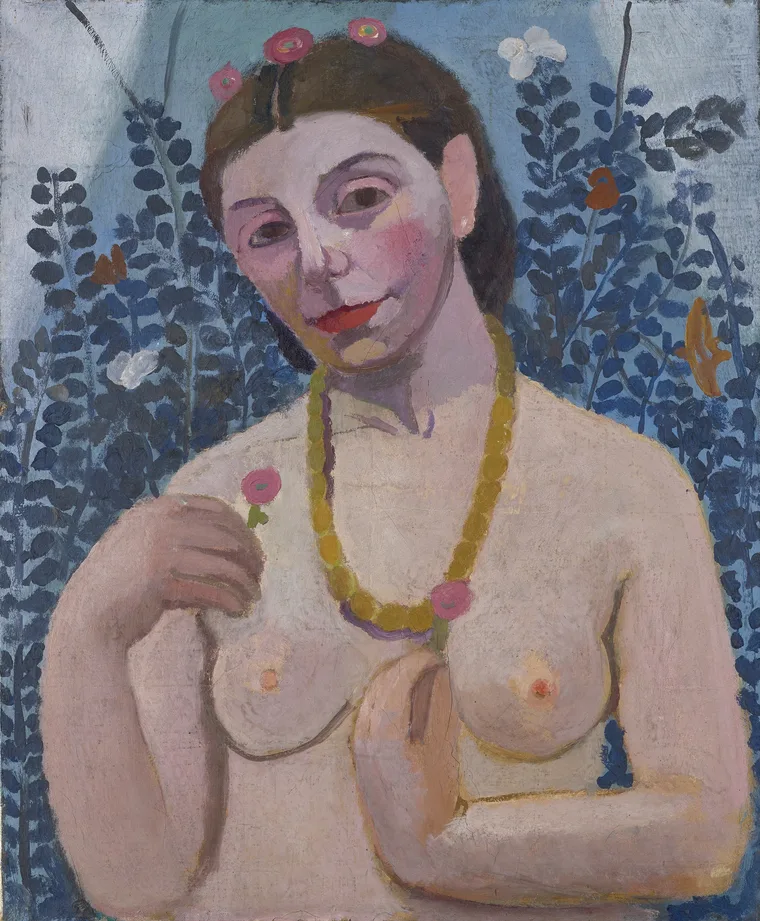
In February 1906 Paula Modersohn-Becker left her husband, the painter Otto Modersohn, moved away from the artists' village of Worpswede near Bremen and began working on her own in Paris. In the course of that year she painted about 15 self-portraits. For some of them she was photographed nude, apparently by her sister Herma, and this self-portrait, the museum writes, was painted from a photograph. The museum considers it one of the first nude self-portraits in history and believes she most likely did not intend to show it in public.
She looks at the viewer with large dark eyes, her head slightly tilted, her firm bright red lips set in a small, restrained smile. There are three pink flowers in her hair. The long necklace of large amber beads is painted as flat mustard-ochre circles and hangs in a horseshoe below her breasts. In her raised right hand she holds a pink flower on a short stem between her fingertips, her left arm lies across her body, and the hand is bent sharply upward. Behind her are dense dark blue stems with leaves against a pale grey-blue ground. The museum sees here the influence of ancient mummy portraits, frontal and large-eyed, with a flower in the hand.
In the spring of 1907 she returned to Worpswede with her husband, gave birth to a daughter on 2 November and died on 20 November, at the age of 31. The self-portrait was first exhibited in 1913, and that same year it was bought by the Hanover collector Herbert von Garvens-Garvensburg. In 1928 the Kestner Museum in Hanover acquired the picture from him, and in 1937 it was confiscated from there.
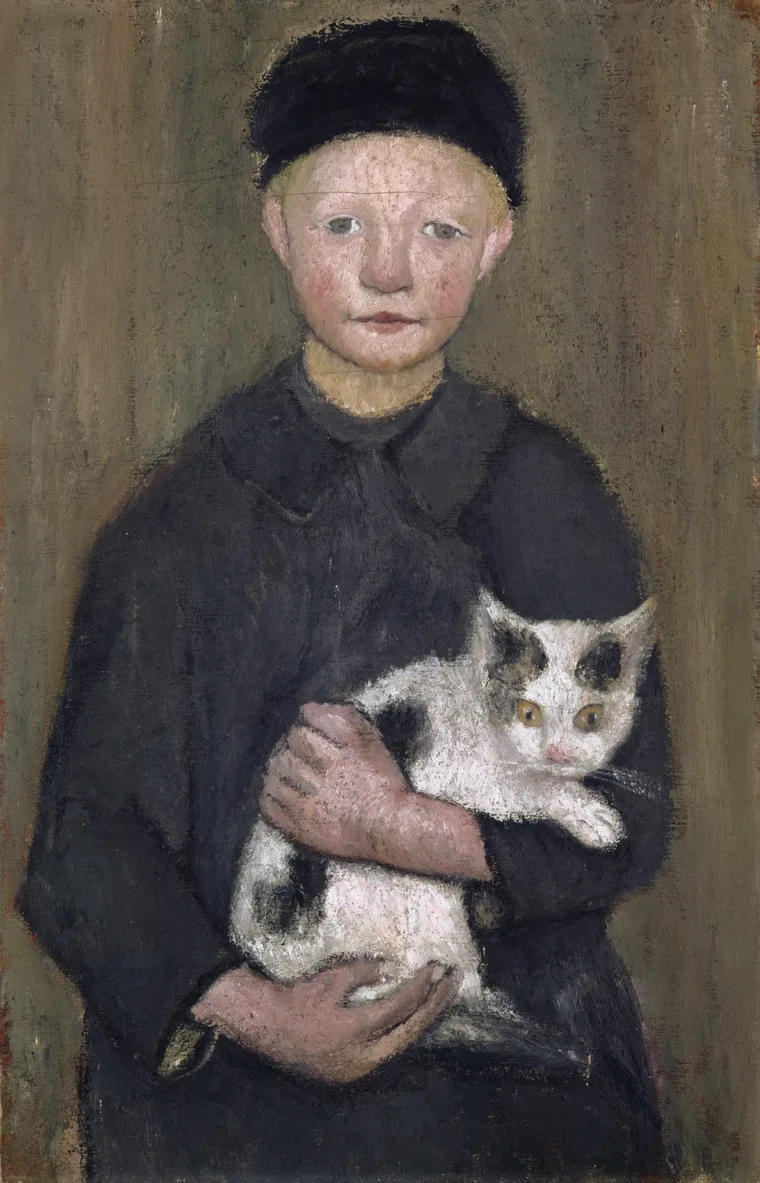
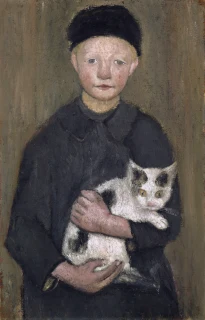
In Lucerne on 30 June 1939 it was lot 97. On the eve of the auction the canton approved 50,000 francs of the 100,000 requested, and the Art Commission bought this picture, although the price went past the limit the commission had set. On the same day Basel let Picasso's The Soler Family go, because it would have taken almost the entire credit. Basel has two more paintings by Modersohn-Becker, bought in 1939 through Buchholz, and one of them, Boy with Cat, had also been confiscated from the Kestner Museum.
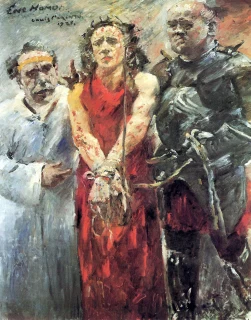
15. Ecce Homo — Lovis Corinth
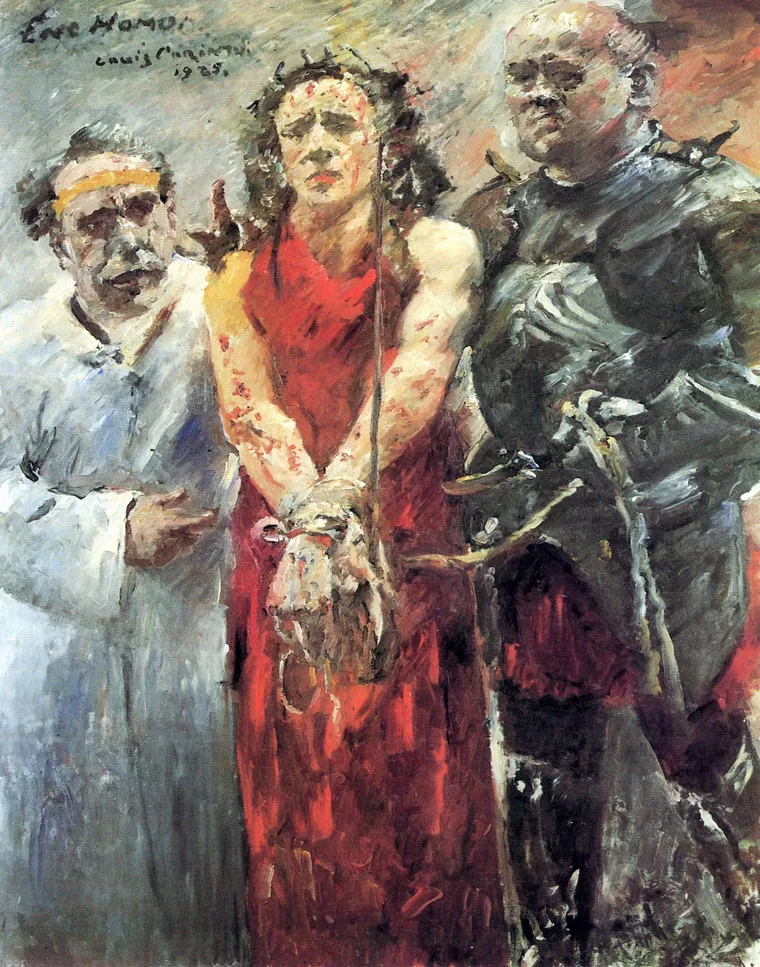
The painter Adolf Ziegler, opening the “Degenerate Art” exhibition in Munich on 19 July 1937, said that Corinth “after his second stroke produced nothing but sick and incomprehensible daubs”. Among the seven paintings by Corinth in the exhibition were three from the Nationalgalerie in Berlin, and Ecce Homo was one of them. It had been confiscated from the gallery on 7 July, in the first wave of confiscations, when works were being gathered for Munich. In all, 45 paintings by Corinth were confiscated from German museums. Eva Reifert, a curator at the Basel museum, said in 2017 that there was apparently no agreement at the time on whether this picture should count as “degenerate”, although it appears in a great many photographs of the Munich exhibition.
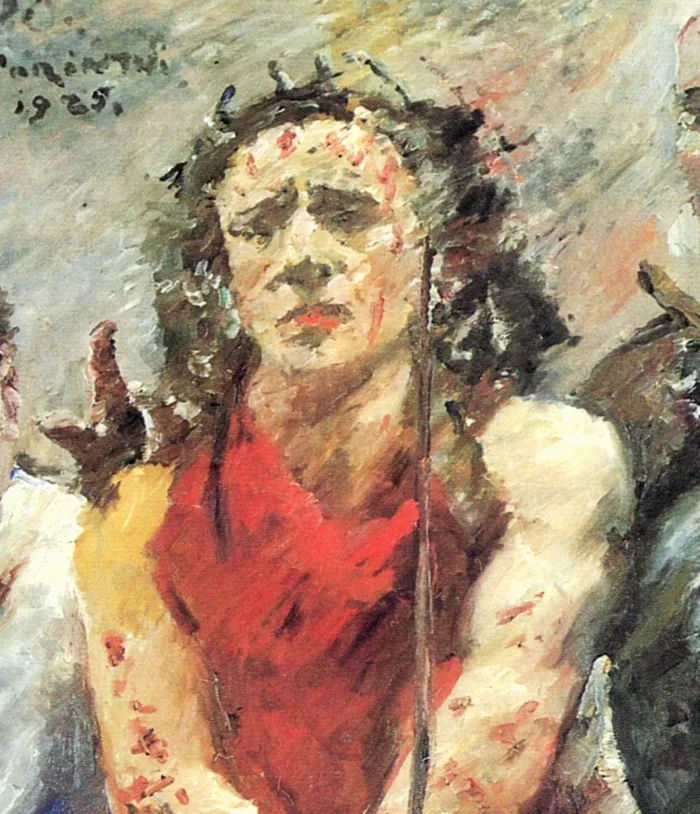
Corinth painted it in 1925, the last year of his life (on him, see no. 11), and according to the museum people he knew posed for it. Three life-size figures stand shoulder to shoulder, cut off at the knees by the bottom edge. In the centre is a young Christ in a crown of thorns and a sleeveless red tunic, his face, shoulders and arms spattered with blood, his crossed wrists bound with thick rope. On the left Pilate, in a white smock painted in lead white and cool blues, with a yellow band around his forehead, points to Christ with an open palm. On the right is a bald soldier in dark steel armour, and the rope runs to him from Christ's bound hands. Red, black-grey and white stand in three large patches, the brushwork is quick and thick throughout, and Christ's face is the most carefully painted part. In the upper left corner Corinth wrote “Ecce Homo. / Lovis Corinth / 1925” on the canvas.
After Corinth's death the picture stayed with his widow, in 1929 the Nationalgalerie bought it, and in August 1938, already confiscated, it ended up in the Schönhausen depot. At the end of May 1939 Georg Schmidt went to Berlin and, together with the dealer Karl Buchholz, picked out works that were later sent to Basel on approval. On 12 June Buchholz acquired Ecce Homo from the Ministry of Propaganda for Basel, and after the Lucerne auction the Art Commission chose 12 more works from those that had been sent, this picture among them. In 1949 Paul Ortwin Rave, who had headed the Nationalgalerie when the picture was taken from it, put Ecce Homo on the cover of his book Kunstdiktatur im Dritten Reich (Art Dictatorship in the Third Reich), one of the first books about the campaign against “degenerate art”.
Émigrés Give, the Museum Buys What It Missed (1941–1977)
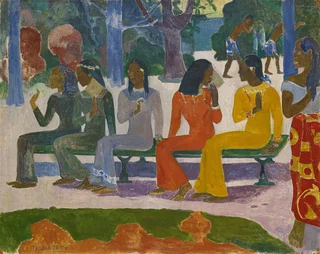
16. Ta matete (The Market) — Paul Gauguin
Robert von Hirsch gave this picture to Basel when he received Swiss citizenship in 1940, and it entered the museum's inventory in 1941. Hirsch was born in 1883 in Frankfurt am Main into an assimilated Jewish family, joined his relatives' leather firm in Offenbach in 1898, was granted the noble “von” by the Grand Duke of Hesse in 1913, and became the firm's sole owner in 1917. He began collecting around 1907, and his collection included medieval goldsmiths' work and enamels, drawings by Dürer, manuscripts and modern French painting. He had planned a large gift to the Frankfurt museums, but in 1933, after the Nazis came to power, he emigrated to Basel, where the firm had a branch, and took his whole collection there except for one painting (more on it in no. 19).
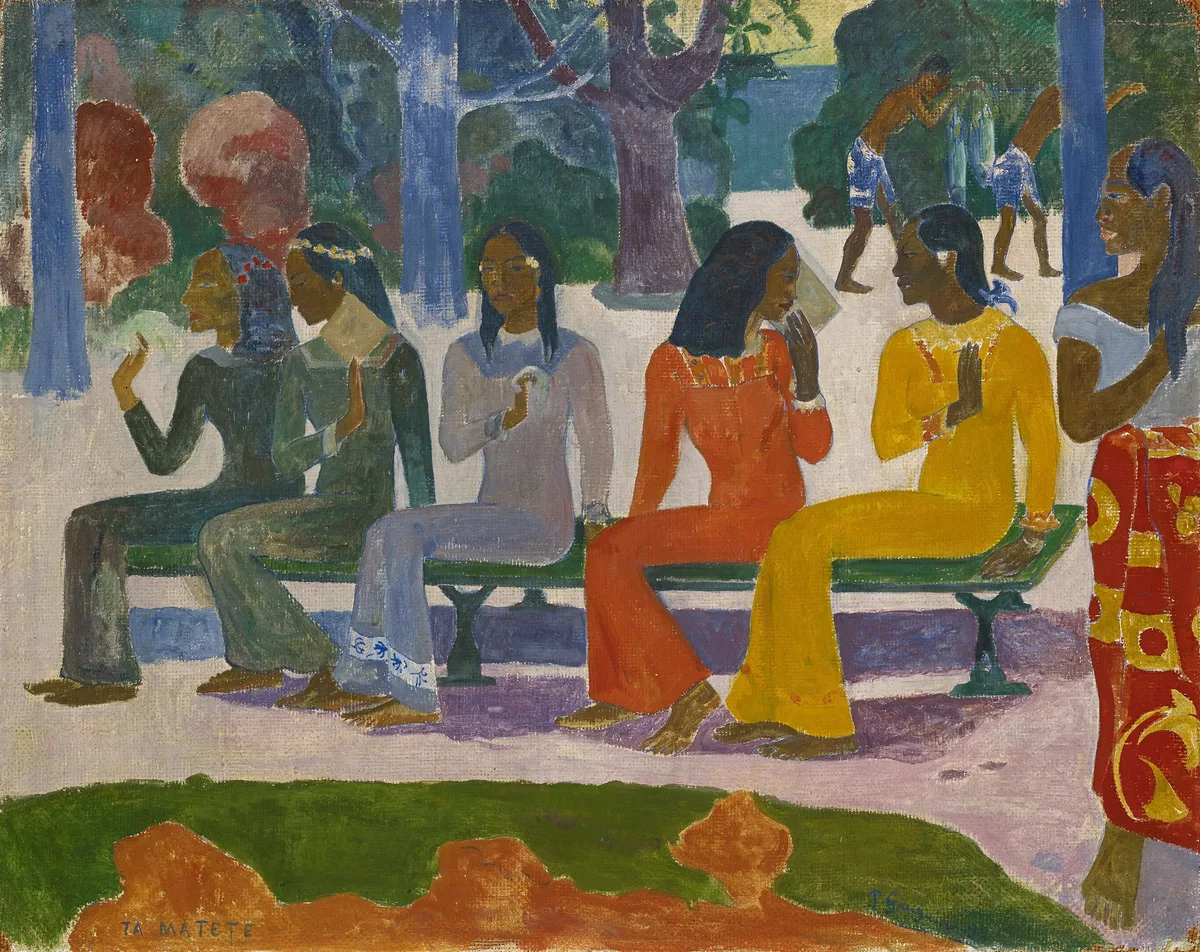
Gauguin painted Ta matete in 1892, during his first stay in Tahiti. In Tahitian the words mean “the market”, and that is what the museum calls the picture. It is also known as We Shall Not Go to the Market Today, a title that does not translate the Tahitian. Five women in long high-necked dresses sit in a row on a green bench, each dress a single flat colour, from an almost black green on the left to yellow on the right. Their heads are some in strict profile, some turned, their raised hands show their palms, and only the woman in the middle looks straight at the viewer. Gauguin based this row on an Egyptian wall painting, a banquet scene from the tomb of the scribe Nebamun in the British Museum, a photograph of which he had brought with him to Tahiti. He painted on jute, and its coarse weave shows through the thin matt paint all over the picture.
In Basel, Hirsch married the sculptor Martha Dreyfus-Koch in 1945, and in 1955 he received an honorary doctorate from the University of Basel. Later he fell out with the museum. Hirsch believed that contemporary art should be bought by private collectors and that museums should keep to the established, and when the Kunstmuseum under its director Franz Meyer began buying new American painting, he gave up the idea of leaving his whole collection to the city. He died in Basel on 1 November 1977, and under his will most of the collection was sold at Sotheby's in London in 1978.
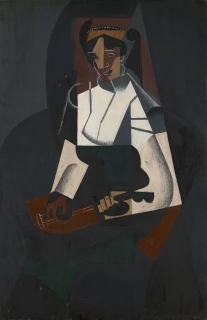
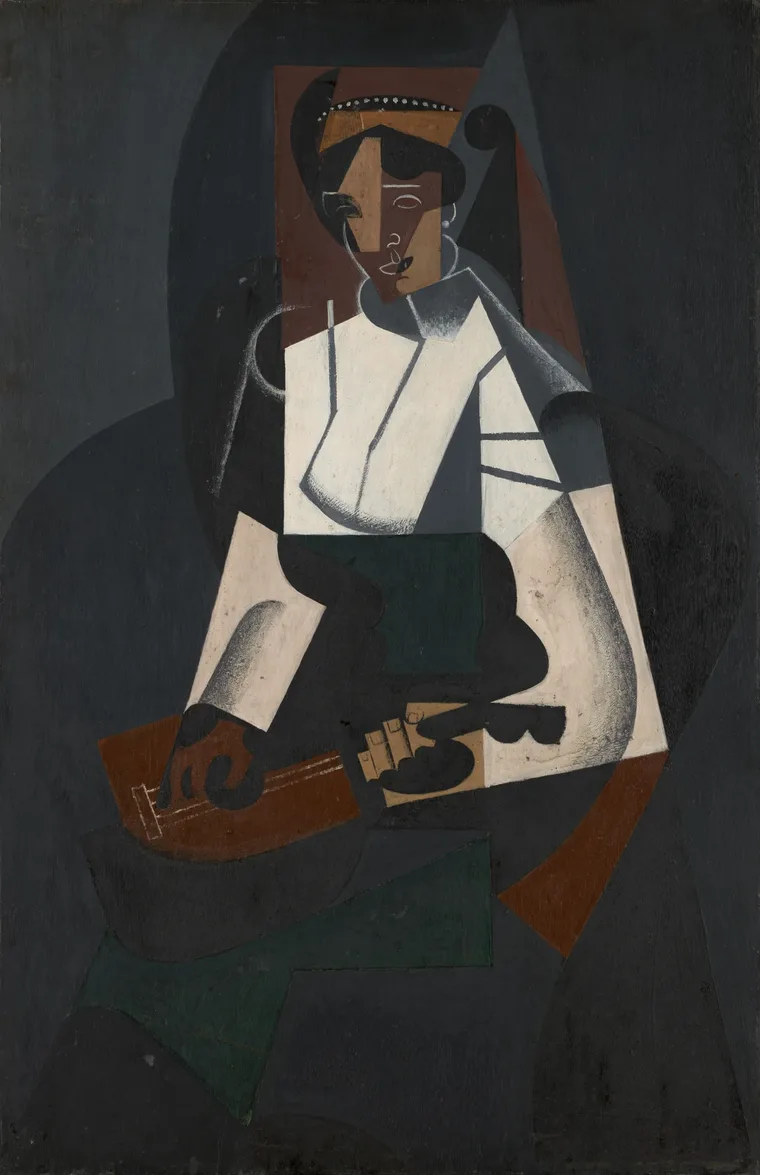
17. Woman with Mandolin (after Corot) — Juan Gris
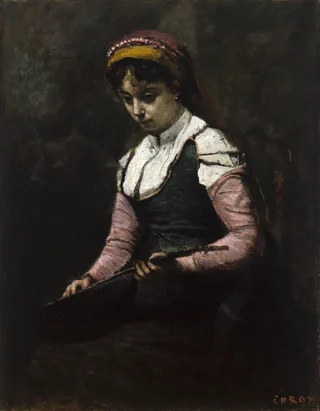
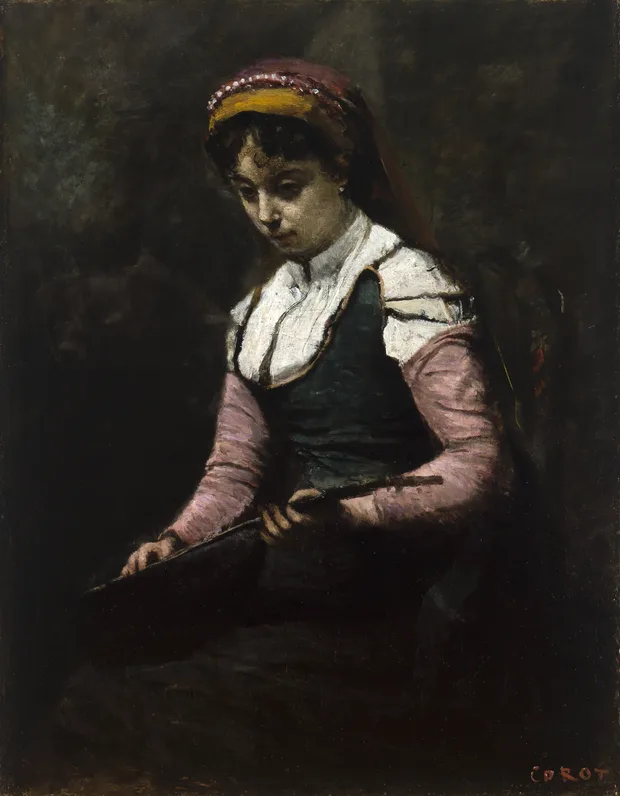
Around 1860–1865 Camille Corot painted, in his studio, a model in Italian costume who sits with a mandolin on her lap and gazes at it thoughtfully, and the picture later came to be called The Dreamer with a Mandolin. In 1916 it hung in Budapest, in the collection of Baron Mór Lipót Herzog, and today it is in the Saint Louis Art Museum. In September of that same year, 1916, Juan Gris painted his own picture after it.
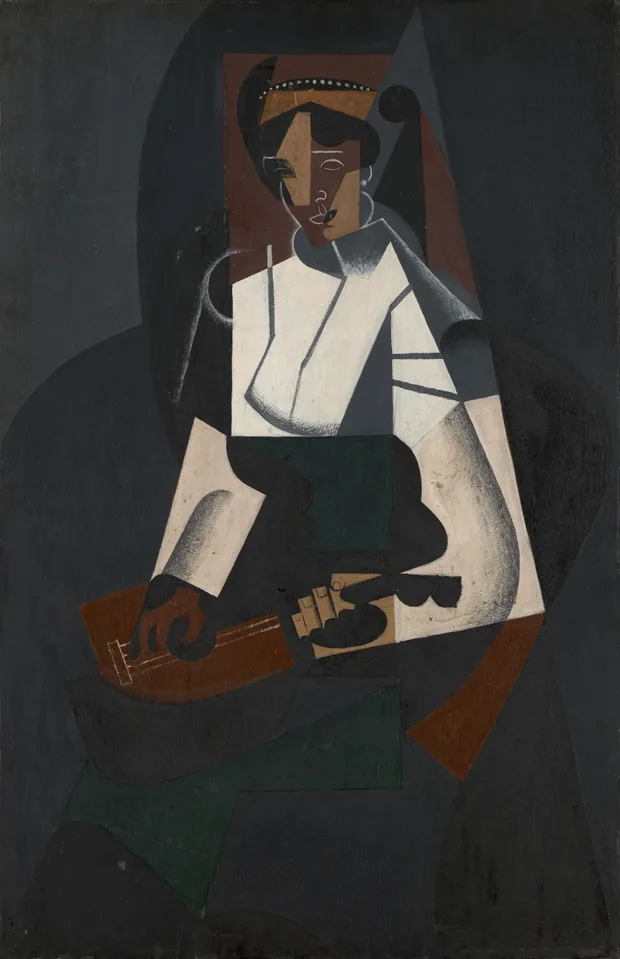
Gris repeated Corot's details: the band in the hair with its row of small beads, the pearl earring, the white chemise under the dark bodice, the mandolin across the knees with its body to the left and its neck to the right, and the tilt of the head. Of Corot's colour he kept almost nothing, and the picture is painted in slate grey, black, chalk white, dark bottle green and rust brown. The face is divided into a light half and a dark half, one eye is outlined with a thin white line, the mandolin has become a rust-brown board with strings scratched in white, and the rounded ends of the white sleeves are shaded with a fine grey speckle that looks sprayed on.
Gris was born in Madrid in 1887 and had lived in Paris since 1906. In 1916 his dealer, Daniel-Henry Kahnweiler, a German national, was sitting out the war in Switzerland, and in May Gris signed a contract with Léonce Rosenberg. That same year he began painting figures and made drawings after Raphael, Velázquez and Cézanne.
The picture was given to Basel by Raoul La Roche, the son of a Basel banker, who worked at a bank in Paris from 1911 to 1954. From 1918 he was a friend of the architect Le Corbusier and the painter Amédée Ozenfant, who helped him collect the Cubists, and Le Corbusier built the Villa La Roche in the Paris district of Auteuil for him and his collection. In 1952, 1956 and 1963 La Roche gave Basel 90 Cubist and Purist works, and after that people began travelling to Basel to see Cubism. Gris painted Woman with Mandolin in oil on plywood, and the vertical grain of the wood shows through the thin grey paint of the background, most clearly in the upper right corner.
18. The River Bank — Henri Matisse
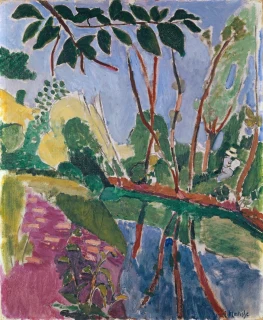
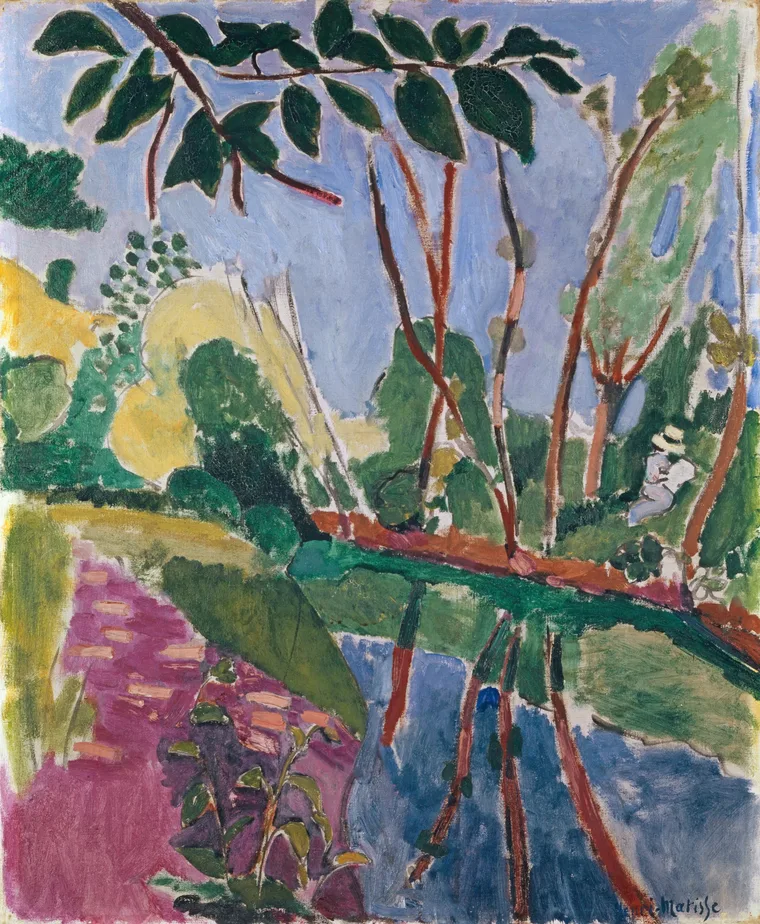
On 30 June 1939 in Lucerne the director of the Basel museum, Georg Schmidt, watched Matisse's The River Bank go under the hammer as lot 96 to Max Mueller of Ascona. Basel bought eight other works that day. The picture had belonged to the Museum Folkwang, whose founder, Karl Ernst Osthaus, bought it in February 1908 at the Galerie Bernheim-Jeune in Paris, a few months after acquiring the first painting by Matisse ever to enter a museum. After Osthaus's death his collection moved from Hagen to Essen in 1922, and in 1937 the picture was confiscated from there as “degenerate art”.
Matisse painted it in the spring of 1907 in Collioure, a fishing village on the Mediterranean near the Spanish border, where in those years he and André Derain arrived at Fauvism. Along the top edge runs a branch with large, dark green, almond-shaped leaves. The thin tree trunks are painted in brick-red and pink lines, and below the red-orange band of the far bank they continue as reflections in the blue water, so that each tree is drawn twice. Green, violet, red-orange and blue lie side by side in pure patches, with no black. At the right edge, among the trunks, sits a tiny figure in a straw hat, dressed in pale lilac, with something white on its lap. The signature in the lower right corner is written in blue over the water: “Henri-Matisse”.
The museum has not established who owned the picture between 1939 and 1953. In 1953, 14 years after Lucerne, Basel was offered the chance to buy it from a private collection through the dealer Ernst Beyeler, and Schmidt, still director, called it a “particularly precious work” from Matisse's classic Fauve period.
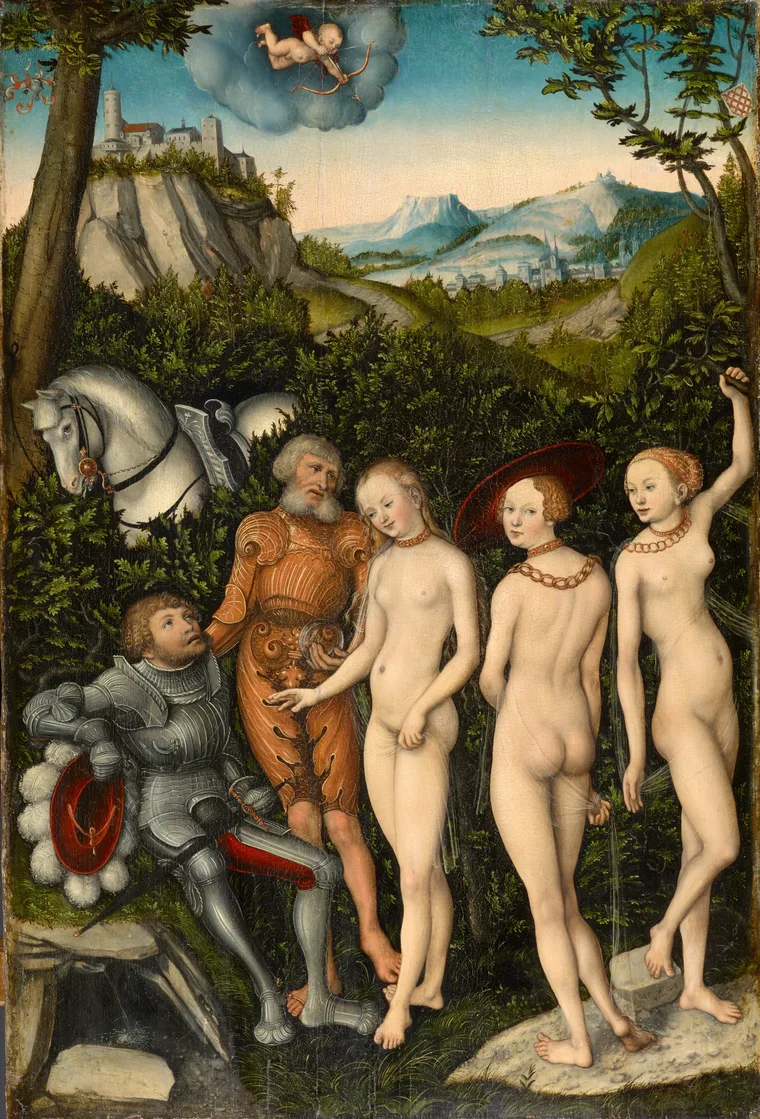
19. The Judgement of Paris — Lucas Cranach the Elder
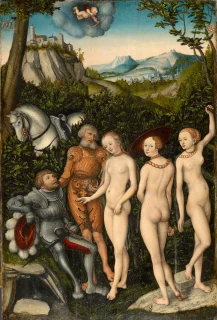
In 1933 The Judgement of Paris was on the German list of nationally valuable works of art, so when Robert von Hirsch left Frankfurt for Basel (on him, see no. 16), he was not allowed to take it out of the country with the rest of his collection. In March 1936 it passed to Hermann Göring through the Berlin dealer Johannes Hinrichsen, and the database of Göring's art collection records the transaction as a forced sale. Another version is often told, although historians have found no document to support it: that Hirsch handed the Cranach over to Göring as the price of permission to take out the rest. In 1937 Göring lent the picture to a Cranach exhibition in Berlin. After the war it was restituted to Hirsch on 31 August 1954, and in 1977 it came to Basel as a gift of Martha and Robert von Hirsch.
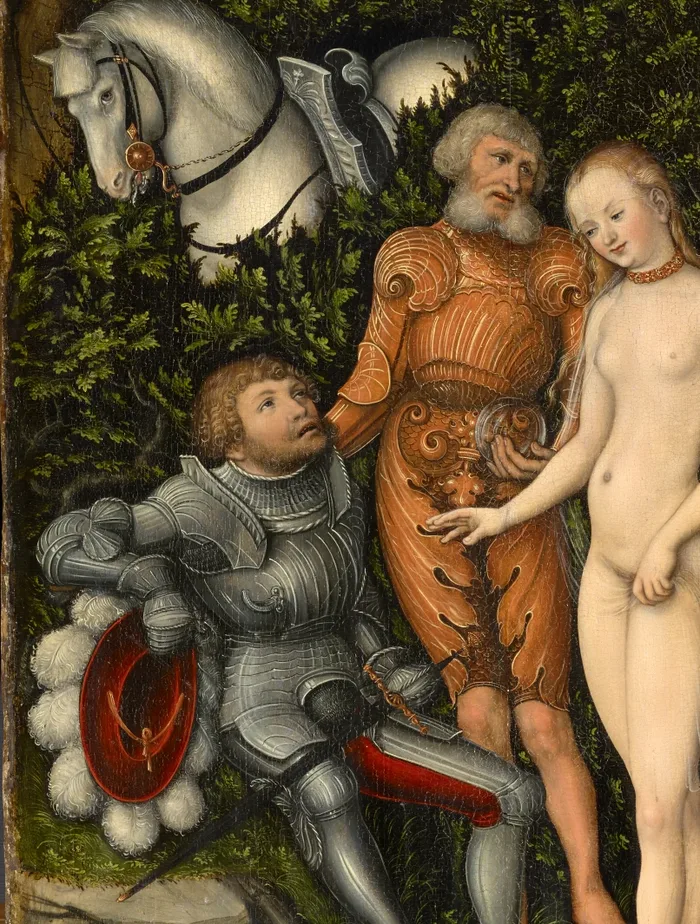
On the left sits Paris in silver armour, curly-haired and bearded, with a hat with white ostrich plumes and a sword at his feet. Above him stands Mercury, a grey-bearded old man in fantastic copper-orange armour covered with shells and spirals, holding a glass sphere. On the right are the three goddesses, naked except for transparent veils that show as thin lines at their hips and arms. The middle one stands with her back turned, in a broad red hat and a heavy gold chain, and looks over her shoulder straight at the viewer. From a cloud above, Cupid takes aim at them, and behind the trees a castle on a rock, a town and blue mountains can be seen. On a stone under the foot of the goddess on the right, Cranach put “15” and “28”, and between them the mark of his workshop, a winged serpent.
On the back of the panel the typed label of the 1937 Berlin exhibition survives, and it gives the owner of the picture as “Minister-President Göring”.
A Purchase Reopened (1940, 2021–2023)
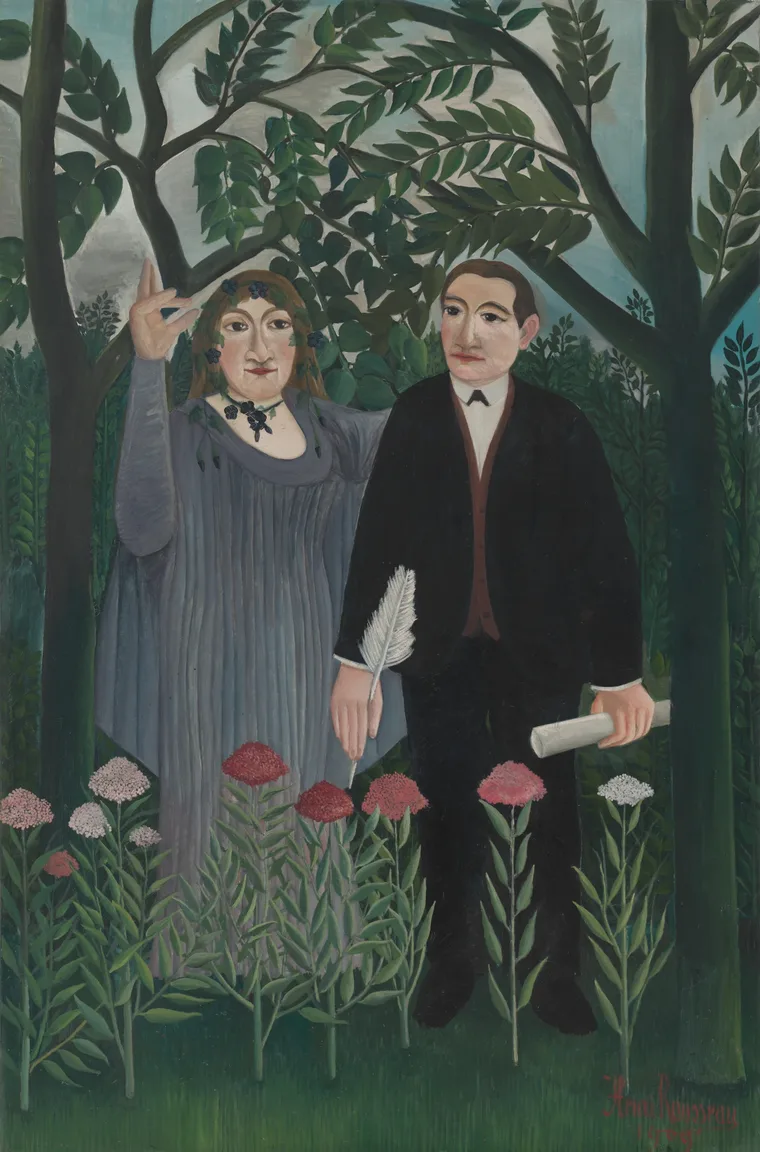
20. The Muse Inspiring the Poet — Henri Rousseau
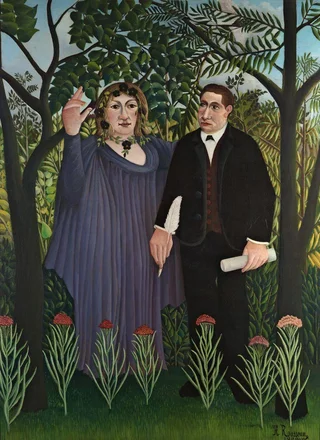
On 12 June 1940 Charlotte von Wesdehlen wrote from Geneva to Alice Bernoulli, the wife of the Basel art dealer Christoph Bernoulli, listed 12 of her paintings and added that she would like to sell one now, “because it is necessary”. Née Reichenheim, she was Jewish, the daughter of Berlin collectors, and had earlier been married to the banker Paul von Mendelssohn-Bartholdy, and in 1913 the couple bought this picture from the Paris dealer Paul Rosenberg. After their divorce in 1927 it went to her. In 1930 she married Count von Wesdehlen, a retired Prussian cavalry captain from Neuchâtel, and became a Swiss citizen. The picture crossed the Swiss border at Brig on 5 October 1935, according to the customs sticker on the back of the canvas, and Charlotte herself left Berlin in 1938. The Reich made her pay the Jewish property tax and the Reich Flight Tax on emigrants, and the two of them took her entire personal fortune.
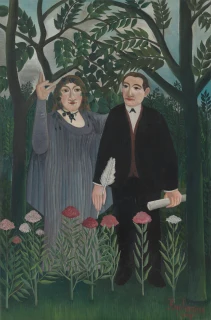
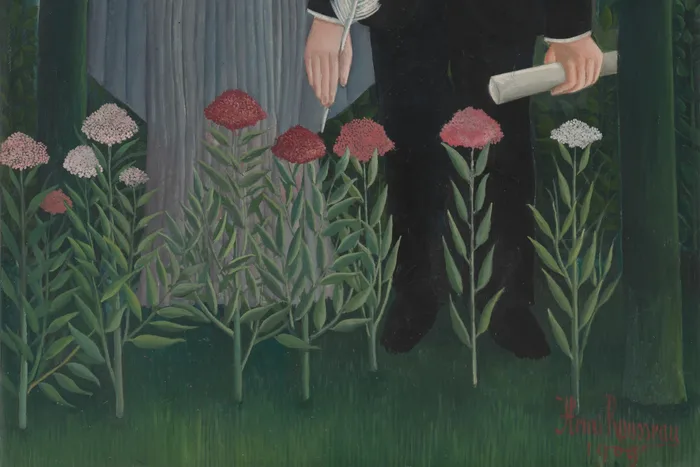
Rousseau, a self-taught painter and a former clerk in the Paris municipal customs service, painted the picture in 1909, a year before his death, on a commission from Guillaume Apollinaire, and it is a double portrait: the poet stands beside his companion, the painter Marie Laurencin, who appears as the Muse. In the first version, now in the Pushkin Museum in Moscow, Rousseau painted stocks instead of sweet williams, which the French call “poet's carnations”, and Apollinaire joked about it in a newspaper. In the second version, the one in Basel, a row of tall sweet-william stems with flat heads of small flowers, pink, white and dark red, stands in front of both figures. The Muse, in a long grey-lilac robe, has raised her right hand with the index finger pointing upward, and there are dark flowers with green leaves in her hair and at her neck. Apollinaire, in a black suit, looks straight ahead, with a white quill in his right hand and a rolled sheet of paper in his left, and above them the branches of the trees meet in an arch of separately outlined leaves. Apollinaire recalled that at the first sitting Rousseau measured his nose, mouth, ears, forehead, hands and whole body and transferred the measurements to the canvas, scaled down. In 1913, a year after his break with Laurencin, Apollinaire gave the picture to Rosenberg to sell.
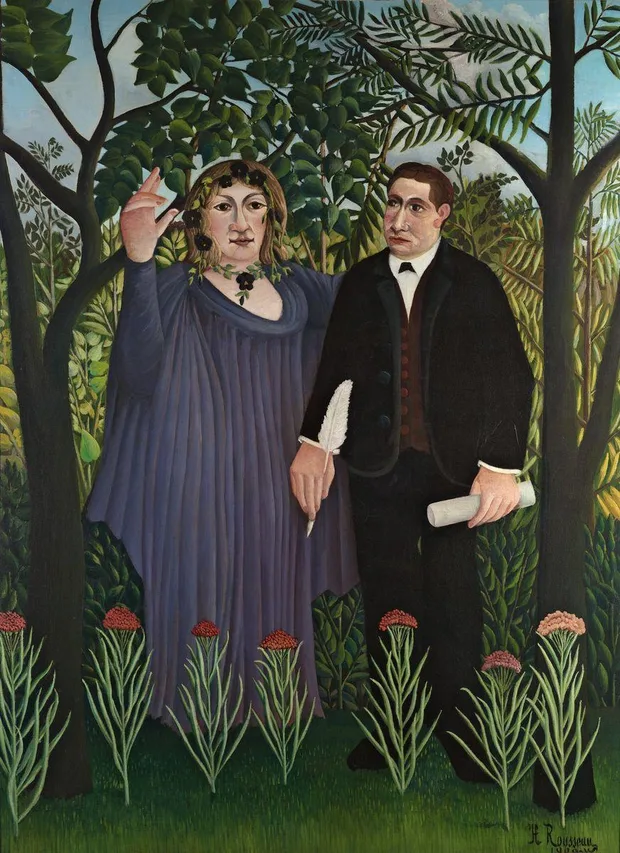
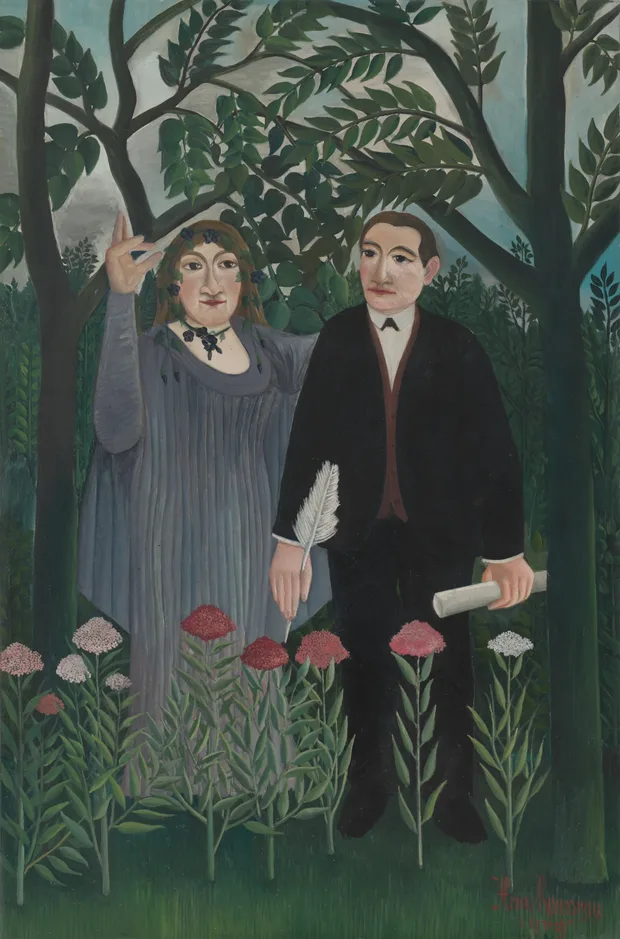
In the summer of 1940 the museum's director, Georg Schmidt, first told Charlotte von Wesdehlen that the museum had no money, because everything was going on moving the collection into bomb-proof stores, and then at the end of July went to see her in Geneva himself. On 1 August he wrote to Bernoulli that he had brought her down “from the heights of falsetto to the ground of reality”, that she seemed to “have to sell at any price”, and that if he put 12,000 on the table she would grab it. To the collector Rudolf Staechelin, who had advanced the museum the money, Schmidt wrote that “everyone involved knows that this is basically a shamefully low price” for one of Rousseau's classic masterpieces. In the minutes of the Art Commission of 2 September 1940 Schmidt called the offer one of the “strokes of luck to be expected as a consequence of the war”. The museum paid 12,000 francs, although in normal times, by Schmidt's own account, the picture would have fetched 30,000 to 40,000. Charlotte von Wesdehlen never complained about the sale afterwards, and she died in Geneva in 1946.
In 2001 the Independent Commission of Experts, which investigated Switzerland's role in the Second World War, examined this purchase as a model case of “flight assets”. That was the commission's term for property that emigrants from Germany sold in countries beyond Nazi control, as distinct from looted art. In 2021 lawyers representing one of Charlotte von Wesdehlen's heirs asked the museum to re-examine the sale, and in 2022 they demanded the return of the picture. On 20 December 2023 the Art Commission issued a 54-page decision. It states that in the conduct of the museum's people at the time “one cannot help but register an alarming degree of disrespect toward the person of Charlotte von Wesdehlen and a considerable cold-bloodedness”, and that this is “part of the history of the Kunstmuseum Basel”. The commission recognised that the sale was connected with persecution, because without the persecution there would have been no sale, and that Charlotte von Wesdehlen needed the money to live on. In 2020 the museum had already reached a similar settlement over prints it bought in 1933 at the sale of the collector Curt Glaser's collection. The commission refused to return the Muse, but supported negotiations on financial compensation “in an appropriate amount”.
What Else to See
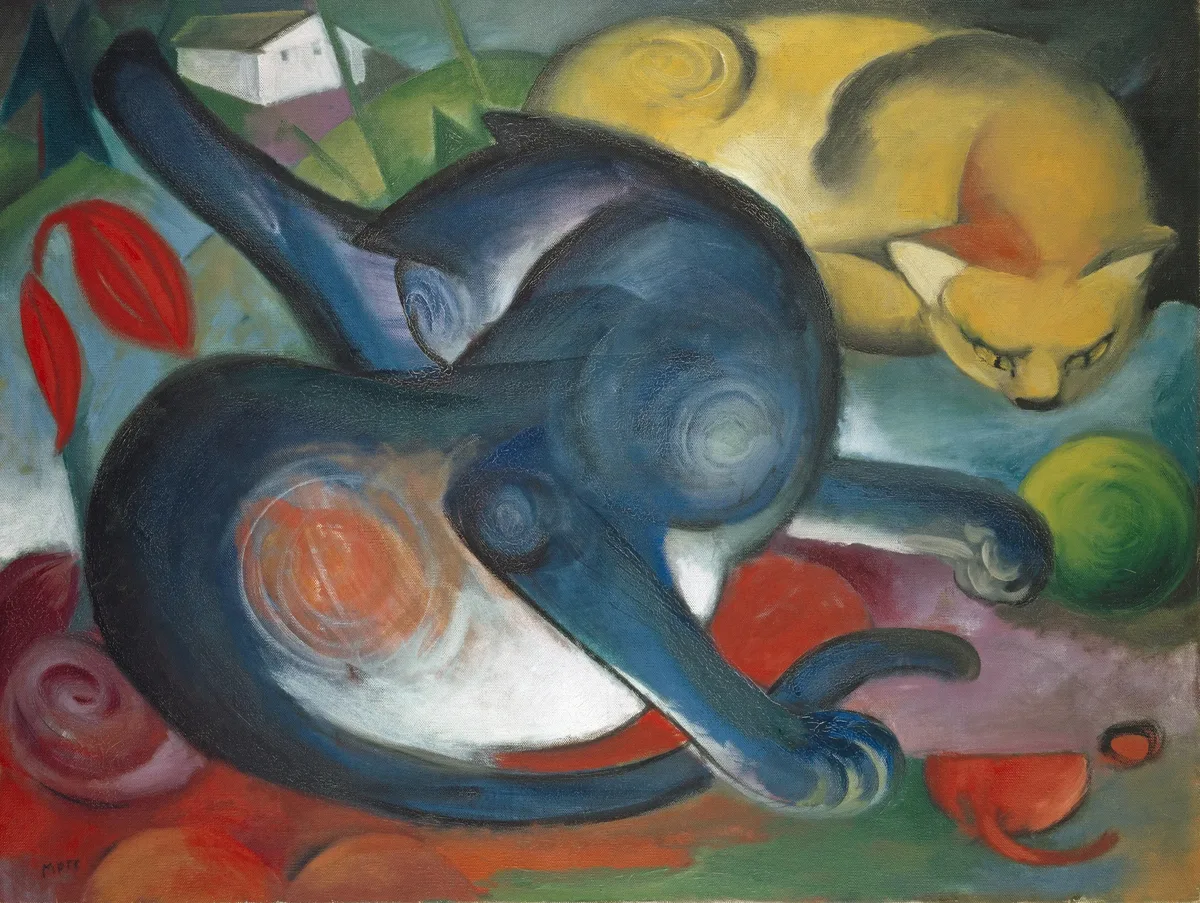
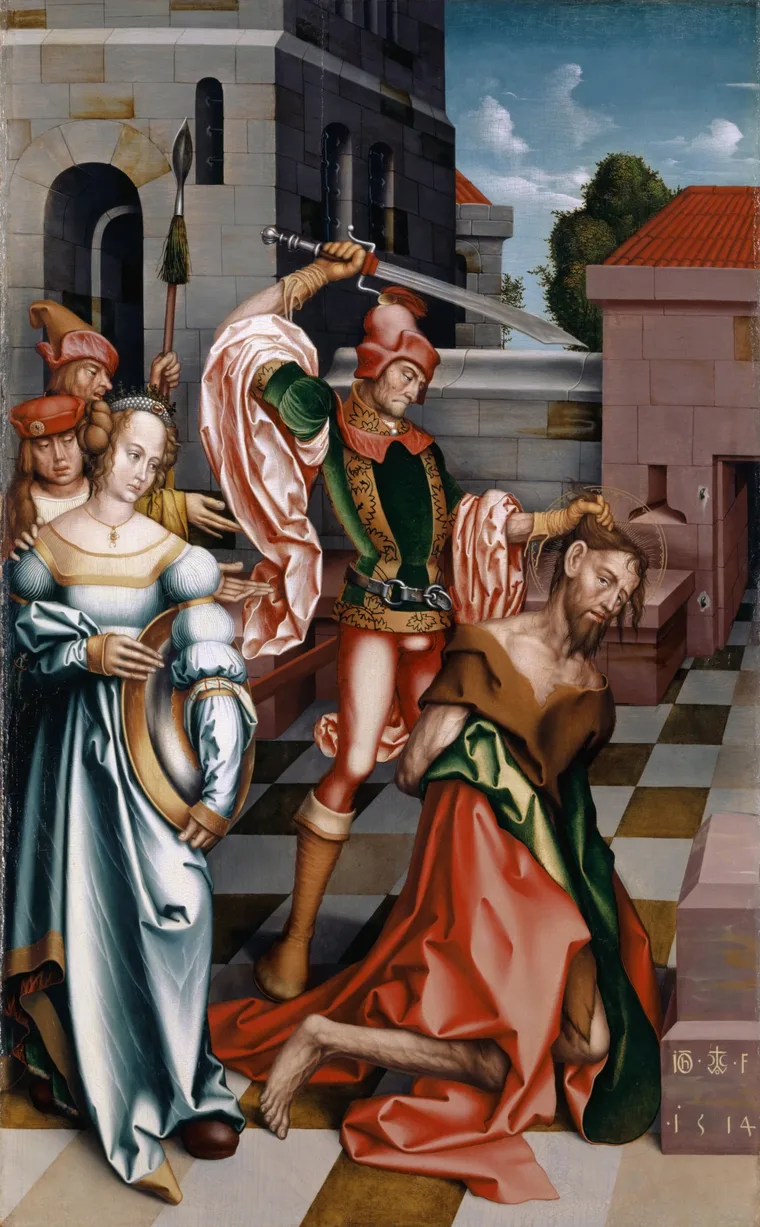
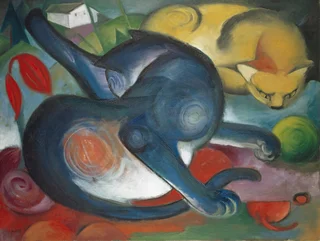
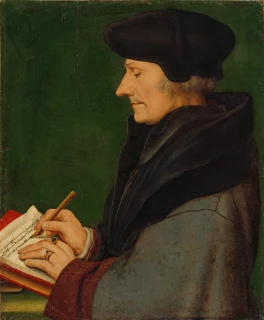
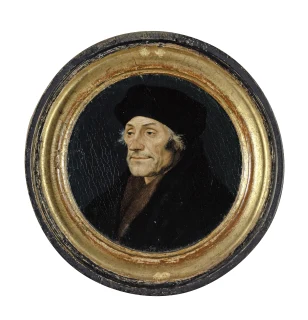
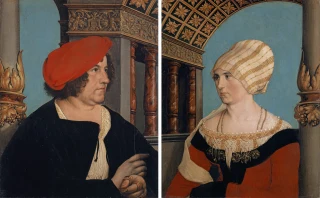
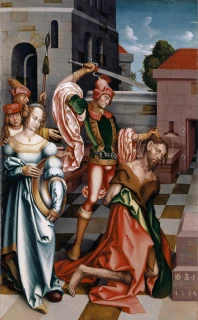
Two paintings by Picasso, The Two Brothers and Seated Harlequin, were bought by the city after the people of Basel voted for the purchase in a referendum in 1967, and Picasso, in gratitude, gave the museum four more works. From the purchases of the summer of 1939 the collection also has Oskar Kokoschka's The Bride of the Wind, Marc Chagall's The Pinch of Snuff and Franz Marc's Two Cats, Blue and Yellow. For more Holbein, there are the portraits of Erasmus of Rotterdam from 1523 and 1532 and the early diptych of Jakob Meyer zum Hasen and his wife from 1516. In The Idiot Prince Myshkin recalls one more picture he saw in Basel, and it is usually identified as The Beheading of Saint John the Baptist by Hans Fries, from 1514, which also belongs to the museum. The Kupferstichkabinett, the department of prints and drawings, which holds most of the museum's more than 300,000 works, also keeps the drawings from the Amerbach cabinet.