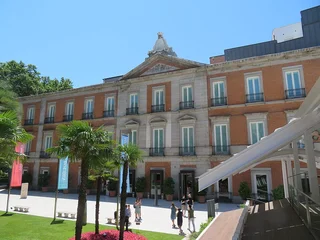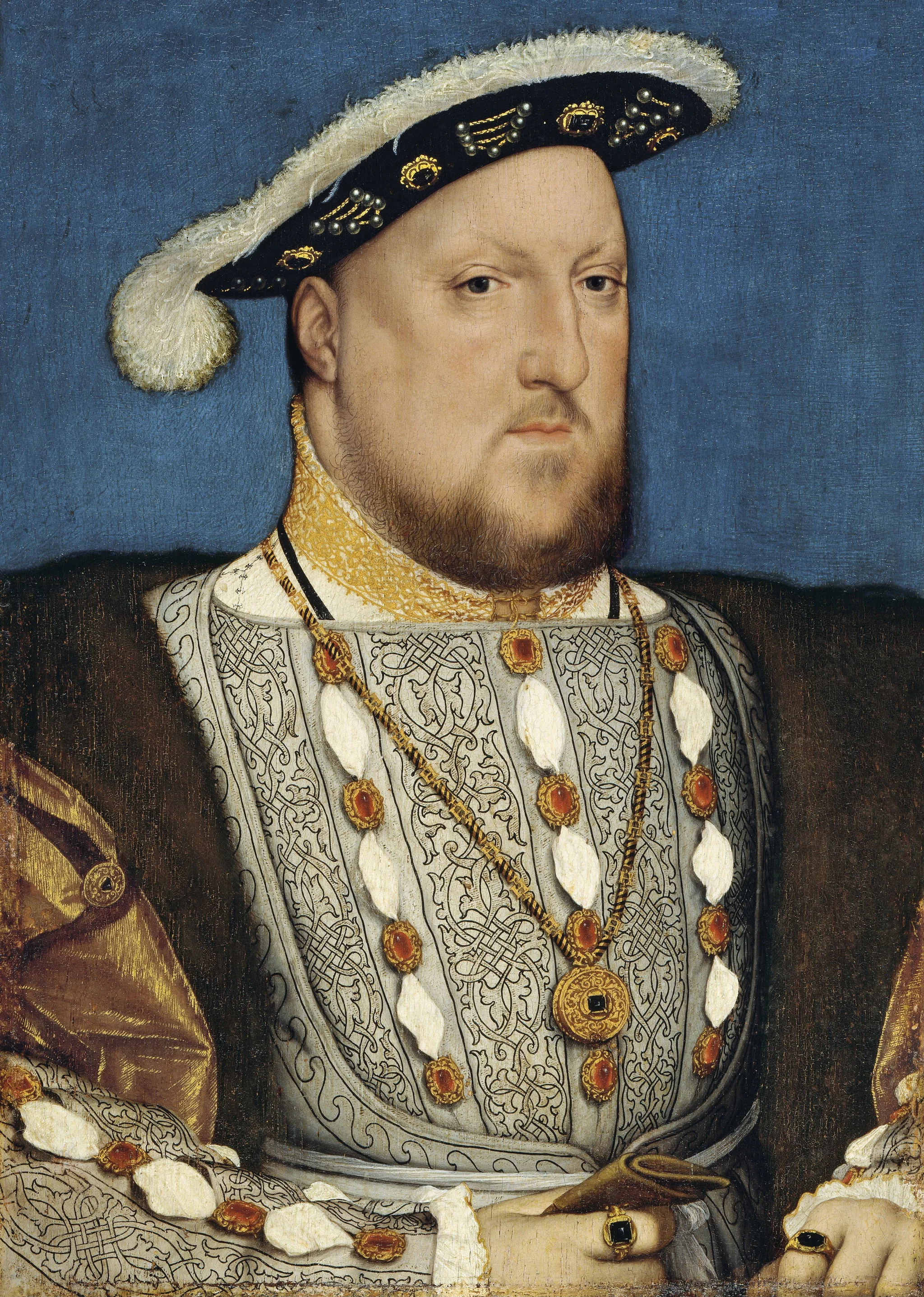
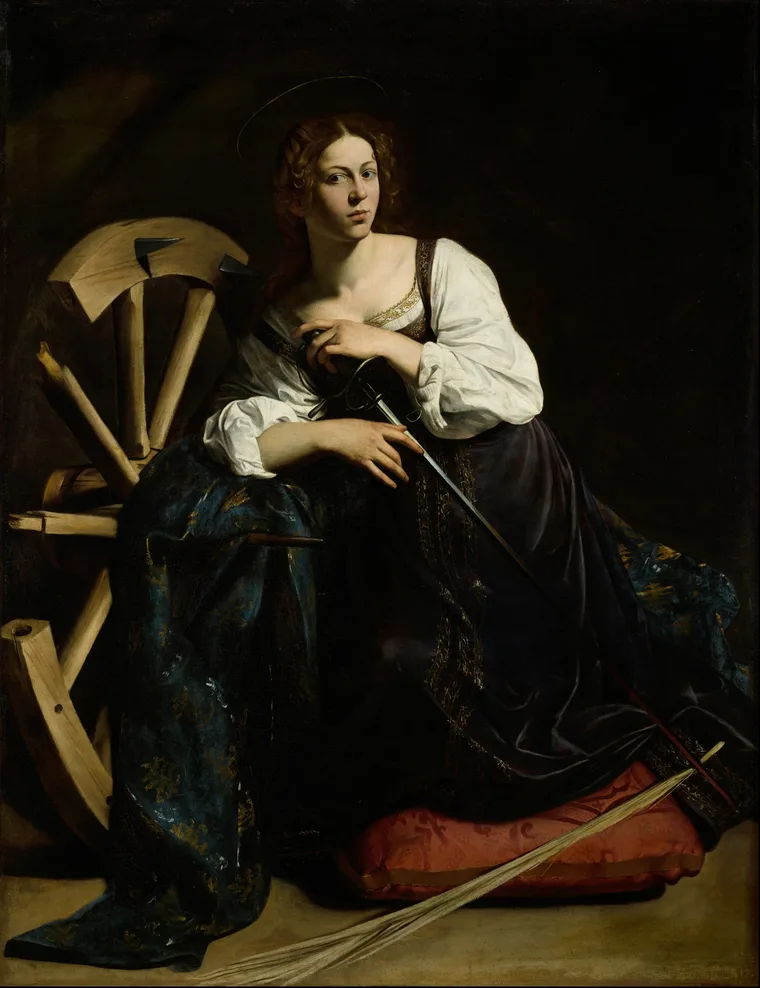
In 1934 three pictures entered the collection of Heinrich Thyssen-Bornemisza one after another, and in the inventory of the Madrid museum they carry consecutive numbers, 1934.37, 1934.38 and 1934.39. They are Caravaggio's Saint Catherine of Alexandria, Albrecht Dürer's Jesus Among the Doctors and Hans Holbein the Younger's Portrait of Henry VIII. The first two came from Palazzo Barberini in Rome, the third from Althorp, the Spencer family's English country house, and the baron bought all three that same year from dealers in Lucerne.
The first four digits of a museum number give the year the picture entered the collection of whoever was buying at the time. Two men did the buying, a father and his son. Heinrich began in the late 1920s, and from 1961 his youngest son, Hans Heinrich, added German Expressionists, the Russian avant-garde and American 19th-century painting to the old masters and carried the collection into the 1970s, with Edward Hopper's Hotel Room and a portrait by Francis Bacon among the later pictures.
We begin with a diptych by Jan van Eyck bought in 1933 and end with a street scene by Camille Pissarro, over which the heirs of its former owner have been suing the museum's foundation in California since 2005.
A Ruhr steel heir buys from old families (1933–1935)
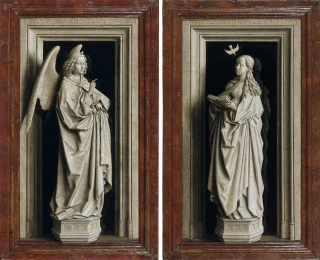
1. The Annunciation Diptych — Jan van Eyck, c. 1433–1435
Heinrich Thyssen was born in 1875 into the family of the Ruhr industrialist August Thyssen. In 1906 he married Margit, daughter of the Hungarian Baron Bornemisza, who had no sons. In 1907 his father-in-law adopted him, and Heinrich became Baron Thyssen-Bornemisza. The family lived at Rohoncz Castle, now Rechnitz in Austria, and after the 1919 revolution in Hungary moved to the Netherlands. The baron began buying on a large scale in the late 1920s, after his father's death, and according to the museum he wanted to build a collection as broad as those of the great German museums, above all the Alte Pinakothek in Munich. In July 1930 his pictures were shown in public for the first time, at the Neue Pinakothek in Munich, as “the Schloss Rohoncz Collection”. In 1932 he bought Villa Favorita in Lugano and built a gallery there, which he opened to guests in September 1936. He bought most heavily in 1933–1935, and the museum's list of those purchases begins with the van Eyck.
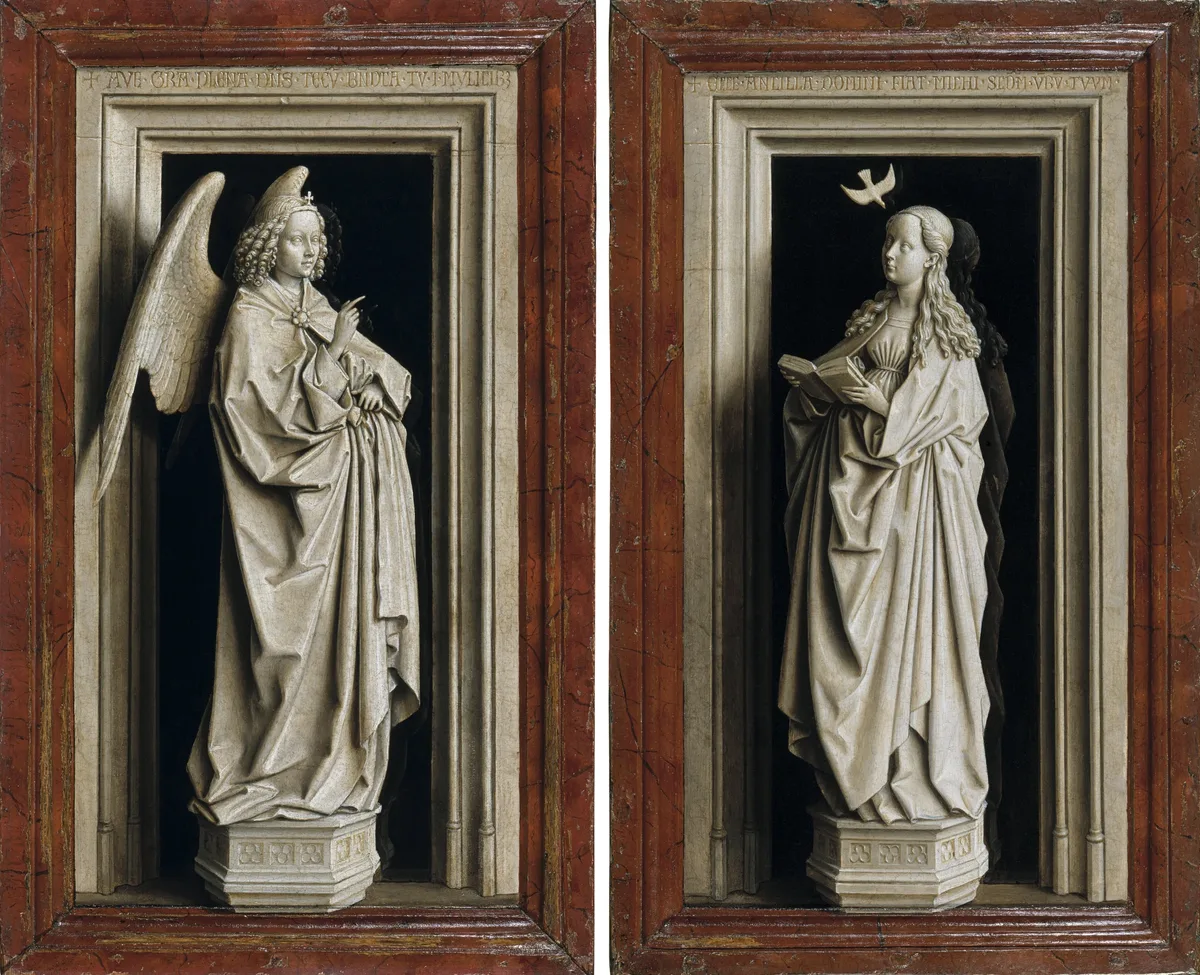
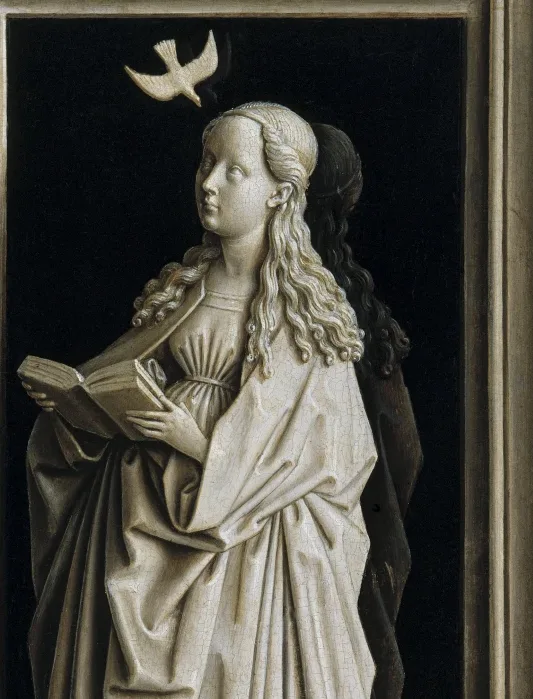
Van Eyck painted two separate small wings, the Archangel Gabriel on the left and Mary on the right, and made both figures look like statues of white stone. The diptych holds only greys and whites, black, and the red-brown marble of the frames, which van Eyck also painted himself. Each figure stands on a hexagonal pedestal in a shallow grey niche. Gabriel's wing reaches over the edge of the niche and casts a shadow on it, Mary holds an open book in both hands, and above her head a small white dove flies head down.
The back wall of each niche is painted as polished black stone, and the figures are reflected in it. To the right of Mary the dark back of her reflection shows in the black, with her long hair and cloak, and behind Gabriel, smaller, his reflected curls and a hand with a pointing finger. The museum connects this mirror with one of the titles of the Virgin, “mirror without blemish”. In 1991 the art historian Rudolf Preimesberger saw in it a contest between painting and sculpture: a statue can be walked round and seen from every side, a picture shows only one, and with the reflection van Eyck showed the back as well. On the grey stone above the figures, as if cut with a chisel, are Latin words from the Gospel of Luke, the beginning and the end of their exchange, Gabriel's greeting “Hail, full of grace” and Mary's reply “Behold the handmaid of the Lord”.
The diptych was bought in 1933, and of its previous owner the museum says only that it was a private collection in France. Max Friedländer, the connoisseur of early Netherlandish painting, published it as a work by van Eyck in 1934, a year after the purchase.
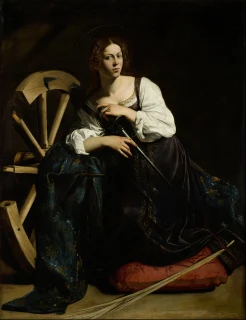
2. Saint Catherine of Alexandria — Caravaggio, c. 1598–1599
Caravaggio painted Saint Catherine for Cardinal Francesco Maria del Monte, in whose Roman house he lived in the late 1590s, and the cardinal kept it until his death in 1626. In 1628 the cardinal's heir sold it with other pictures to pay his debts, and after that it came into the hands of Cardinal Antonio Barberini, nephew of Pope Urban VIII.
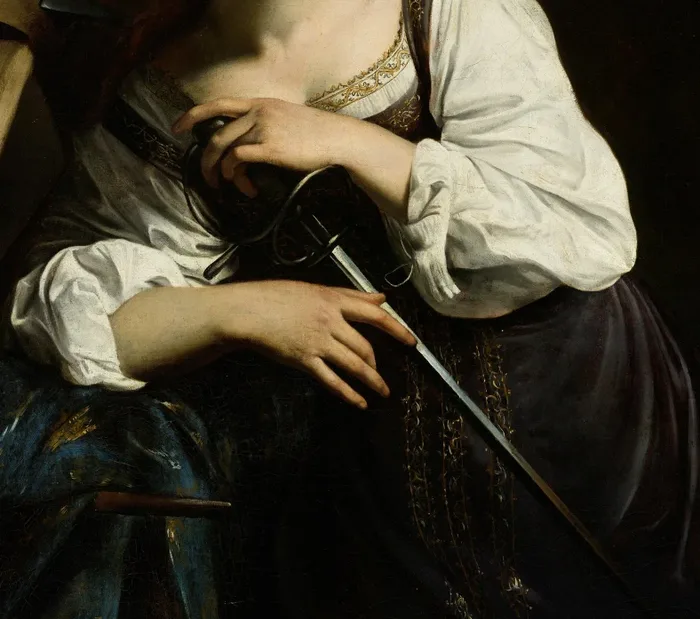
According to legend, Catherine was to be executed on a wheel set with blades, and when the wheel flew apart she was beheaded with a sword. Caravaggio gathered all these signs around her at once. She kneels on a red patterned cushion, her body turned to the left and her head turned back towards us, looking straight at the viewer. On the left stands a wooden wheel with iron blades round the rim, the rim cracked and one spoke broken, the martyr's pale palm branch lies across the lower edge, and in Catherine's hands is a rapier with a ring guard. With her left hand she presses the hilt to her chest, with her right she barely touches the blade, and the lower part of the blade glints red. Above her head there is only the thin gold ring of a halo. The light falls from the upper left, on her face, her white shirt, her hands and the steel, and the background behind her is almost black. Her dress is made of two fabrics, a bright blue with gold arabesques and a dark brownish-violet velvet with bands of gold embroidery, and she is dressed as a noblewoman of Caravaggio's own day.
The museum, like many scholars, believes the model was Fillide Melandroni, a courtesan from the painter's circle, and recognises her face in other pictures of his, although some scholars dispute the identification. In 1916 the art historian Roberto Longhi suggested that Saint Catherine was painted by Orazio Gentileschi, a follower of Caravaggio. Later research, however, confirmed Caravaggio's authorship.
The picture remained with the Barberini until 1934. Their collection was bound by a fideicommissum, a family entail that forbade selling or dividing the inheritance, and in 1934 a royal decree lifted it. The Italian state took 17 works for itself and granted duty-free export licences for 106 pictures, and that same year Saint Catherine was bought for the Thyssen collection from a gallery in Lucerne.
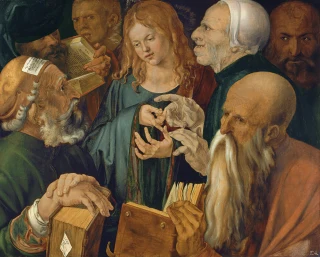
3. Jesus Among the Doctors — Albrecht Dürer, 1506
Four hands meet at the very centre of the panel. The 12-year-old Christ holds a finger of his left hand with his right, as if counting off arguments, and an ugly old man in a white cap reaches towards him with both hands, holding one palm over the boy's hands and jabbing at them from below with the index finger of the other. The old man's hands are paler and greyer than the boy's. Six scribes crowd round Christ, their faces almost touching the edges of the panel, and the dark background shows only in the upper corners and between the heads. Around 1926 Vincenzo Golzio, the author of a guidebook to Palazzo Barberini, put a question mark after Dürer's name, called the centre of the picture a “monstrous tangle of fingers” and the old man in the cap a figure “out of a nightmare”.
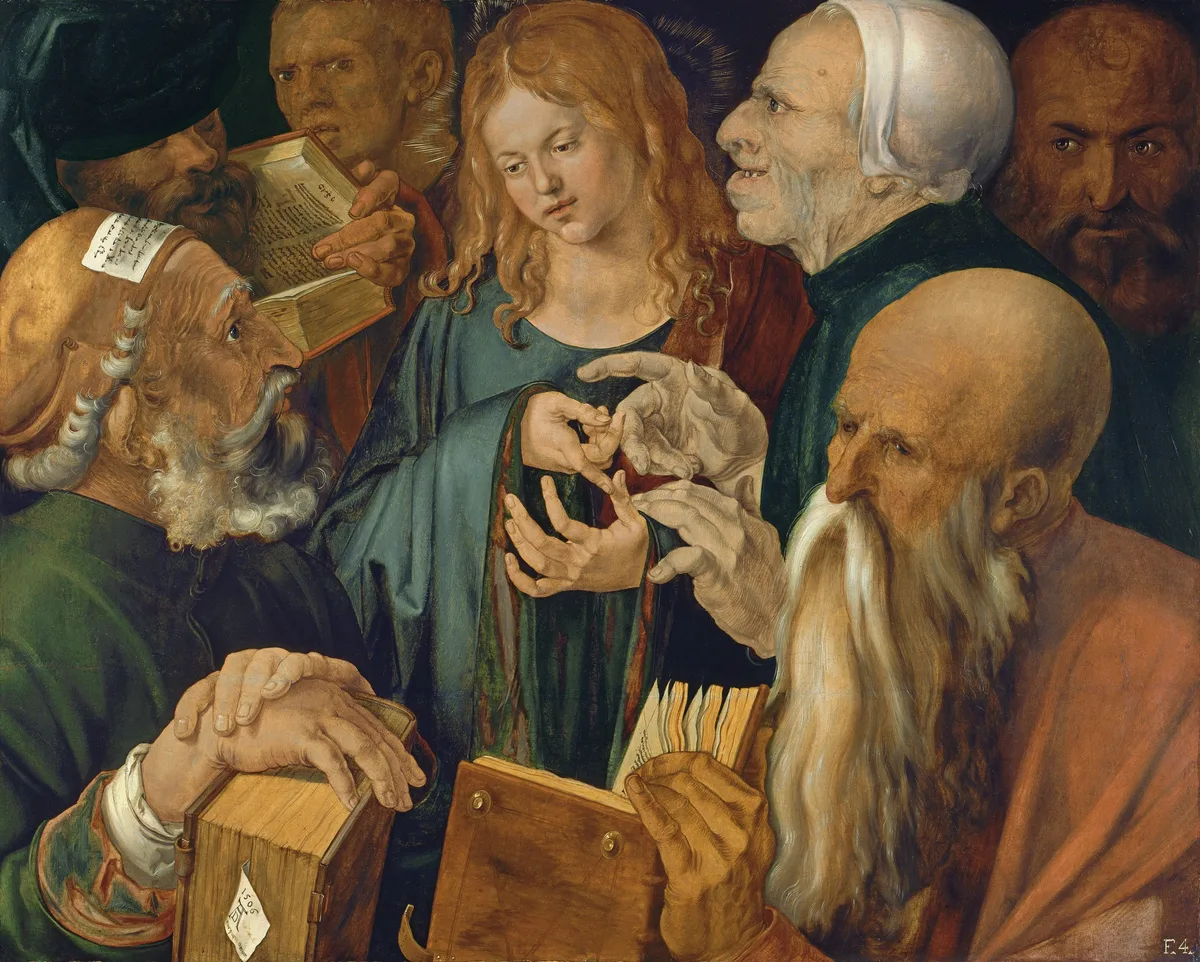
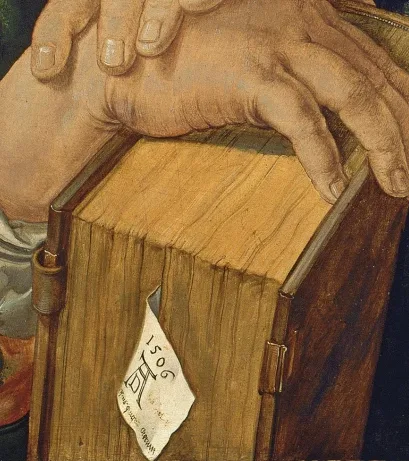
Dürer painted the panel in Venice in 1506, on his second journey to Italy, while he was working there on the Feast of the Rose Garlands altarpiece for the church of the German merchants. He had first drawn the hands with the brush on bluish Venetian paper, and these drawings are now in Vienna and Nuremberg. At lower left a white slip sticks out of a book stood on end, with the date 1506 and the monogram AD, and below them the Latin line “opus quinque dierum”, “the work of five days”. Emil Bosshard, the Thyssen collection's restorer, established in 1993 that these words were written over paint that had already dried, although he himself believed that Dürer had added them later. In 2009 the Dürer scholar Thomas Schauerte noticed that the tail of the letter Q curves round a deep crack, which means the line was written after the paint surface had already cracked, and scholars still argue over who wrote it. The museum catalogues the painting as Dürer's without qualification.
By the 17th century the panel was in the Barberini collection in Rome, and only in 1837 did it enter art history, when the German historian Georg Kaspar Nagler found it in Palazzo Barberini. It left Italy under the same decree of 1934 as Saint Catherine, and that same year it was bought for Thyssen through the Lucerne gallery Mercuria. Two Barberini collection stamps remain on the back of the panel.
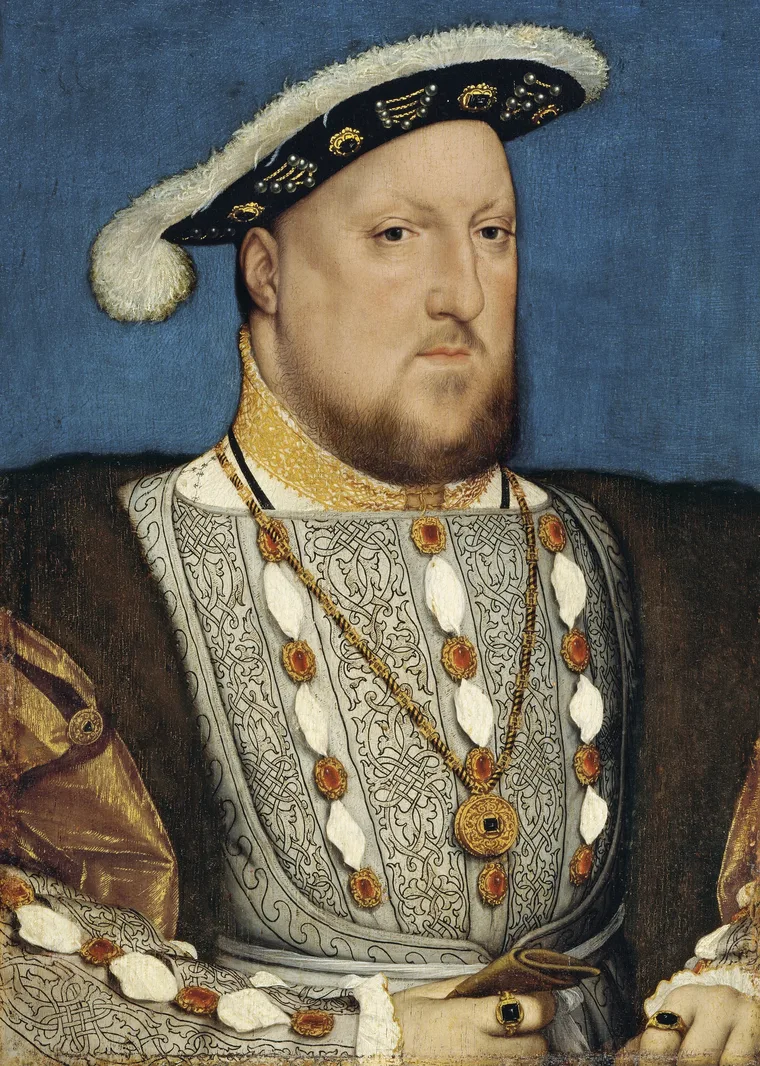
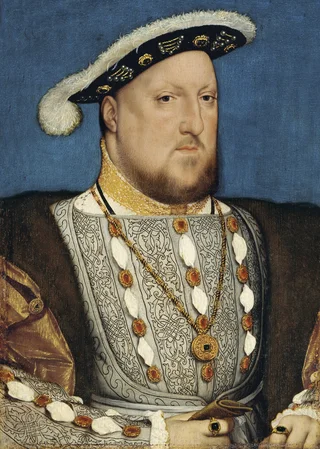
4. Portrait of Henry VIII — Hans Holbein the Younger, c. 1537
The mural that Holbein finished in 1537 on a wall of the king's privy chamber in Whitehall Palace in London burned with the palace in 1698. It showed four figures, Henry VIII and Jane Seymour in front, his parents Henry VII and Elizabeth of York behind. It is known from Holbein's own surviving cartoon in the National Portrait Gallery and from a small copy of the whole wall made for Charles II, now in the Royal Collection.
The Madrid panel is connected with this mural, and according to the museum the king's head in the copy of the wall is the same as here. Henry is shown to the waist, and his fur-covered shoulders run past both edges of the small panel. He wears a flat black cap with pearls and gold settings sewn round the brim, and a white ostrich feather curled over his right ear. His silver-grey doublet is covered in dense black embroidery, and in its slashes white puffs of shirt alternate with red stones set in gold. A long gold chain runs diagonally on one side and hangs straight down on the other, and both strands meet at a round medallion with a square black stone. In his right hand the king holds a pair of folded gloves, there are rings with dark stones on his fingers, and the background behind him is a deep blue, uneven and patchy.
Many portraits of Henry of the Holbein type survive, painted by the workshop and by later copyists. The Madrid panel remains the only painted portrait of Henry that specialists accept without dispute as Holbein's own. The museum considers it possible that the portrait belonged to the king himself, although it has not been found in the royal inventories. In the early 20th century it hung at Althorp, the Spencers' seat in Northamptonshire, and in 1913 it appeared as the colour frontispiece of the second volume of Arthur Chamberlain's monograph on Holbein, captioned “Earl Spencer's collection, Althorp”. The Spencers owned it until about 1933, in 1934 it was with the Mercuria gallery in Lucerne, and that same year it was bought for the Rohoncz collection.
According to The Art Newspaper, in 1988–1989 Prince Charles, then a trustee of the National Gallery in London, tried to borrow the portrait for London from Hans Heinrich, the baron's son (more about him in the entry on Cossa's portrait). The talks broke down over the insurance valuation, because the gallery offered 30 million dollars and the owner wanted 55 million.
5. Young Knight in a Landscape — Vittore Carpaccio, c. 1505 (dated 1510 on the painting)
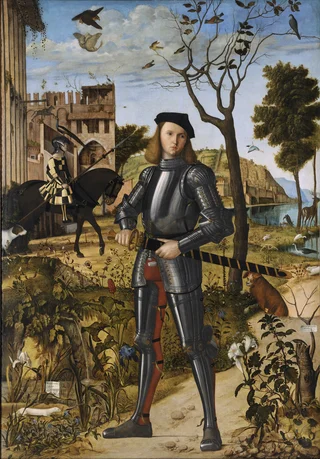
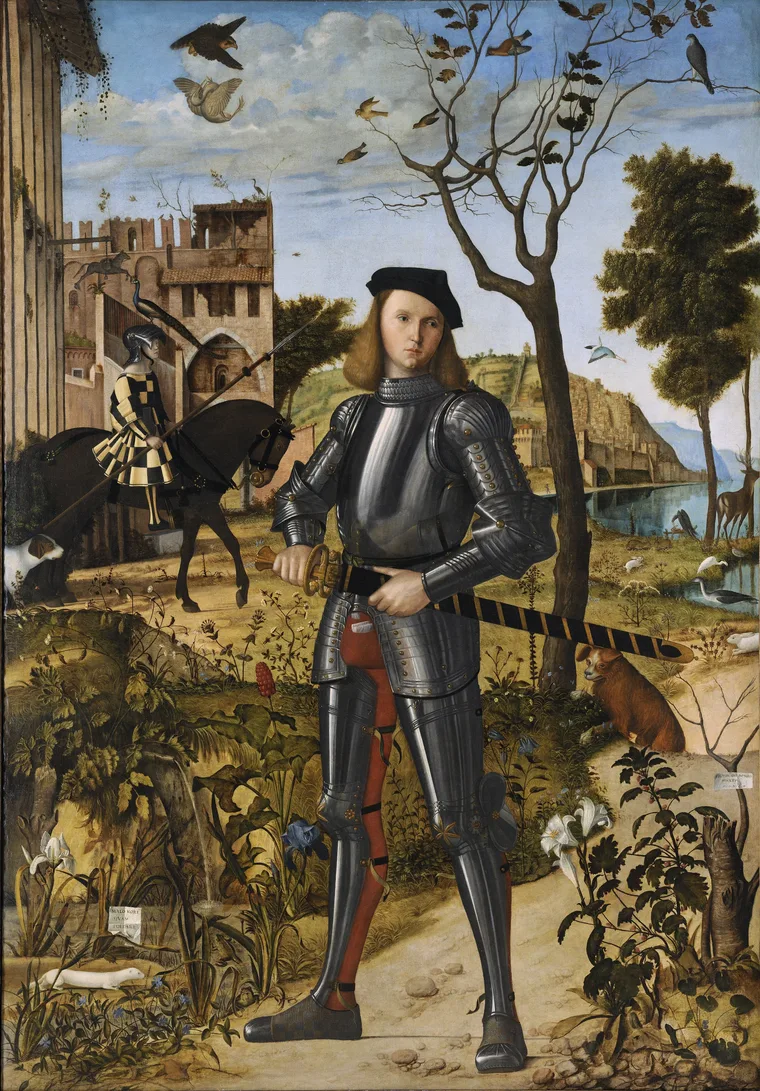
Until 1919 this knight hung at Wentworth Castle, the Yorkshire seat of the Vernon-Wentworth family, as a work by Dürer. The picture bore a forged AD monogram, and Carpaccio's signature had been painted over. In November 1919 the collection was sold at Christie's in London, where the picture was already offered as a Carpaccio, under the title Saint Eustace because of the stag by the water. It then went to the London dealer Sulley, and while it was with him the false monogram was removed. After that it was bought by the New York banker Otto Kahn, and in 1935, a year after Kahn's death, Heinrich Thyssen-Bornemisza bought it.
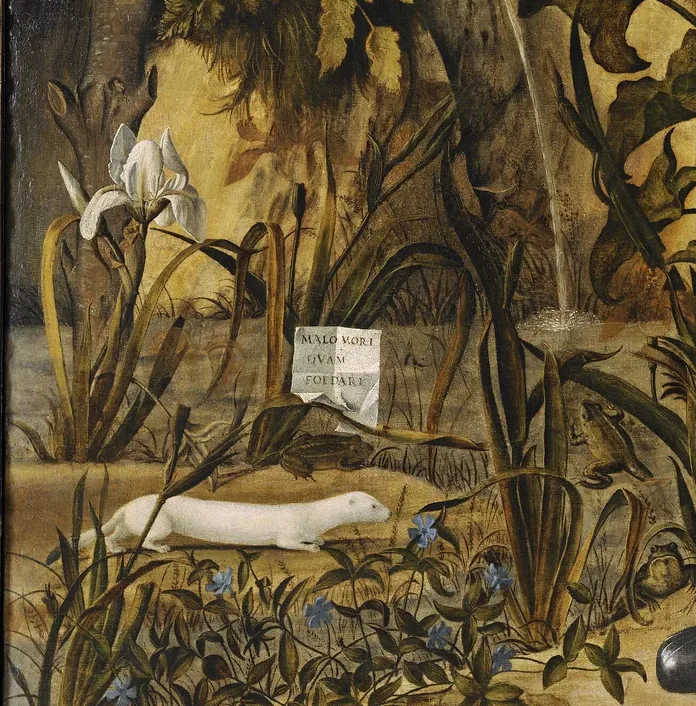
The proof of authorship came in 1958, when Heinrich's son Hans Heinrich gave the picture to the restorer William Suhr in New York and two paper slips painted on the canvas came to light under the overpaint. On the right, a slip fixed to a thin forked sapling carries the inscription VICTOR CARPATHIVS FINXIT M.D.X., “Vittore Carpaccio painted this, 1510”. At lower left, among the reeds by the water, a folded slip bears the words MALO MORI QUAM FOEDARI, “better to die than be dishonoured”, a frog sits beneath it, and a white ermine runs along the bottom edge. According to the museum, this was the motto of the Order of the Ermine, and the knight may have been a member. The museum itself, however, dates the picture to about 1505.
The young man in dark steel armour stands full length on a sandy path, long reddish hair escaping from under a black cap, his eyes turned to the right and both hands resting on the sword at his belt. On the left, in front of a tower with a gateway, a horseman in a black-and-yellow chequered doublet sits on a dark horse, a peacock has settled on the wall above his helmet, in the sky a falcon swoops on a heron that tumbles downward, a stag stands by the lake, there are rabbits and dogs in the grass, and white lilies and irises grow at the knight's feet.
The museum leaves the young man's identity open and lists the names that have been proposed. He has been seen as Francesco Maria della Rovere, Duke of Urbino, and as King Ferdinand of Aragon, and a recent proposal makes him Marco Gabriel, a Venetian who commanded the fortress of Modon in Greece. When Modon fell in 1500, Gabriel was accused of cowardice, captured and executed, and according to this proposal his family commissioned the picture to restore his honour. If it is a portrait, it is the earliest known full-length portrait in Italian painting. X-rays of the back of the canvas, under a later lining, revealed the words “A. Durer” in paint, left from the years when the picture was thought to be by Dürer.
6. Portrait of Giovanna degli Albizzi Tornabuoni — Domenico Ghirlandaio, 1489–1490
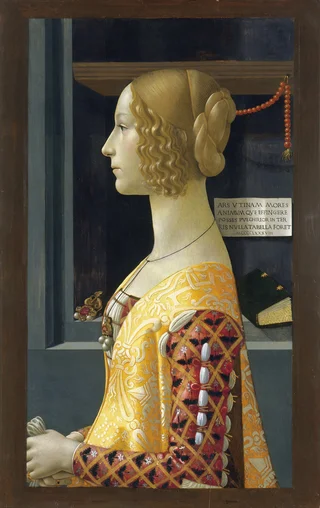
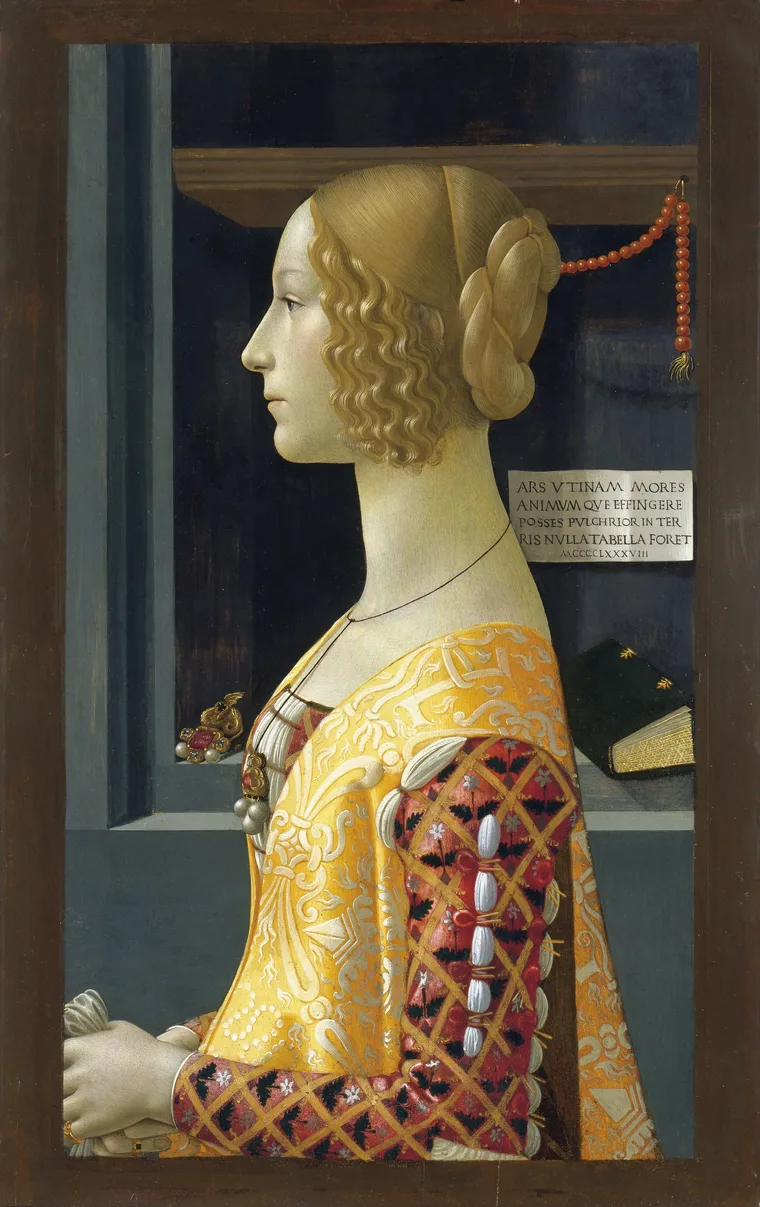
Giovanna degli Albizzi married the Florentine Lorenzo Tornabuoni in 1486, gave birth to a son in 1487 and died in October 1488, aged 19, while expecting her second child.
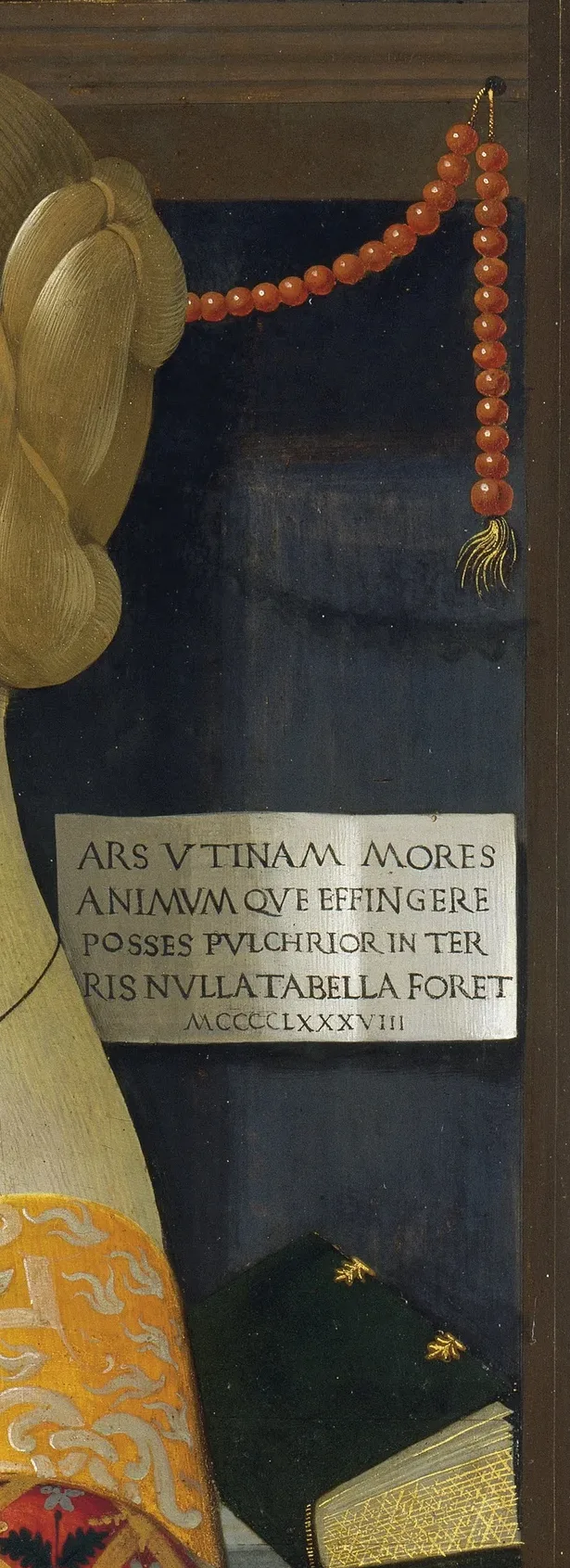
Ghirlandaio painted her in strict profile, facing left, against a dark wall. Her pale fair hair is combed smoothly back, tight spiral ringlets fall at her temple and cheek, and a plait is coiled at the back of her head. She wears an open-sided giornea of golden brocade with the letter L, her husband's initial, woven on the shoulder, and her lowered hands are folded, holding a white handkerchief. Behind her a string of coral beads with a gold tassel hangs from a nail, and on a ledge in the wall lie a closed green book and a gold brooch in the form of a winged dragon with a red stone and pearls, which she has not put on. On the right a white sheet is stuck to the wall with a Latin inscription, adapted lines by the Roman poet Martial: “Art, if only you could portray character and soul, there would be no lovelier picture on earth.” Under the lines is the year 1488, the year of her death, while the museum dates the portrait to 1489–1490.
Ghirlandaio placed her full length, in the same dress, with the same hairstyle and jewels, in the scene of the Visitation, one of the frescoes Lorenzo's father commissioned for the Tornabuoni Chapel in the Florentine church of Santa Maria Novella. The sitter of the panel was identified from a medal with her profile and name, attributed to Niccolò Fiorentino.
The portrait stayed with the Tornabuoni and in the 17th century belonged to the Florentine Pandolfini family. In the 19th century it passed through the collections of Baron Achille Seillière and the Princesse de Sagan to Henry Willett in Brighton, then to the Paris collector Rodolphe Kann, and in 1907 the American financier John Pierpont Morgan bought it. Morgan died in 1913, and in 1935 the portrait left the Morgan collection in New York for Heinrich Thyssen-Bornemisza.
The estate is divided, and the son buys back and then buys for himself (1947–1957)
7. Portrait of a Man with a Ring — Francesco del Cossa, c. 1472–1477
Heinrich Thyssen-Bornemisza died in 1947, and his heirs divided the collection. The youngest son, Hans Heinrich, known as Heini, received the largest share, and over the following years he bought back at auction the pictures his brothers and sisters put up for sale. He was born in 1921, so at the division he was 26. In 1948 the gallery at Villa Favorita opened to the public for the first time. According to the museum, at first he bought old masters with his father's taste and with the help of the same adviser, Rudolf Heinemann.
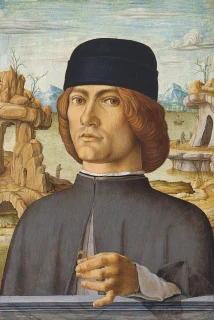
He bought Portrait of a Man with a Ring in 1956, and it is one of the first pictures he chose himself. In 2015 The Tretyakov Gallery Magazine called it his first purchase from outside the family collection. The panel came from the von Pannwitz collection at Bennebroek in the Netherlands, and in the 18th century it hung in Bologna, in the palace of the Marchesi Boschi.
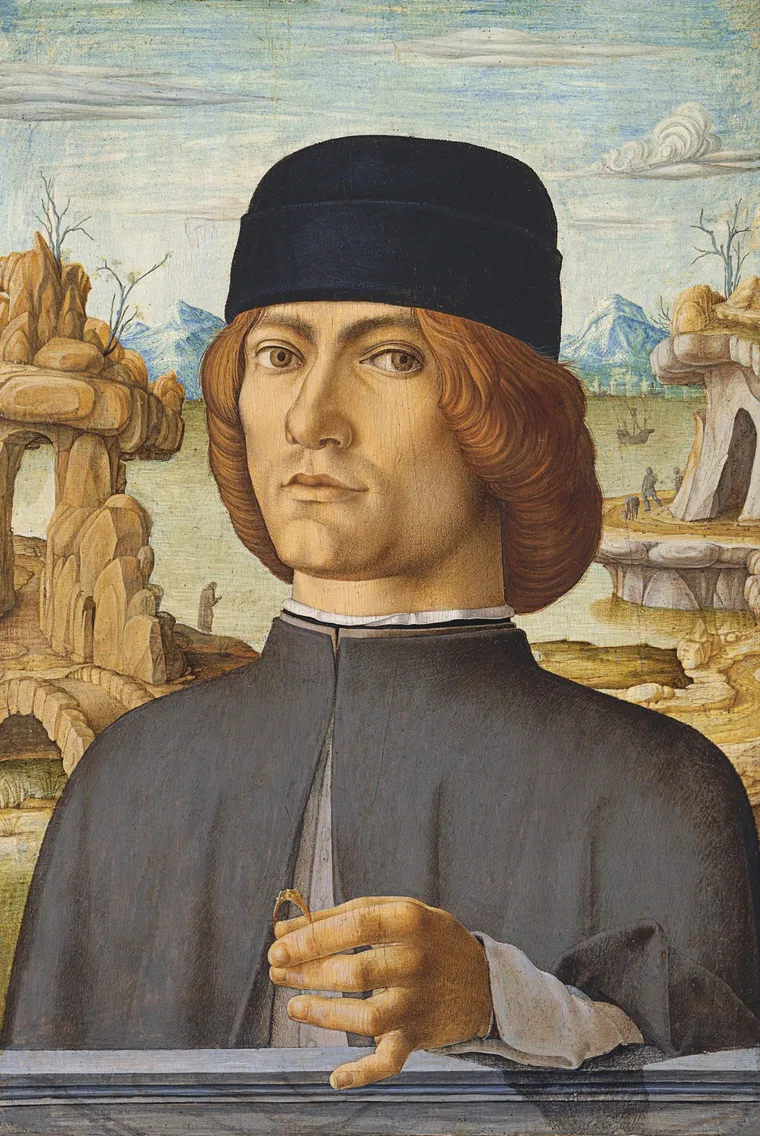
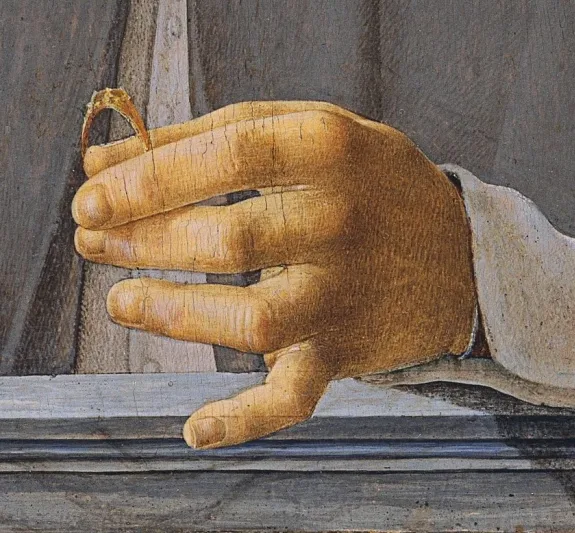
The young man has turned his head to the left and brought his eyes back to the viewer. His copper-red hair is cut level with the jaw and painted strand by strand, he wears a blue-black velvet cap and a smooth grey cloak, and the only jewel he wears is the ring. A thin gold ring with a small stone stands upright on the tip of his index finger. His hand rests on a stone parapet at the lower edge, the little finger bent over the edge of the parapet towards us, and the sleeve casts a shadow on the stone. Behind him rise towers of reddish stone slabs stacked one on another, with a natural arch and thin bare saplings on top, a tiny hooded figure stands at their foot, a ship with bare masts lies in the bay, and beyond are a town and snowy mountains.
Scholars argued for a long time over who painted the portrait. In 1913 it was published as the work of Francesco del Cossa, a Ferrarese painter who worked in Bologna in the 1470s. Bernard Berenson took it for a work by Ercole de' Roberti, Roberto Longhi argued for Cossa, and Italy's national biographical dictionary calls it the only convincing portrait by his hand. In 1915 the English art historian Herbert Cook suggested that the sitter was a member of the Este family, because the diamond ring was one of that dynasty's emblems. In the Boschi inventories the portrait was listed as a likeness of Francesco Francia, the Bolognese goldsmith and painter.
8. Venus and Cupid — Peter Paul Rubens, c. 1606–1611
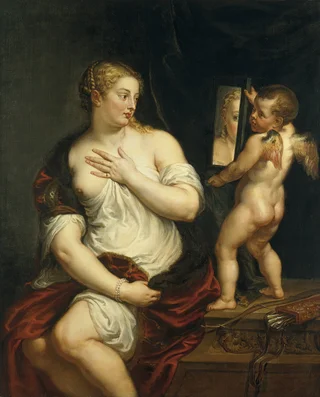
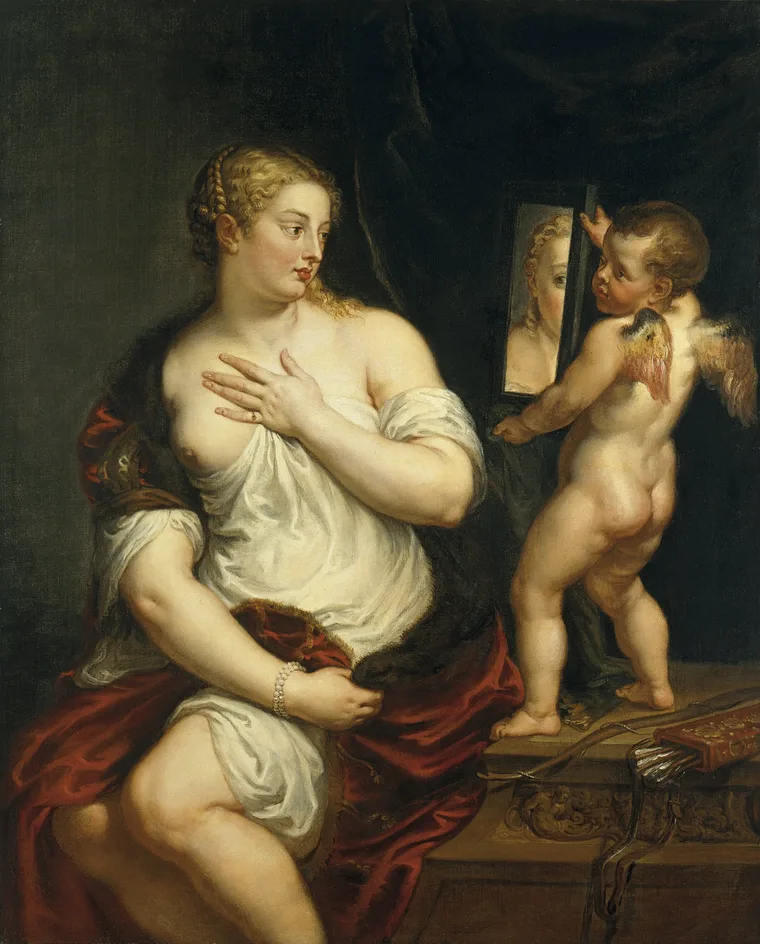
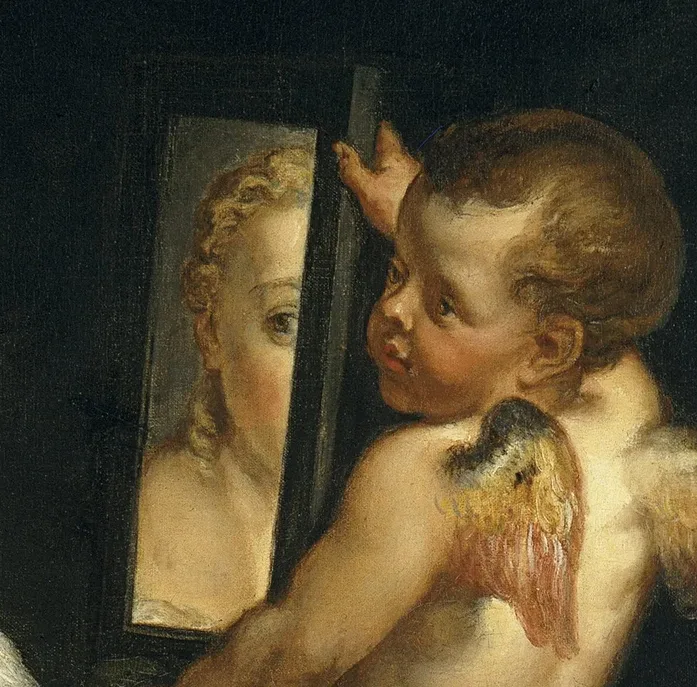
The 1636 inventory of the Alcázar palace in Madrid records a Titian in the bedroom of King Philip IV: Venus with her breast uncovered, dressed as if she had just got out of bed, in red, with a pearl bracelet on her right arm and a ring on the little finger of her left hand, and before her a naked Cupid holding a mirror in which she looks at herself.
Rubens's canvas has the same scene and the same details, and from them the museum works out which of Titian's pictures was the model. Venus sits on the left in a white shift slipping from her shoulders and a crimson cloak lined with dark fur. Her left hand lies flat on her breast, with a thin gold ring set with a small stone on the little finger, her right hand gathers the fur at her knees, and on her wrist are two strands of pearls. Cupid stands on a ledge with his back to us, holding a narrow mirror in a dark frame. Venus looks sideways at the mirror, and in the mirror her face is reflected full-face, with one eye visible, and that eye looks straight at the viewer. Cupid's quiver of arrows and his bow lie at lower right, on a ledge carved in relief.
The museum dates the canvas to 1606–1611, which means Rubens probably painted it some 20 years before he saw the royal bedroom himself, perhaps from another version of the same composition that he may have seen in Italy or in Antwerp. He copied Titian all his life and kept the copies, and the museum identifies this canvas with a picture in the inventory of Rubens's possessions drawn up after his death in 1640.
The canvas next appears in 1914, with the Brussels collector Léon Cardon. In June 1921 it was sold at auction in Brussels, in 1956 the New York firm Rosenberg & Stiebel exhibited it, then it was with a dealer at Hergiswil near Lucerne, and in 1957 Hans Heinrich bought it for the collection in Lugano. The Titian from the royal bedroom survived the Alcázar fire of 1734 and disappeared during the Peninsular War at the beginning of the 19th century.
The son buys what his father never bought (1961–1983)
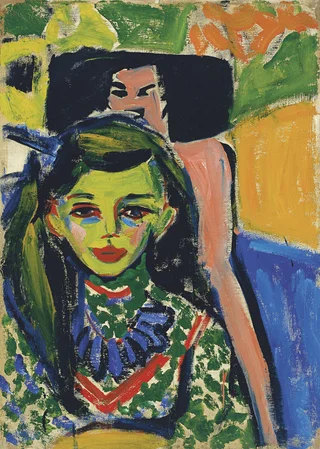
9. Fränzi in Front of a Carved Chair — Ernst Ludwig Kirchner, 1910
In early May 1961 Roman Norbert Ketterer, a dealer and the owner of the Stuttgarter Kunstkabinett auction house, gave Hans Heinrich and his wife a white carnation. After hard bidding the baron had just bought at his auction Emil Nolde's watercolour Young Couple, at the highest price yet paid for a Nolde work on paper, and it was his first purchase of 20th-century art. His father, as the museum's magazine writes, had considered 20th-century art of little interest, and Hans Heinrich himself said more than once that part of what drew him to the Expressionists was that the Nazis had branded their art “degenerate”. Soon afterwards Ketterer, who according to the museum needed money at the time, offered the baron two Kirchners from his own collection, Doris with Ruff Collar and Fränzi in Front of a Carved Chair.
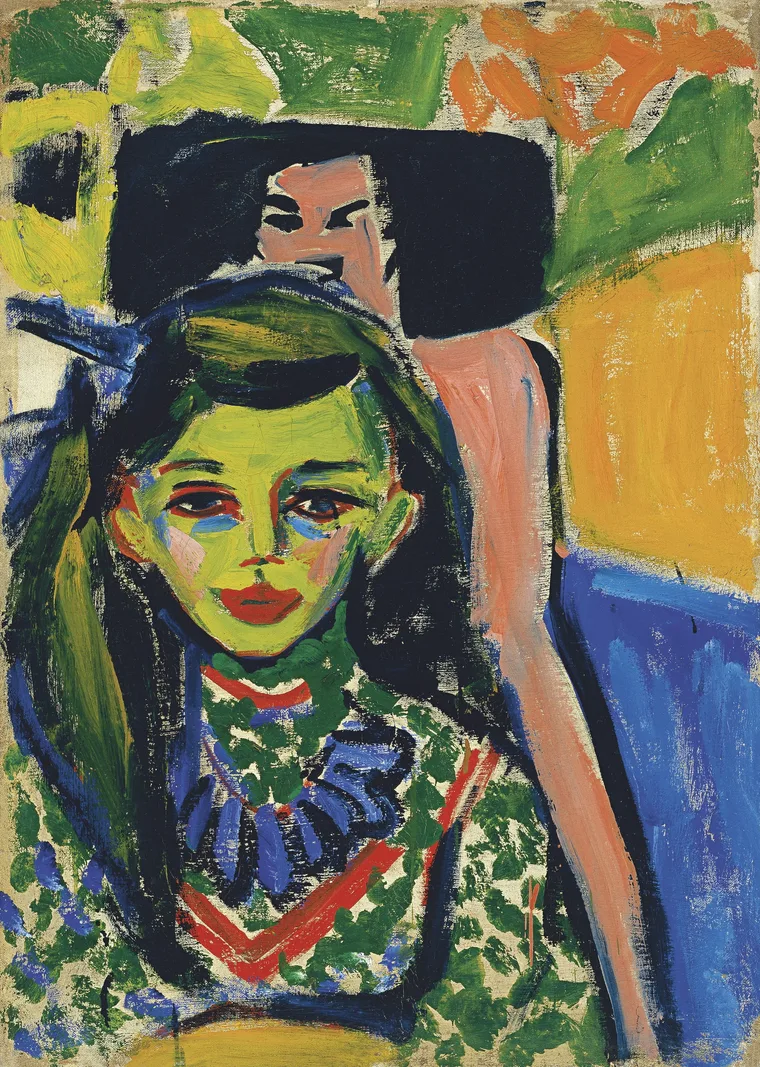
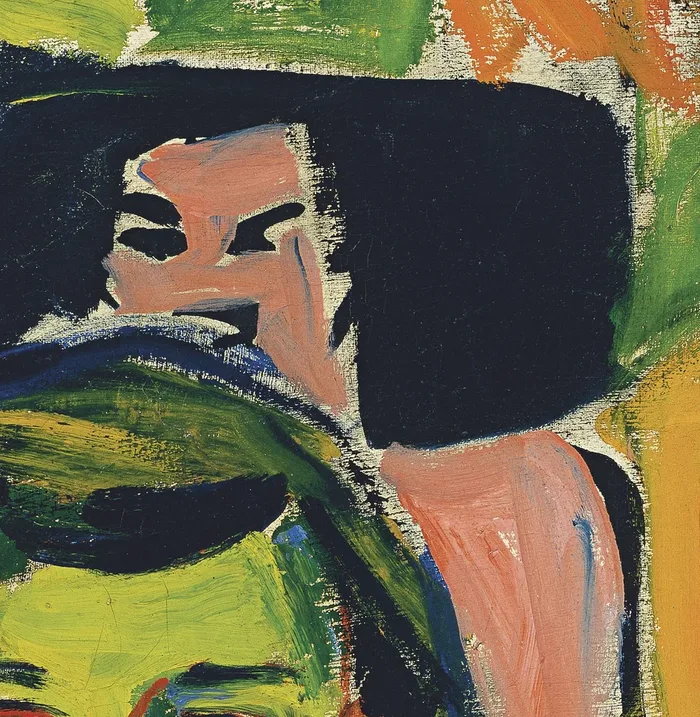
Ernst Ludwig Kirchner, one of the founders of the Dresden group Die Brücke, painted Fränzi in 1910, when she was nine. Her face is an acid yellow-green, her eyes are ringed with red with blue strokes beneath them, her mouth is bright red, dark hair streaked with green falls to her shoulders, and a large blue necklace of diamond-shaped strokes lies on her chest. Behind her head is the black back of the chair, and a pink female figure is carved on it, a pink face with black slits for eyes and mouth just above the girl's head and a long pink arm running down the right edge of the picture. According to the museum, Kirchner most likely carved the chair himself. Many years later he wrote that in the Dresden Ethnographic Museum he had seen carved beams from the Palau Islands whose figures were made in the same language of forms as his own. The strokes are laid on quickly, and bare canvas glows between the patches of the dress and around the hair.
Until the 1990s the girl was known only by her nickname. The Kirchner scholar Gerd Presler found the surname Fehrmann in a note the artist made in 1926, and through parish and civil registers she was traced as Lina Franziska Fehrmann, born in Dresden in 1900 into a working-class family.
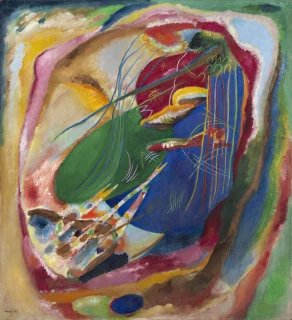
10. Picture with Three Spots, No. 196 — Wassily Kandinsky, 1914
Kandinsky painted this picture in Munich in the first half of 1914. By then he had almost given up depicting recognisable objects. On 3 August, two days after Germany declared war on Russia, he left Munich for Switzerland as a Russian subject.
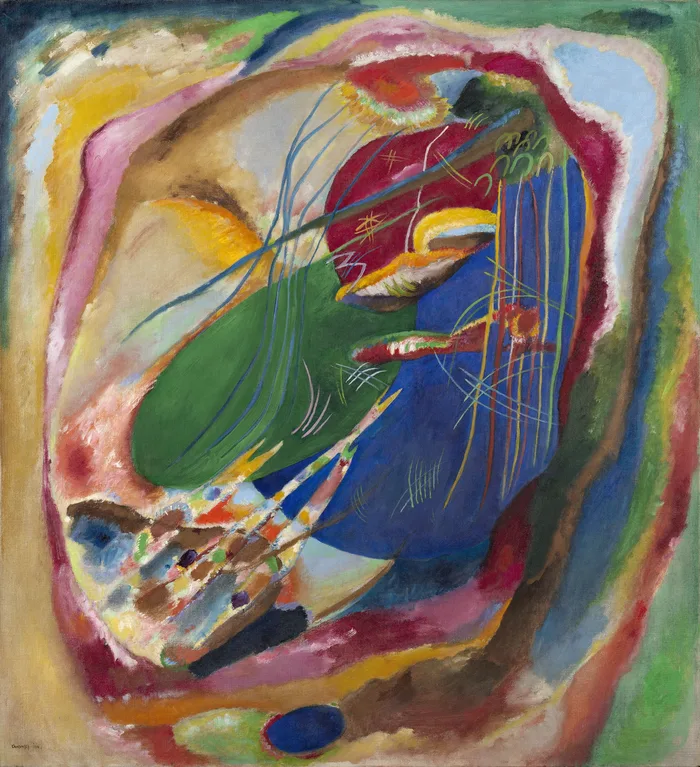
The canvas is almost square, and a ragged ring of pink, crimson, ochre and brown bands runs round its edges, with dark blue and bright green beyond it in the corners. Inside lie the three spots of the title, a large green one slanting on the left, a deep ultramarine one on the right, the largest in area, and a round crimson one at the top, half covered by the other two. A sheaf of thin blue lines falls over them from above, a yellow-orange crescent like a boat lies in the middle, and small strokes of many colours are scattered in the lower left corner. According to the museum, the preparatory sketches had boats with figures in that corner. At lower left, in small letters, Kandinsky wrote “KANDINSKY 1914”.
Later the picture went to New York, to the Solomon R. Guggenheim Foundation, and in 1971 the foundation sold it for what was then reported as a record price for Kandinsky. In 1975 Hans Heinrich bought it in Milan. It is number 196 in Kandinsky's own handwritten list of his works, and under numbers 198 to 201 the artist entered four large panels commissioned that same year, 1914, by the American Edwin Campbell for his New York apartment.
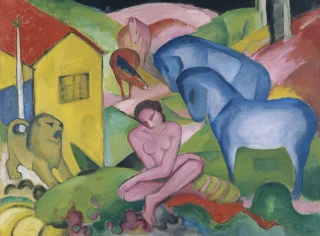
11. The Dream — Franz Marc, 1912
Kandinsky sent Improvisation 12, a picture with a rider, to Franz Marc in the summer of 1911, and on 31 July Marc wrote to him that it had arrived safely, that it had come, been hung and conquered. Marc gave Kandinsky The Dream in return, in 1912 or early 1913, soon after he finished it. Marc and Kandinsky (more on him in the previous entry) edited the Blue Rider almanac together, and it came out in May 1912.
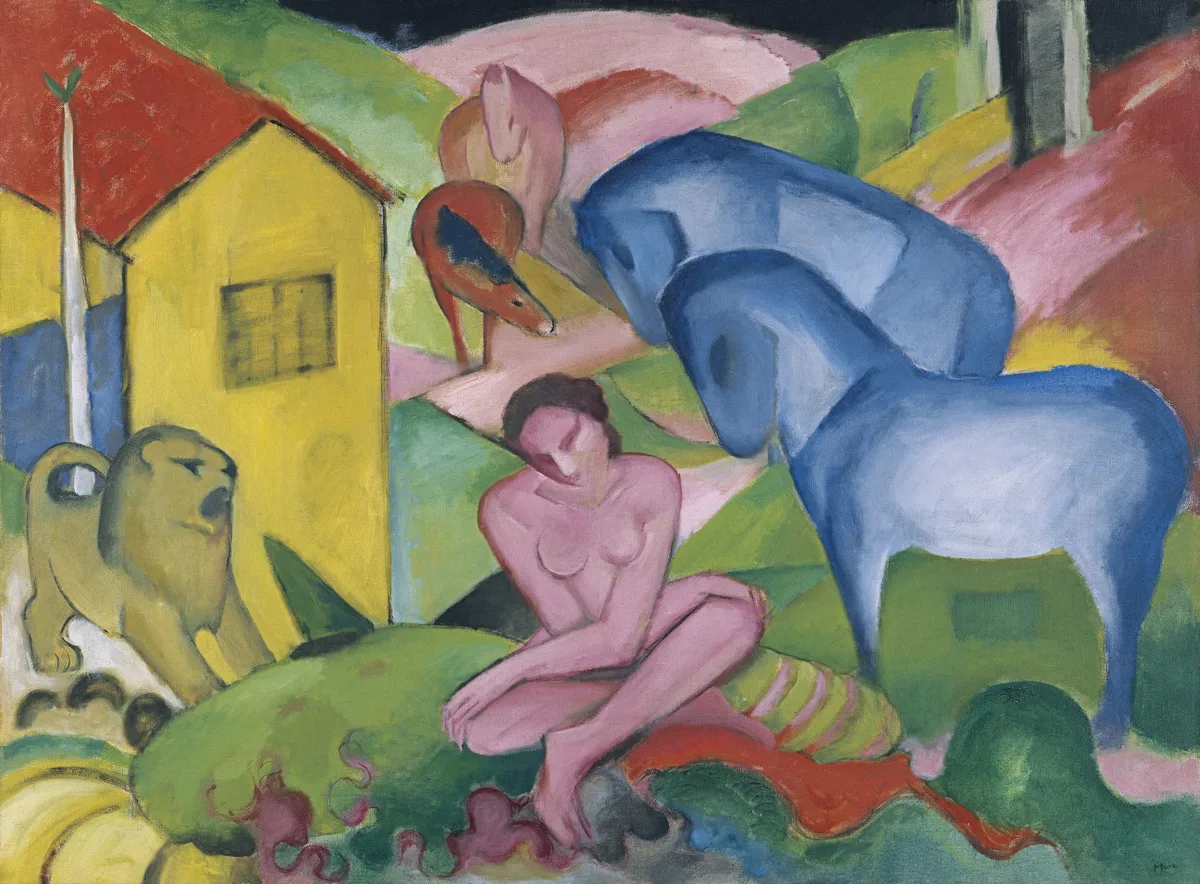
On a green mound in the middle sits a naked woman with pinkish-violet skin, her knees drawn up, her eyes closed and her head bowed. On the left stand a yellow lion with its tail curled in a loop over its back and a single yellow house with a red roof and a dark window, on the right two large blue horses built of facets bend their heads towards her, and at the top is another horse, red-orange, with a pale pink one behind it. According to the museum, Marc's colours carried the meanings he set out to the painter August Macke in 1910: blue was for him the male, spiritual principle, yellow the female, gentle and sensual one, and red was matter, a heavy brute force.
Marc was killed at Verdun on 4 March 1916, aged 36. Kandinsky was in Russia at the time, and the picture stayed in Munich with his companion, the painter Gabriele Münter. In 1916 Marc's widow, Maria, organised memorial exhibitions of his work in Munich and Wiesbaden, borrowed The Dream from Münter for them, and then, as the museum's researcher Marta Ruiz del Árbol writes, kept it at her home in Ried for at least four years, next to Improvisation 12. By 1926 the picture was back with Kandinsky, and the American collector Katherine Dreier chose it from him at the Bauhaus for the large exhibition of modern art that her Société Anonyme opened at the Brooklyn Museum. Researchers have not traced where the picture spent the next half-century. In 1978 Hans Heinrich bought it in New York.
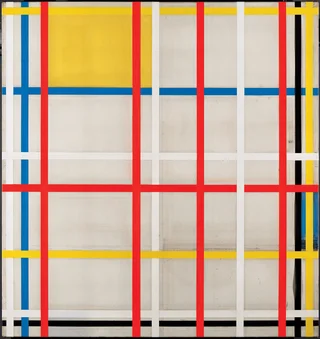
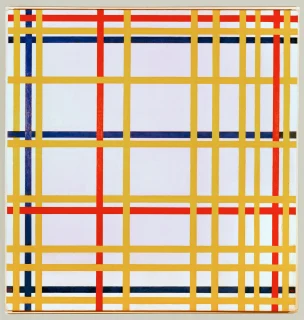
12. New York City, 3 (unfinished) — Piet Mondrian, 1941
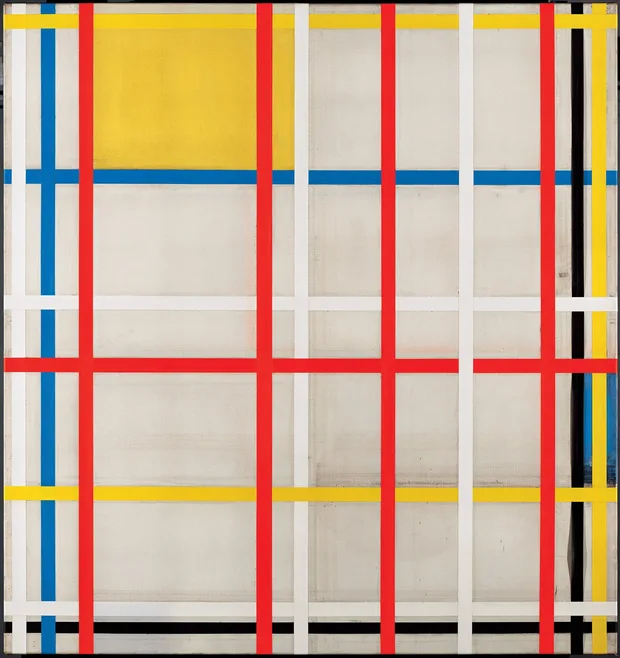
The bands on this canvas are made of coloured adhesive tape. Four red verticals run the full height, yellow, blue, white, red and black horizontals cross them, and at each crossing sometimes one tape lies on top and sometimes the other, so the grid looks woven. The white bands are easy to miss, since they are white tape on an almost white ground. Two fields are painted with the brush, a yellow rectangle at the upper left and a blue field at the right edge with a ragged lower edge scrubbed with a dry brush, and the brushstrokes show in them, while the tapes lie flat and smooth. Between the bands the bare canvas shows through, with pencil marking-out and traces of erased rectangles.
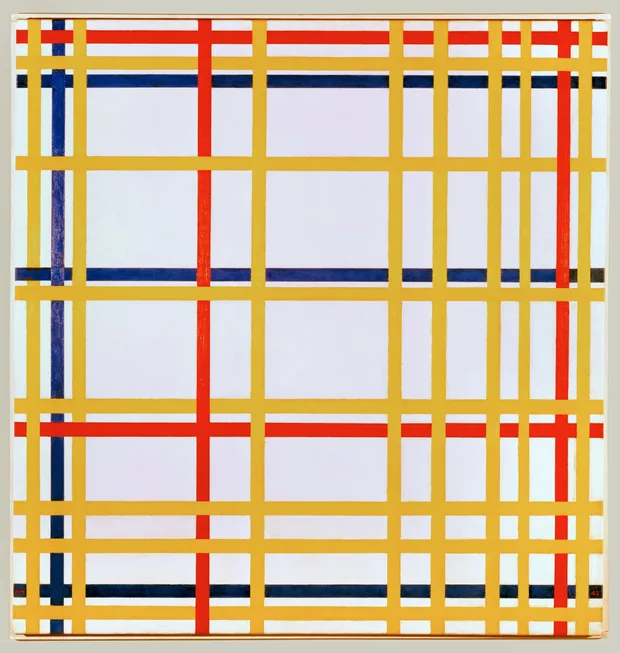
Mondrian could move the tape around until the balance satisfied him and replaced it with paint only as the last step. The museum writes that in the whole series Mondrian carried only one canvas through to paint, New York City of 1942 in the Centre Pompidou in Paris. This canvas may have been begun in London around 1938 as Composition with Yellow and Blue, and it is one of the pictures Mondrian took with him to New York in 1940, after the bombing of London, and went on reworking. The American painter Harry Holtzman had invited him to New York. Mondrian died there on 1 February 1944, the canvas was found in his last studio on 59th Street, and Holtzman took charge of the estate.
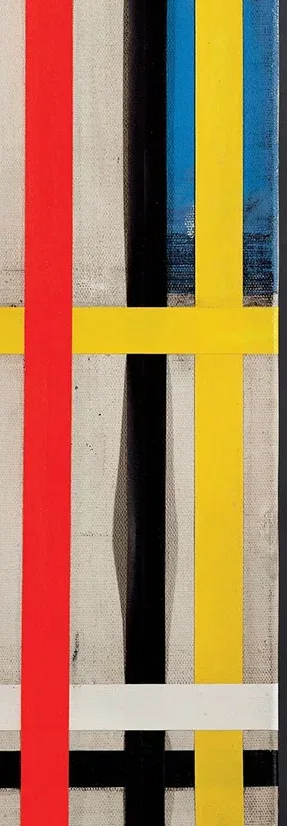
According to the museum, in 1977 Holtzman and Bill Steeves stuck the loose tapes back in place and replaced the torn ones with new tape of the same colours in the same positions, so some of the tape was laid after Mondrian's death, and nobody recorded which bands are new. Hans Heinrich bought the picture in 1983. Near the right edge at the bottom, between the lower yellow and the white horizontals, the black vertical has come away from the canvas, bulging in a wave and casting a shadow.
In the same years: old masters, Americans and a picture bought back from a sister (1971–1986)
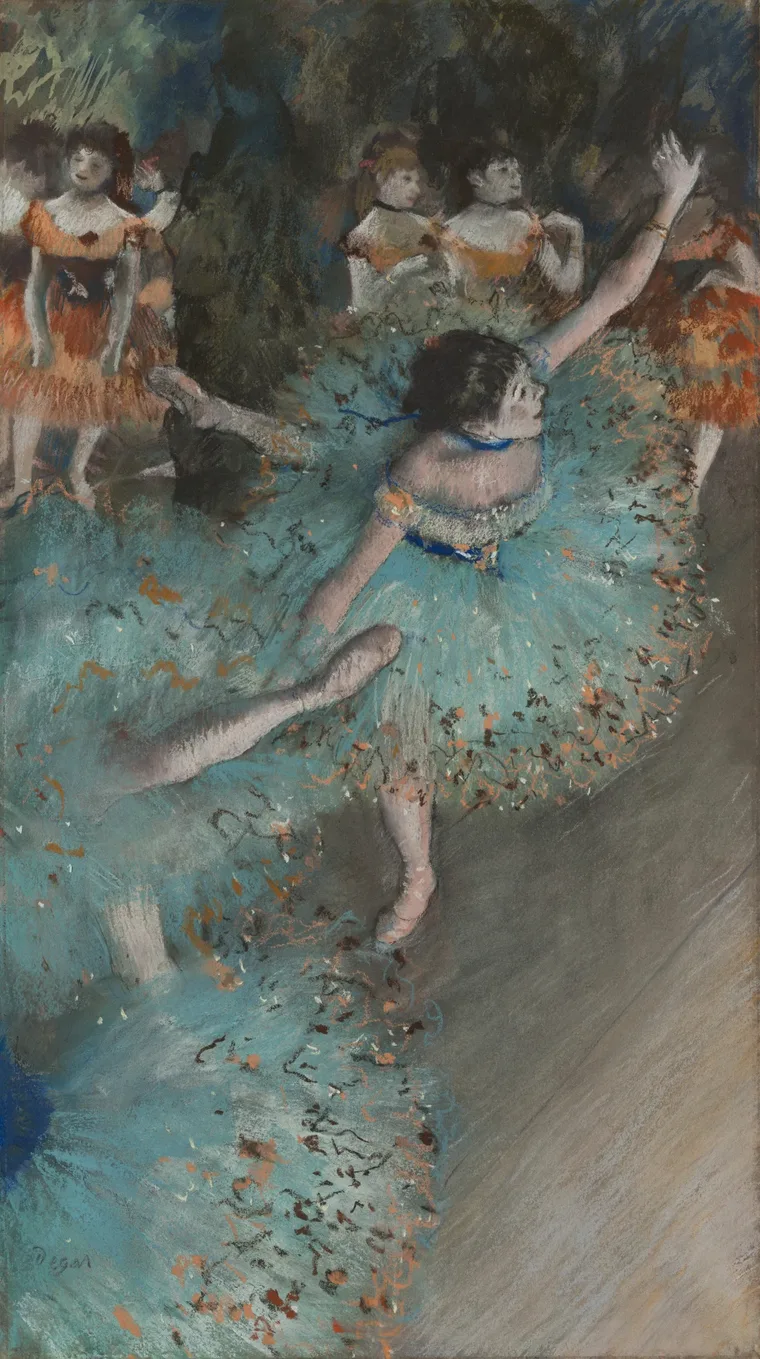
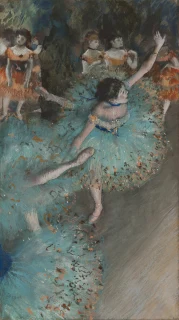
13. Swaying Dancer (Dancer in Green) — Edgar Degas, 1877–1879
Around 1886 the English painter Walter Sickert bought this pastel, according to the museum probably through Charles Ephrussi, the art historian and collector. Sickert had met Edgar Degas in Paris in 1883 and learned from him to paint from drawings and from memory. Shortly before the purchase Sickert's wife, Ellen, wrote to the painter Jacques-Émile Blanche that they were delighted Degas was selling. From the spring of 1886 the pastel hung in the place of honour in their house in West Hampstead.
It is done in pastel and gouache on paper. Degas looked at the stage from above and to the side, as if from a box, the floor in his picture tilts upward, and the whole lower right corner is taken up by empty grey-brown boards. In the centre a dancer in a pale green tutu with a blue sash turns on one point, one arm with a gold bracelet flung up towards the upper right corner, the other thrown down and back. The left side is flooded with the green tulle of other dancers cut off by the edge of the sheet, and out of the tulle stick legs in pink tights, without heads or bodies. At the top, by the backdrop, dancers in orange skirts are waiting.
When the Sickerts' marriage broke up, the pastel went to Ellen and from her to her sister Jane Cobden Unwin, and in 1902 the Cobden family sold it to Paris. After that it passed through Paris dealers, the collection of the Scot William Cargill and a London auction of 1963 to the collector Norton Simon of Pasadena, and on 5 May 1971, at the sale of his pictures at Sotheby Parke Bernet in New York, Hans Heinrich bought it. Sickert gave the pastel its second title, Dancer in Green, according to the museum possibly at Degas's own suggestion.
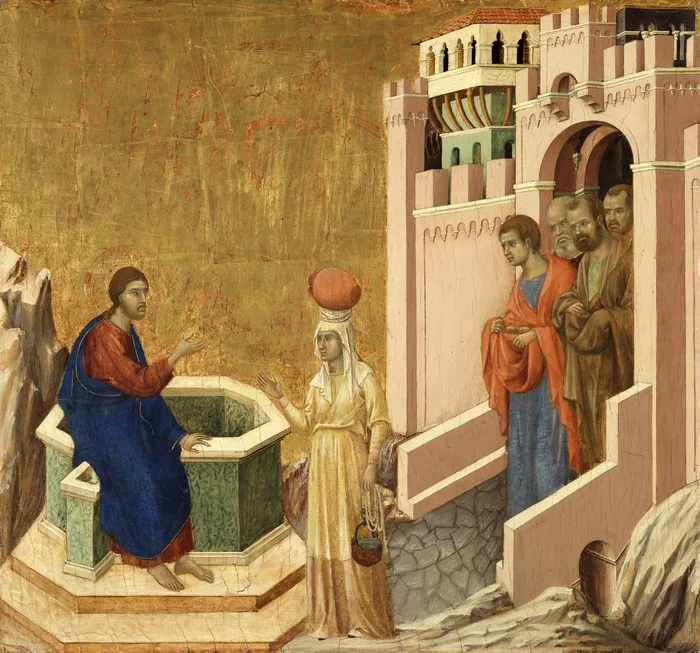
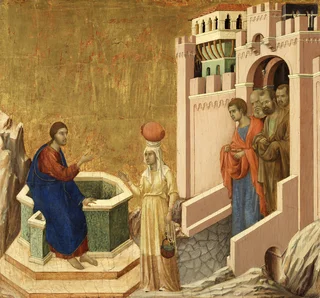
14. Christ and the Samaritan Woman — Duccio di Buoninsegna, 1310–1311
On 1 August 1777, in the Sienese church of Sant'Ansano in Castelvecchio, Duccio's Maestà, a double-sided altarpiece painted for the high altar of Siena Cathedral, was sawn apart, and the saw slipped and damaged the Virgin's face. Duccio had signed the contract on 9 October 1308, undertaking to work without interruption and to accept no other commissions, and on 9 June 1311 a procession led by the bishop, with candles and lamps, carried the finished altarpiece through the city to the cathedral. The front showed the Madonna enthroned among saints and the back the scenes of the Passion, and below them, in the predella, ran episodes from the life of Christ, painted in a row on long planks. Every surviving predella scene was sawn out of one of these planks, and the eight scenes from the back are now in Siena, New York, Washington, London, Fort Worth and Madrid.
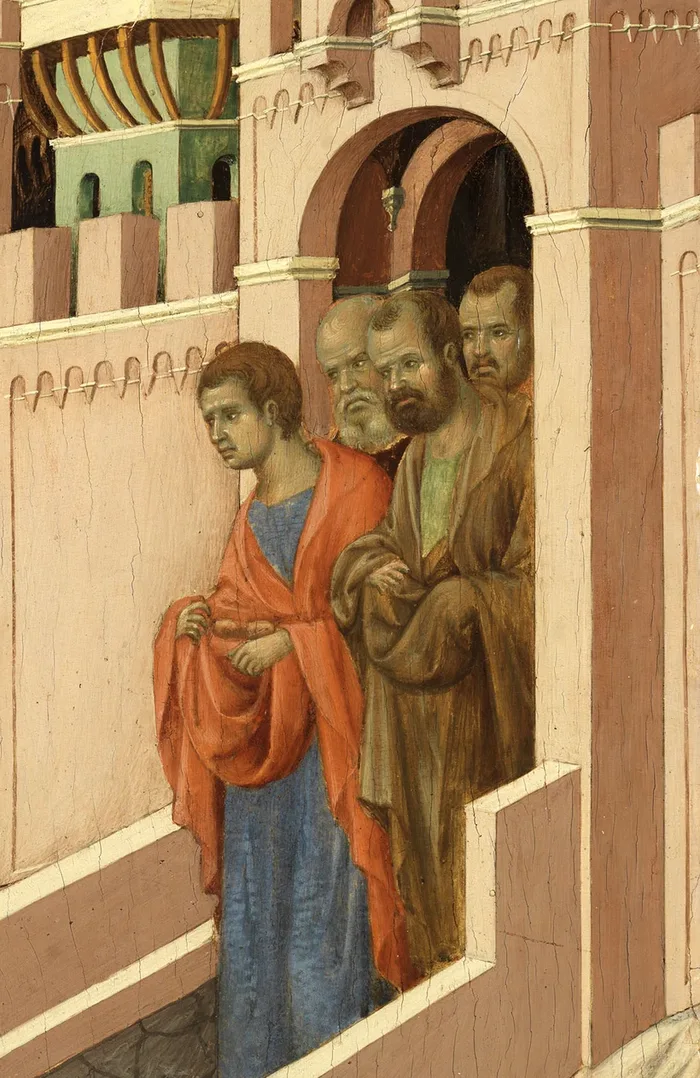
Christ sits sideways on the edge of an octagonal well of green marble, in a red tunic and blue cloak, his bare feet on a step, raising his right hand towards the woman. The Samaritan woman, in a long pale yellow dress and a white veil, carries a jug on her head. On the right the apostles, who had gone into the town for food, come out of the gate of a pink crenellated town, and the one in front, young and beardless, has loaves in a fold of his cloak. A small lamp hangs under the arch of the gate. The gold of the background has worn away, and the red bole it was laid on shows through in streaks and scratches, so the sky looks mottled.
In 1879 the panel belonged to the Dini brothers of Colle di Val d'Elsa and was shown at an exhibition in that small town. In 1886 the painter and dealer Charles Fairfax Murray bought it, with three more predella scenes, for the London collectors Robert and Evelyn Benson. In 1927 the dealers Duveen Brothers bought the Bensons' entire Italian collection, and the four Duccio panels went to American buyers. The Temptation on the Mountain was bought by the Frick Collection in New York, The Calling of Peter and Andrew is now in Washington, and The Raising of Lazarus and Christ and the Samaritan Woman went to the Rockefeller collection in New York. The Kimbell Art Museum in Fort Worth bought Lazarus in 1975, while Hans Heinrich had already bought the Samaritan panel from the Rockefeller collection in 1971.
In her left hand the Samaritan woman holds a coil of white rope and a small copper bucket. In the Gospel of John, Christ asks her for a drink, and she answers that he has nothing to draw with and the well is deep.
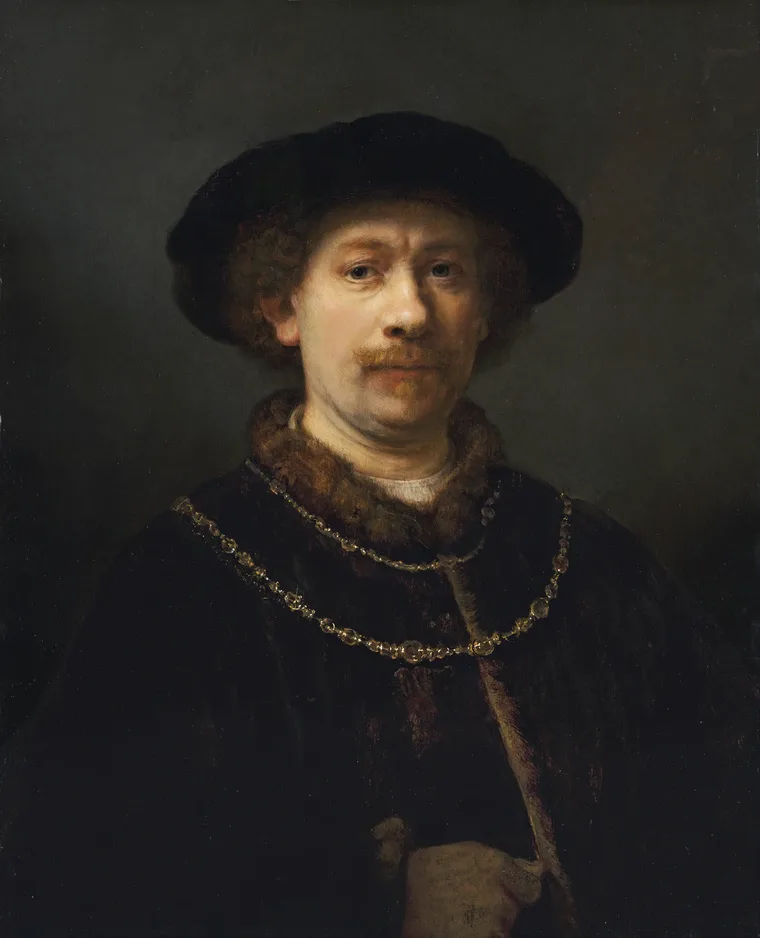
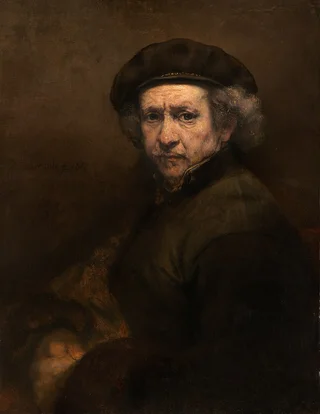
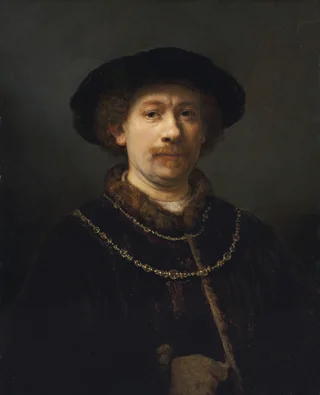
15. Self-portrait Wearing a Beret and Two Chains — Rembrandt, c. 1642–1643
The art historian Horst Gerson raised doubts about this self-portrait in 1968, troubled by the condition of the panel, so when Hans Heinrich bought it in 1976 its authorship was already in question. X-rays and infrared photography in 1987–1988 found extensive later overpainting on the nose and eyes, the beret, the clothing and the background. Analysis of the wood showed that the panel was made from timber of the 1630s or early 1640s, so the picture is of the 17th century, and in 1990 the collection's own catalogue, compiled by Ivan Gaskell, assigned the portrait to Rembrandt's workshop.
Rembrandt painted himself to the waist, almost full-face, with the light falling on his face from the upper left. He wears a wide, flat black beret with reddish curls escaping from under it, a moustache above his lip, a small tuft of beard below the lower lip, and a thick fur collar round his neck. A short gold chain of round links lies in a shallow loop on the fur, and a long one sags in a deep curve across his whole chest. At the lower edge a hand holds the fur-trimmed edge of his garment, painted rapidly, almost as a sketch. The Calouste Gulbenkian Museum in Lisbon, where the picture was shown on loan in 2022, writes that Rembrandt is dressed in the same way as the early Netherlandish painters Dirk Bouts and Rogier van der Weyden in two prints published by Hieronymus Cock in 1572.
In 1994 a second dendrochronological study showed that the wood of the panel matched that of four other Rembrandt panels, and according to the museum the Rembrandt Research Project no longer had any reason to deny him the authorship. In 2005 the self-portrait was included in the fourth volume of A Corpus of Rembrandt Paintings, devoted to the self-portraits.
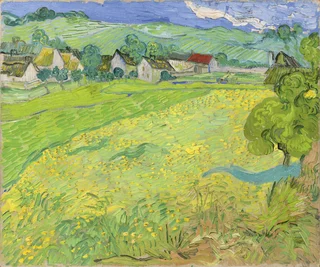
16. Les Vessenots in Auvers — Vincent van Gogh, 1890
Around 1900 a small watercolour copy of this landscape was made by Blanche Derousse, the niece of Dr Paul Gachet's housekeeper and his pupil, who copied pictures from his collection in miniature. The copy is in the Louvre's department of prints and drawings, and from it we know that the picture hung in Gachet's house. The museum names the doctor as its first owner. Gachet treated Van Gogh in Auvers-sur-Oise, and Les Vessenots, according to the museum, was the part of the village where the doctor himself lived.
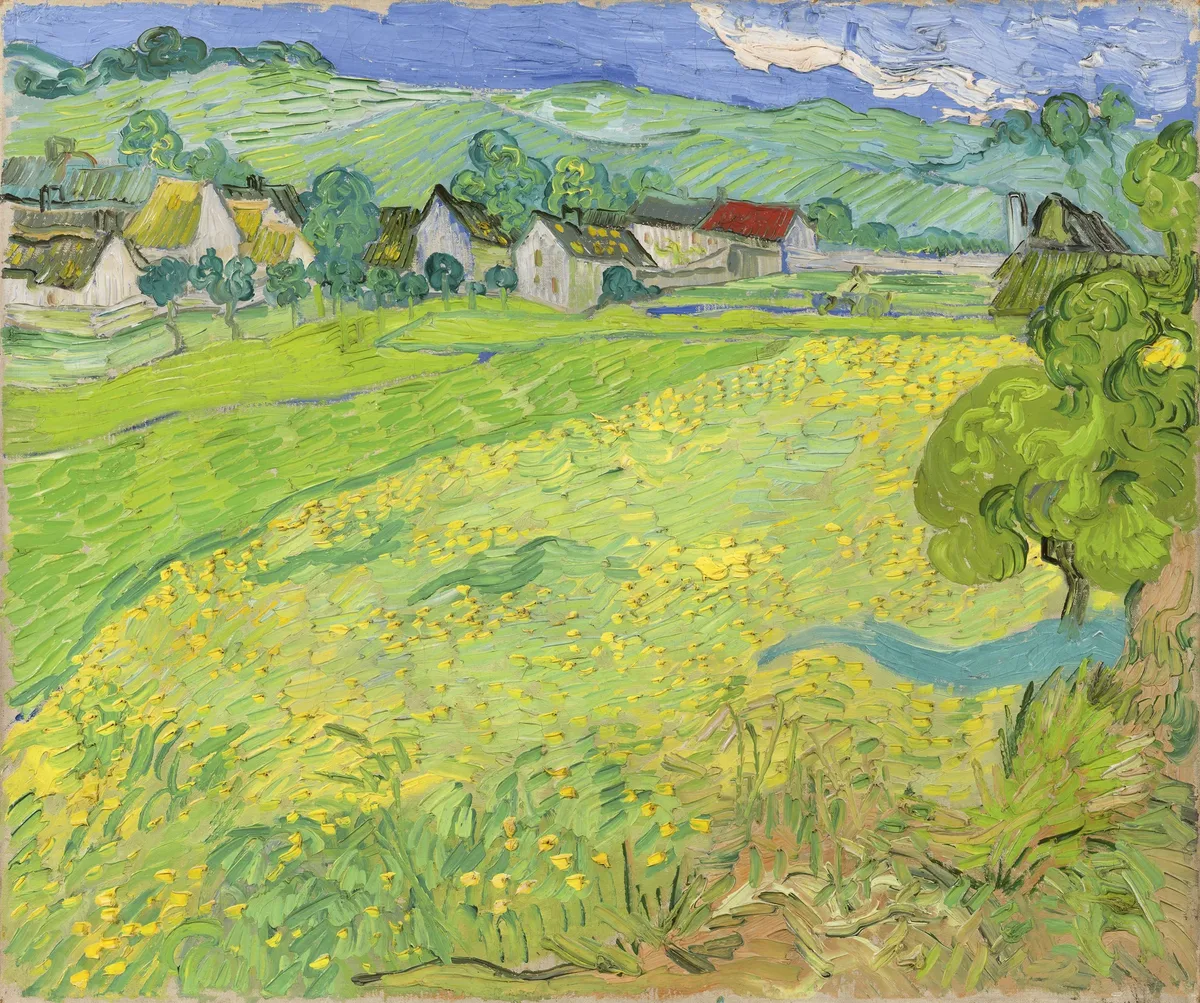
Van Gogh painted these outskirts in 1890, in the last weeks of his life. The lower two-thirds of the canvas are taken up by a yellow-green field of short curving strokes dotted with hundreds of lemon-yellow points, on the right a wavy light blue strip like a ditch runs across the field, and at the right edge stands a large tree of swirling olive masses, cut off by the frame. Higher up a row of white houses with thatched and grey roofs runs across the canvas, and one roof, a little right of centre, is red, the only strong warm patch in the picture. Below this house and to the right, on a pale strip beyond the field, a few strokes suggest a tiny figure with a horse and cart. Above the houses rise striped hillsides, and the sky is left a narrow strip at the top edge, with dense white clouds laid on in thick paint.
Hans Heinrich bought the picture in 1978. In July 2023 the museum issued its first NFT collection based on Les Vessenots, 100 digital tokens at €30,000 each.
17. Expulsion. Moon and Firelight — Thomas Cole, c. 1828
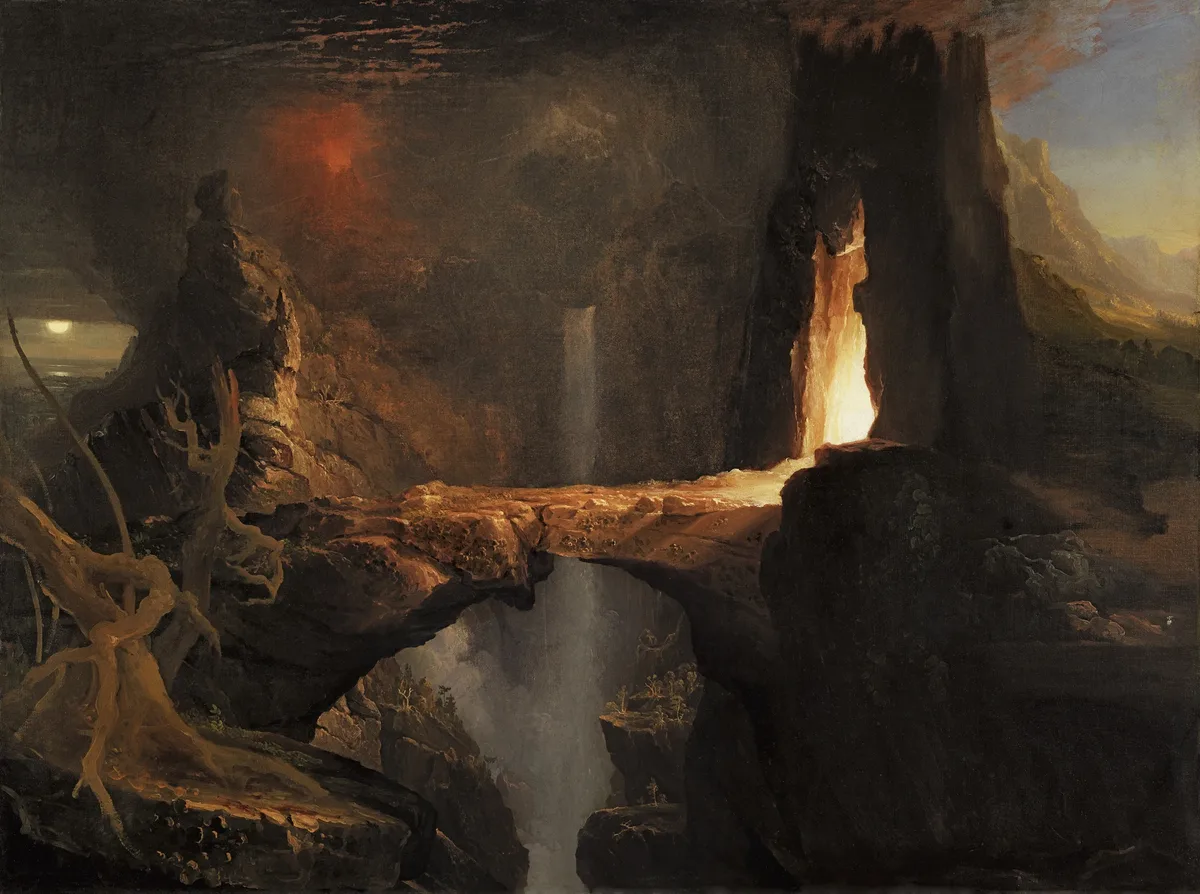
Thomas Cole painted the expulsion from Paradise as a single landscape. In the middle a huge natural rock bridge spans a chasm, behind it a thin white waterfall drops into a gorge, and the bridge and the waterfall cross at a right angle, in which the museum sees a cross. On the right rises a dark tower of rock with a narrow opening, inside which a yellow-white flame blazes, the brightest place on the canvas, and the light from the opening spreads across the right end of the bridge. Beyond the tower, in the upper right corner, it is day, with blue sky and pink clouds, a sunlit slope and a green valley, which according to the museum is Paradise. On the left, in the world after the Fall, it is night, and right at the edge, a little below the middle, a small full moon hangs over a distant plain with a glint of water. Above a rocky peak a red glow stands in smoky clouds, which the museum's materials for schools call a volcano, and in the foreground a twisted dead tree shows white.

Cole had seen the bridge over the precipice in 1827, in the White Mountains of New Hampshire. In 1828 he exhibited Expulsion from the Garden of Eden in New York, a picture now in the Museum of Fine Arts in Boston, where tiny figures of Adam and Eve can be seen in the shining gateway. The Madrid canvas has the same bridge and the same gateway with its light, and here Cole removed the people and turned the left half into a moonlit night. Cole was born in England, in 1818 his family emigrated to America, and he is regarded as the founder of the Hudson River School.
Hans Heinrich began buying American 19th-century painting at the end of the 1970s, when, according to The Tretyakov Gallery Magazine, the market still took little interest in it, and his collection became one of the few European collections with American 19th-century painting. In his memoirs he wrote that he had been prompted by the art historian Barbara Novak's book Nature and Culture, and in a 1984 catalogue he put his interest down to being perhaps “a quarter American”, through a grandmother from Delaware. He bought Expulsion in 1980. One of the later editions of Novak's book has this picture on its cover.
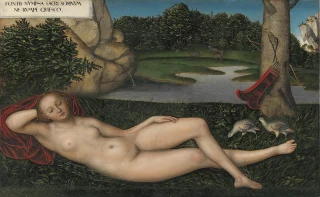
18. The Nymph at the Fountain — Lucas Cranach the Elder, c. 1530–1534
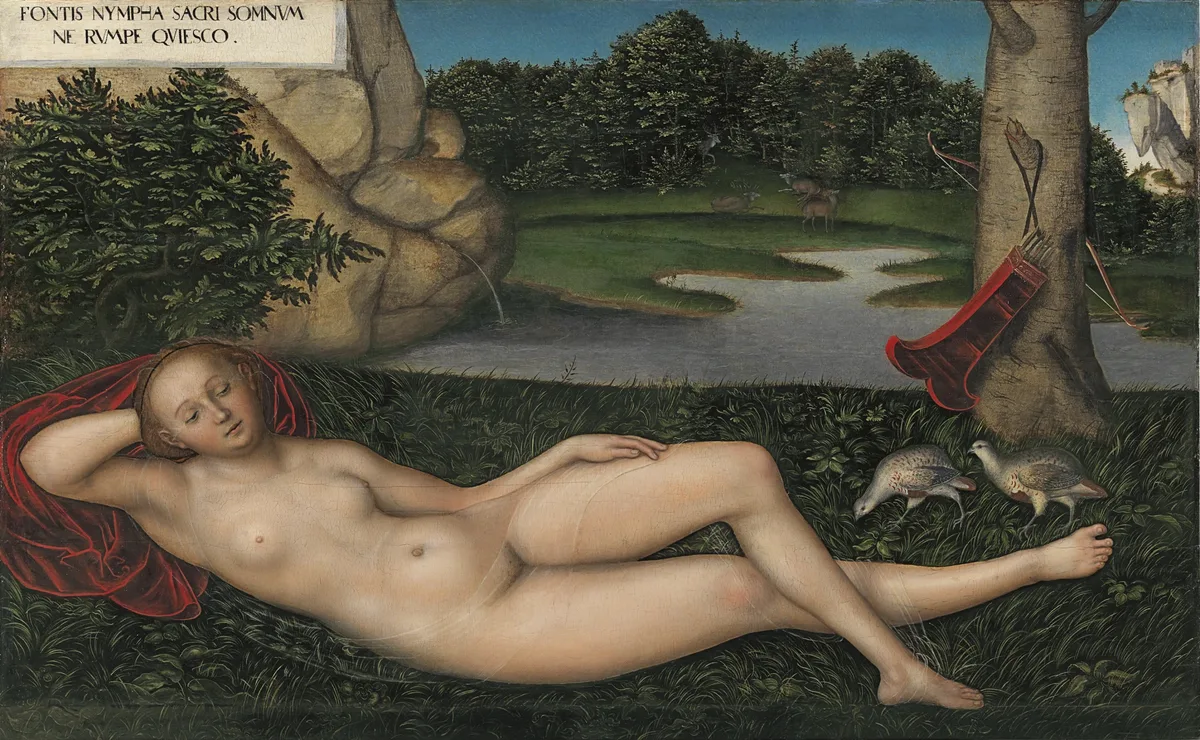
On a light tablet in the upper left corner, in Latin capitals, is the inscription FONTIS NYMPHA SACRI SOMNVM NE RVMPE QVIESCO, “I am the nymph of the sacred spring, do not break my sleep, I am resting.” It is a shortened form of an epigram that was copied in the 15th century as a genuine ancient inscription and is now usually attributed to the Italian humanist Giovanni Antonio Campano. From 1518 Cranach's workshop painted this nymph again and again, and more than 20 versions are known.
Here she lies across the full width of the panel, head to the left, on crimson velvet, one arm folded behind her head. Her eyelids are heavily lowered, but dark pupils show between them, so the nymph may be dozing or may be peeking. Her body is covered by a transparent veil, visible only as thin light lines across her forehead, belly, thighs and shins. On the left a jet of water arcs from a cleft in an ochre rock, beyond the pool four deer stand and lie at the edge of the wood, on the right a bow and a red quiver of arrows hang on a smooth grey trunk, and two partridges peck in the grass at the nymph's feet.
The panel belonged to the Berlin painter Wilhelm Trübner. In 1918 it was sold at auction in Berlin, then it passed through Haberstock's gallery in Berlin and the Amsterdam firm of Goudstikker, and in 1928 Heinrich Thyssen-Bornemisza bought it, five years before his great purchases of 1933–1935. In 1930 the nymph was shown in Munich at the first exhibition of his collection. At the division of his estate it went to his daughter Margit, Countess Batthyány, and in 1986 Hans Heinrich bought it back from his sister for Villa Favorita.
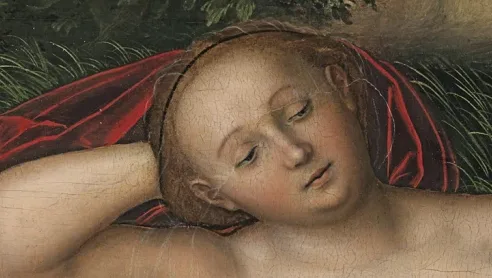
At some point the panel was cut down on all four sides, and the inscribed tablet now runs into the top and left edges. A narrow strip was added along the bottom, and the heel of the nymph's bent leg touches this added strip.
Who owns them now (since 1984)
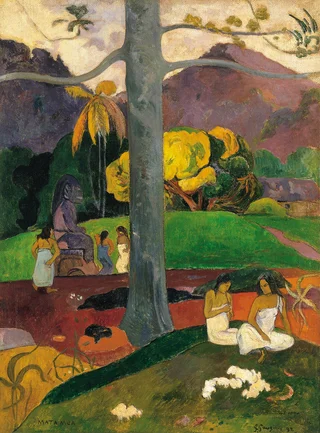
19. Mata Mua (In Olden Times) — Paul Gauguin, 1892
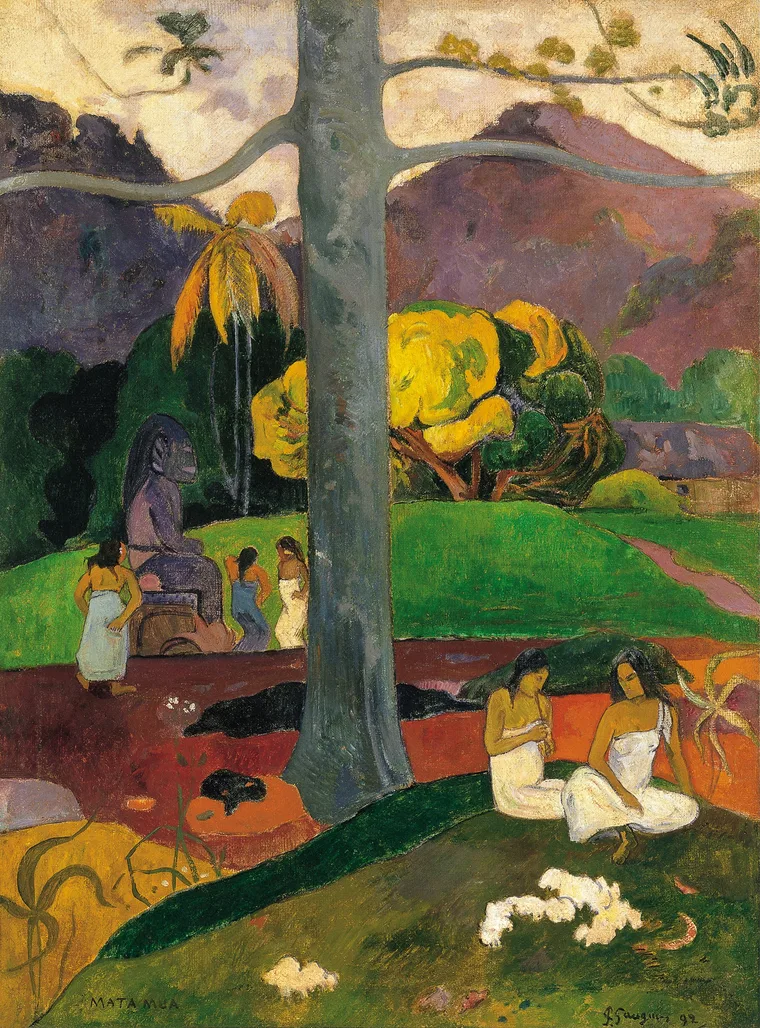
In 2020, while the museum was closed by the pandemic, Mata Mua was taken from Madrid to Andorra, home of its owner, Carmen Cervera, Hans Heinrich's widow. He had married her in 1985, when he was looking for a permanent home for the collection. Switzerland would not pay to extend Villa Favorita, offers came from Britain, from the Getty Museum, from German cities and from Spain, and according to the museum it was Carmen who chose Spain. In 1988 the baron signed a contract with the Spanish state lending 775 works to Madrid with a view to their sale. On 8 October 1992 the museum opened in the Palacio de Villahermosa, rebuilt inside by the architect Rafael Moneo, and in June 1993 the state bought these 775 works for 350 million dollars and handed them to a public foundation. Mata Mua was not part of that deal and belongs to Carmen Cervera's own collection, known as the Carmen Thyssen collection. The most famous Gauguin in the building has never belonged to the museum.
Gauguin painted the picture in Tahiti in 1892, and at his auction of 1895, where he sold off his work to go back to Oceania, it found no buyer. In May 1984, at Sotheby's in New York, Hans Heinrich and the Bolivian collector Jaime Ortiz-Patiño bought it in equal halves, for less than four million dollars according to the press, and in 1989, again at auction in New York, Hans Heinrich became its sole owner. Carmen Cervera told the magazine ¡Hola! in an interview that they had bought it three times.
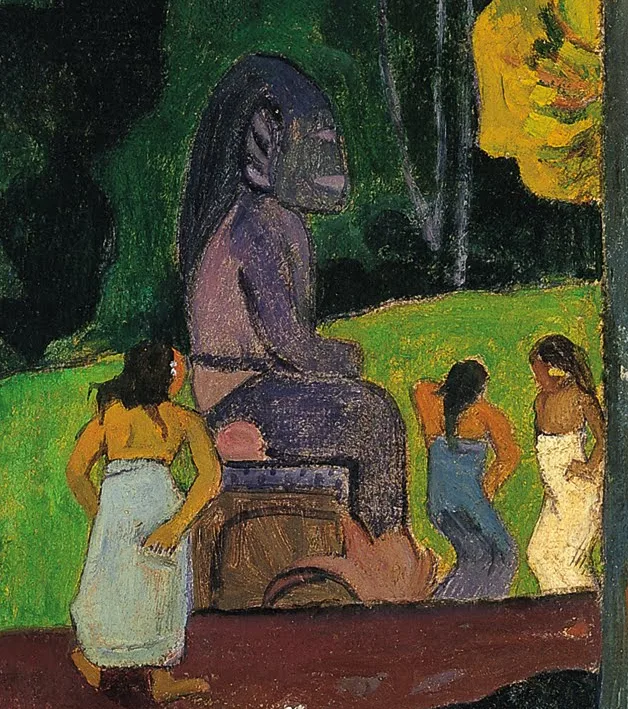
A grey-blue tree trunk divides the canvas in half and runs out past the top edge. On the left, in the distance, sits a large dark violet idol, and three women, bare to the waist, dance around it. On the right, in the foreground, two women in white pareos sit on dark green grass, and one of them plays a flute. Behind them stretch a red-orange band of earth, a bright green meadow and pinkish-violet mountains. According to the museum, the idol represents Hina, the goddess of the moon, and Gauguin composed its figure himself. At lower left, in small letters, is written MATA MUA, Tahitian for “in olden times”, and at right the signature “P Gauguin 92”.
On 7 February 2022 Mata Mua returned to Madrid, and two days later, on 9 February, the Ministry of Culture signed a contract to rent the Carmen Thyssen collection, some 330 works, for fifteen years at €6.5 million a year. Since then the collection has been shown in the museum under a fifteen-year rental contract signed with the Spanish state in 2022, and the preferential right to buy belongs to the Thyssen-Bornemisza Collection Foundation, which may pass it to the state. Under the contract the owners may freely sell three works from the collection, any except Mata Mua.
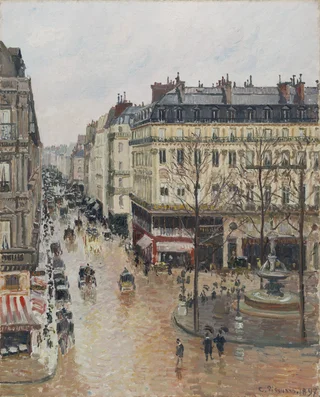
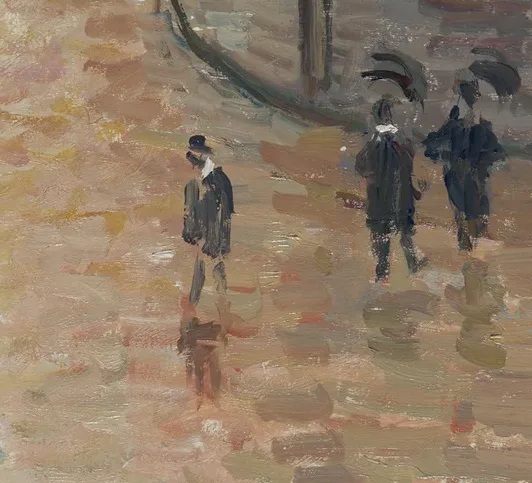
20. Rue Saint-Honoré in the Afternoon. Effect of Rain — Camille Pissarro, 1897
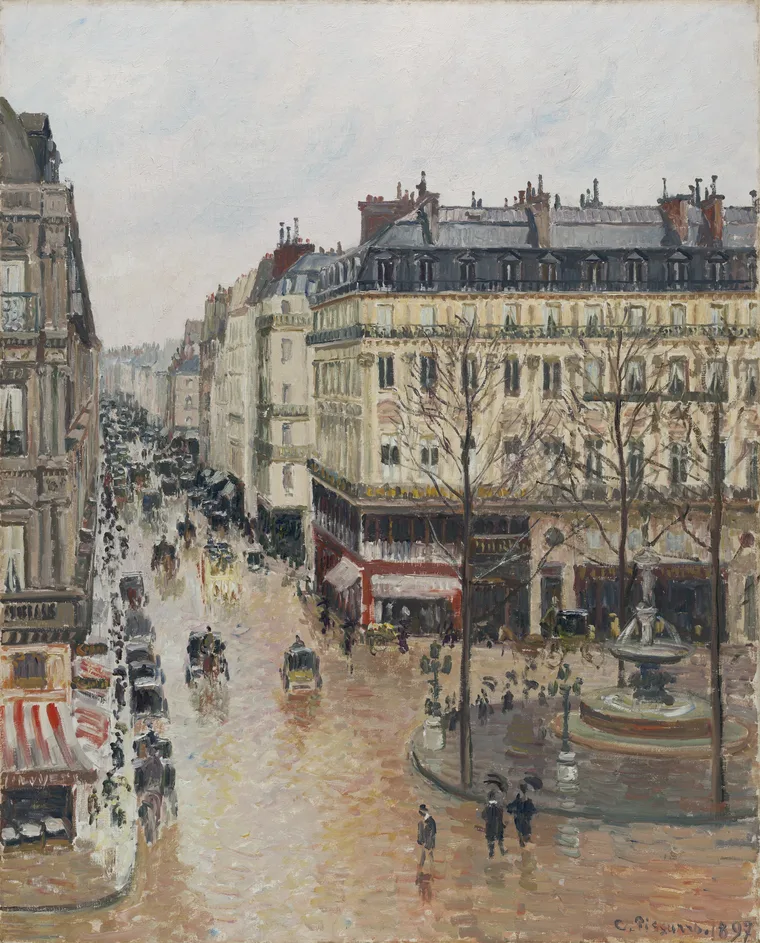
In 1939 Lilly Cassirer was forced to sell this picture to the Berlin dealer Jakob Scheidwimmer for 900 Reichsmarks in order to get an exit visa from Germany, and the money went into an account she could not use. The picture had hung in her home in Berlin. In 1900 the dealer through whom Pissarro sold his work had sold it to Paul Cassirer of the Berlin family of art dealers, and Lilly later inherited it. In 2024 a US federal appeals court wrote in its ruling, “There is no dispute that the Nazis stole the Painting from Lilly.”
In 1943 the picture was sold at auction in Berlin. After the war Lilly sought its return, and in 1958, when the picture was believed lost, the Federal Republic of Germany paid her 120,000 Deutschmarks in compensation. Meanwhile, in 1951, the picture had been taken out of Germany to the United States, from 1952 to 1976 it was in a private collection in St Louis, and in 1976 Hans Heinrich bought it through the Stephen Hahn gallery in New York for $275,000. It has been in Madrid since 1992, and in 1993 it was among the 775 works bought by the state.
Pissarro painted the Rue Saint-Honoré in 1897 from the window of a Paris hotel, and it is one of 15 pictures he painted from the same window in the winter of 1897–1898. The street runs diagonally up and to the left from the bottom of the canvas and dissolves in a greyish haze, a line of dark carriages stretches along the left pavement, at lower right a round fountain stands on a traffic island, and on the left a red-and-white striped awning hangs over a shop window. Most of the space is taken up by the wet roadway in pink, ochre and violet strokes, with reflections under the carriages and people, and a little right of centre at the bottom edge a lone man in a top hat is walking, with his reflection beneath him.
Lilly's grandson, Claude Cassirer, sued the Thyssen-Bornemisza Collection Foundation in California in 2005. The foundation maintains that the baron bought the picture in good faith and that it belongs to the foundation, while the heirs consider it stolen. On 9 January 2024 the Ninth Circuit Court of Appeals decided the case in the foundation's favour under Spanish law, by which the foundation had acquired the picture through acquisitive prescription. In September 2024 California passed a law requiring California law to be applied in such suits, and on 10 March 2025 the US Supreme Court vacated the 2024 judgment and sent the case back for reconsideration. On 12 September 2025 the parties filed cross-motions for summary judgment, in November the Attorney General of California asked to intervene in the case to defend the new law, and on 13 April 2026 the federal Holocaust Expropriated Art Recovery Act (HEAR Act) was signed, a law drafted with this case in view that rules out a defence based on acquisitive prescription. As of 29 September 2026 the case is pending in the US District Court for the Central District of California, with no final judgment.
What else to see
Among Heinrich's purchases, look for Frans Hals's Family Group in a Landscape, bought in New York in 1935 from the Mogmar Art Foundation, and Hans Maler's Portrait of Anne of Hungary and Bohemia, which came into the collection in 1937 through the same Lucerne gallery, Mercuria, that sold the Dürer and the Holbein. Hans Heinrich bought Caspar David Friedrich's Easter Morning at auction in 1973, and among the American landscapes the collection also has Cole's Cross at Sunset. Of 20th-century painting the collection has Edward Hopper's Hotel Room, Roy Lichtenstein's Woman in Bath and Francis Bacon's George Dyer in a Mirror. Hans Heinrich bought Fra Angelico's Madonna of Humility in 1986, the same year as the Cranach nymph.