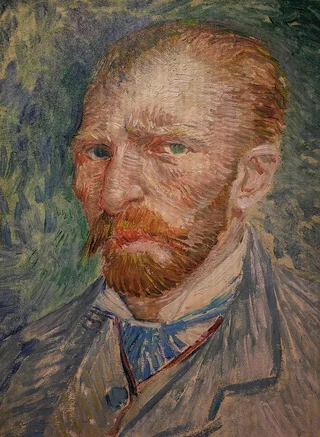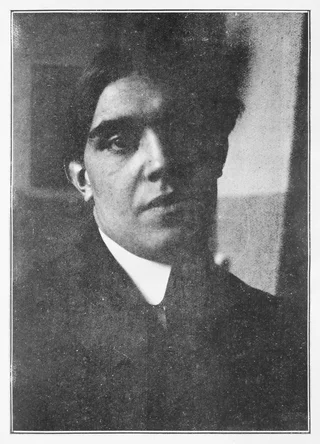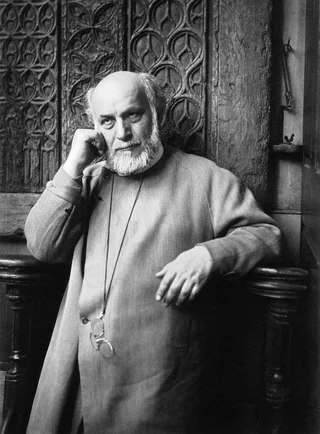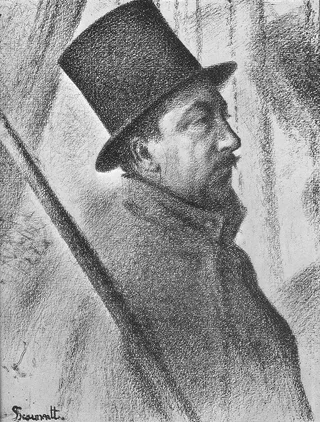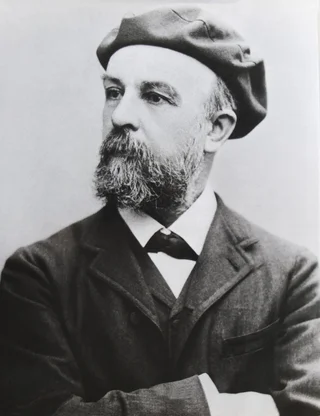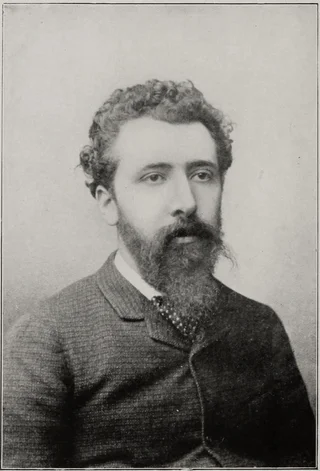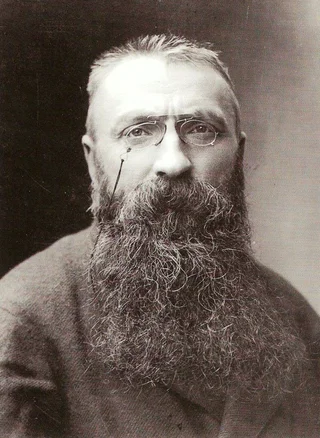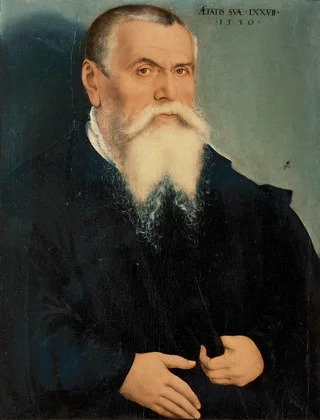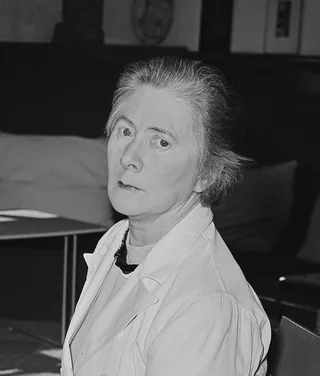
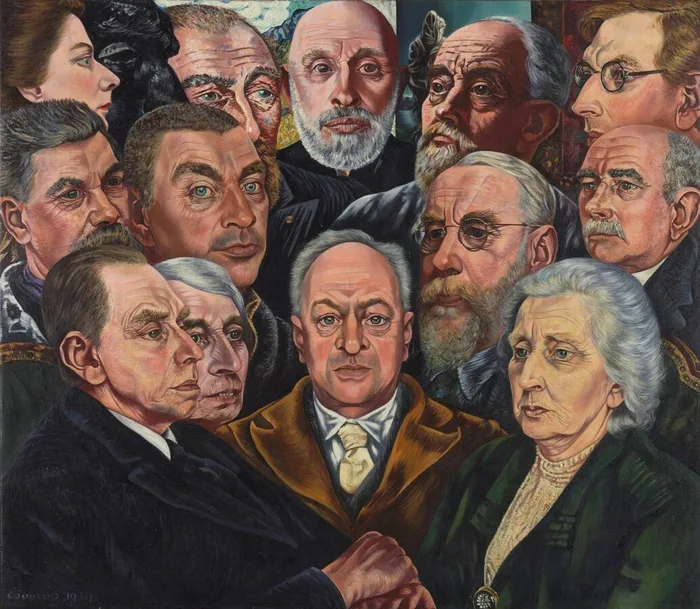
Helene Kröller-Müller (1869–1939) was born in Germany and married Anton Kröller, a Dutch shipping and trading magnate. In 1907 she began taking lessons from Henk Bremmer, a teacher of “practical aesthetics”. Bremmer taught that art moves from realism to idealism, from the visible to the spiritual, and he saw Van Gogh as the painter in whom that turn takes place. From 1908 until about 1929 Helene bought paintings on his advice, and sometimes against it. In 1935 she offered the collection to the state, and in 1938 a museum designed by Henry van de Velde opened in the Hoge Veluwe park. It was intended as a temporary building, because the large museum that first the architect Berlage and then Van de Velde himself had designed for her was never built. The museum holds 88 paintings and 172 works on paper by Van Gogh, the second-largest Van Gogh collection in the world.
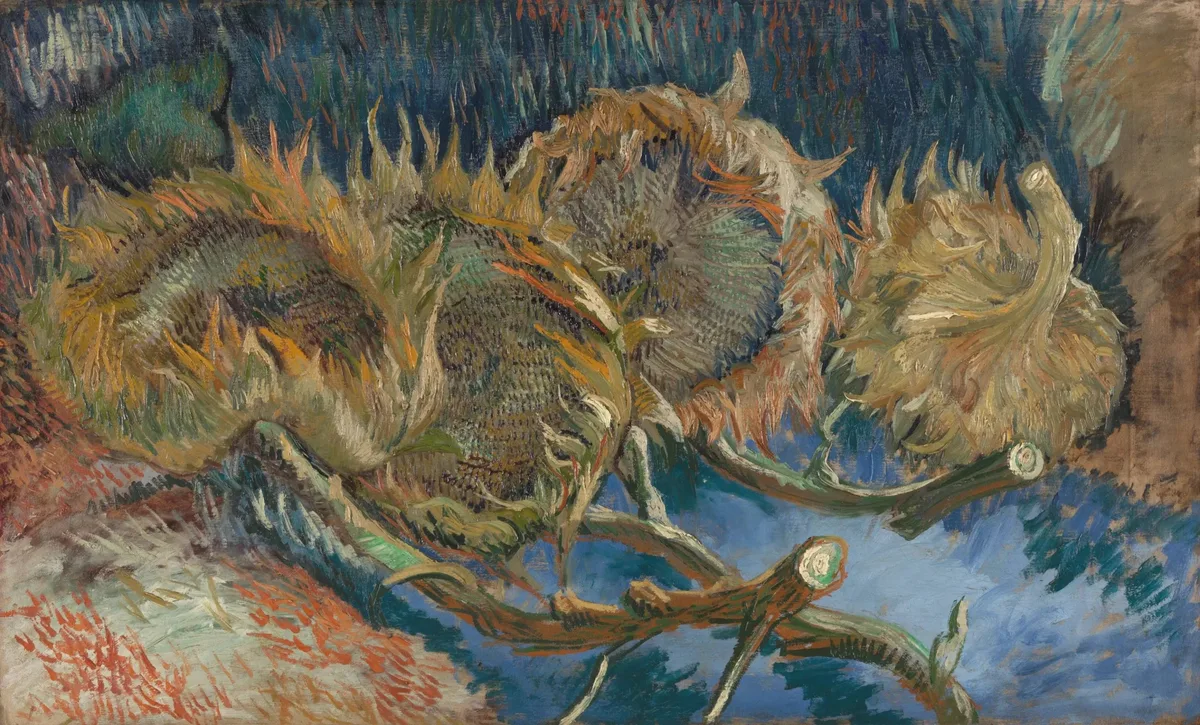
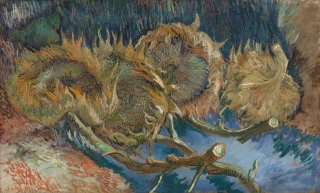
Helene died on 14 December 1939 at the St Hubertus hunting lodge. The next day a hearse carried her to the museum, followed on foot by Anton, their son Bob, Sam van Deventer and her nurse, and she was laid out among her beloved Van Goghs, directly in front of Four Withered Sunflowers, a Paris canvas she had bought in 1908, her first year of collecting. She was buried the day after that at the foot of the Franse Berg hill, beside the foundations of the large museum that had been planned for the spot, and her headstone carries her words, “I believe in the perfection of all things”.
Helene herself bought most of the works in this article. The museum acquired the rest after her death, following a rule she left it. We begin with a dark study that cost her 110 guilders and end with a bronze cast 18 years after the sculptor was killed.
How the Collection Began
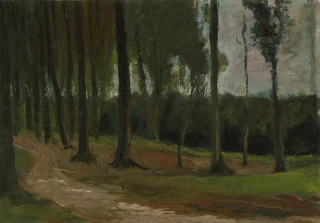
1. Edge of a Wood — Vincent van Gogh, 1883
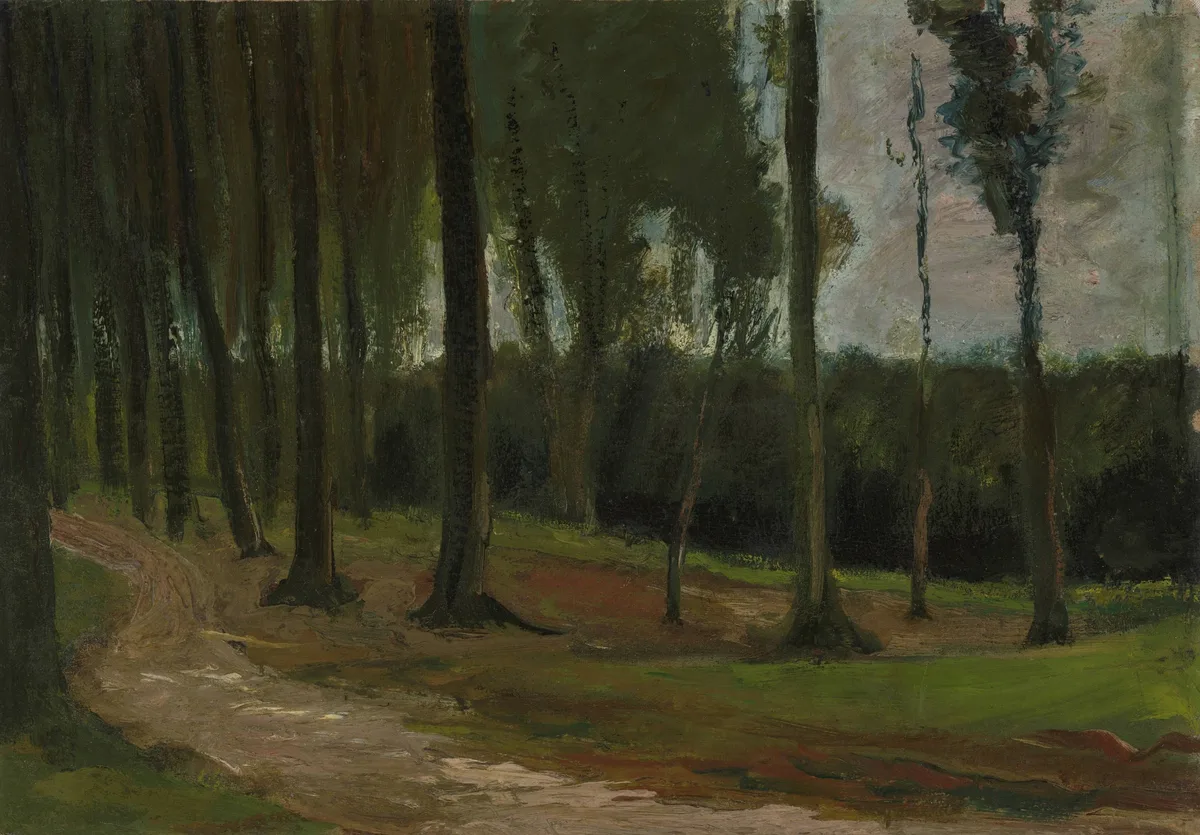
Vincent van Gogh bought a field easel in The Hague at the end of July 1883 and wrote to his brother Theo that with it “one doesn't get as dirty as when one works on one's knees outdoors”. The museum connects this purchase with the slightly raised viewpoint of Edge of a Wood, from which the path and the ground between the trunks are seen a little from above. At the beginning of September Vincent told Theo about a piece of cloth he had bought to make canvases for himself and had then given to Sien Hoornik, the woman he was living with, for vests for her scrawny children. The museum thinks the study may have been painted on an offcut of that very cloth. A few days later Vincent left Sien and The Hague for the province of Drenthe.
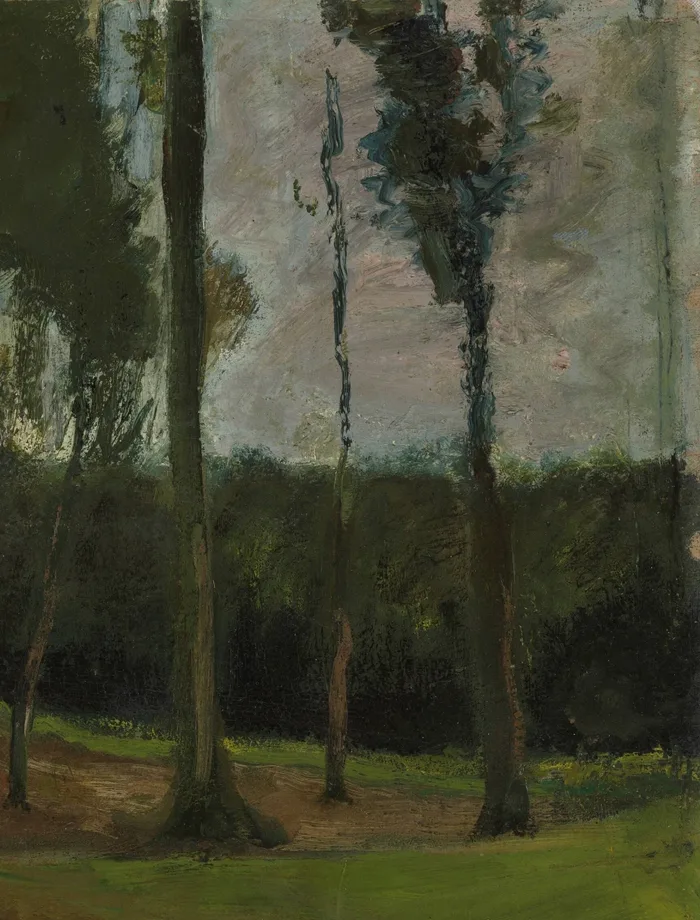
A solid row of tall, straight trunks, brown-green and dark, fills the left side of the picture, their crowns cut off by the top edge. Towards the middle the trunks thin out and pale sky shows between them, and on the right two slender young trees with wavy crowns stand against a grey-lilac overcast sky. A low, almost black band of undergrowth runs across the whole picture, and that band is the edge of the wood. A pinkish-beige sandy path comes in from the left, bends downward and widens along the bottom edge. Rust-red patches of earth lie between the roots, a strip of bright, flat green grass runs along the lower right, and the light everywhere is even and dull, as at dusk.
In 1908, on Bremmer's advice, Helene Kröller-Müller bought this study at auction for 110 guilders. It was her first Van Gogh, a small, dark study from nature of the kind he painted in large numbers and did not sell.
Older catalogues dated Edge of a Wood to August 1882. The museum has moved it a year later, to August–September 1883, on the evidence of the easel and the cloth in the letters.
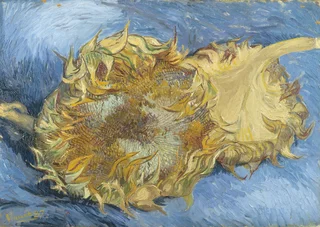
2. Four Withered Sunflowers — Vincent van Gogh, 1887
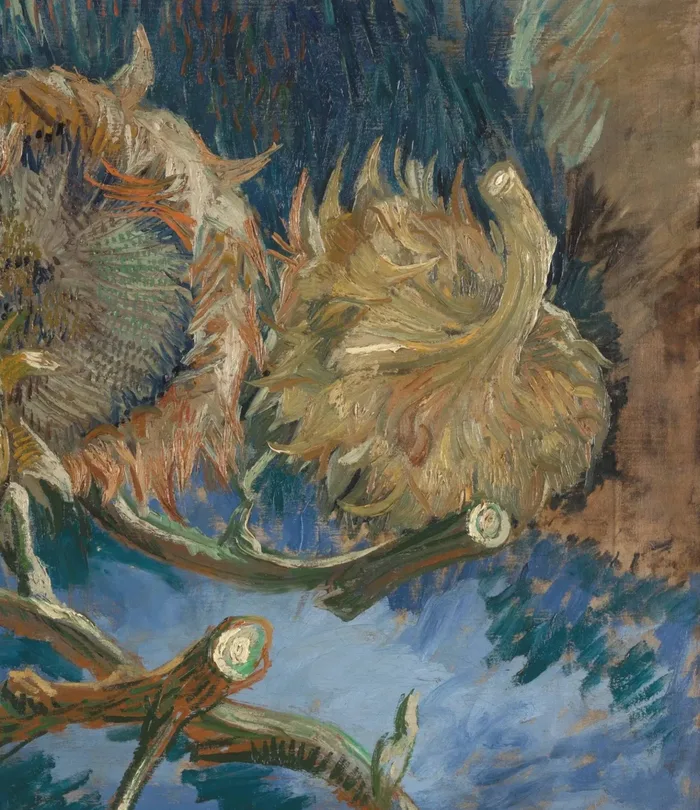
Four large cut sunflowers lie in a row across the canvas, directly on a coloured ground, in a space the museum calls strange and undefinable. The one on the far left lies on its side and shows its green-brown back with a fringe of ochre petals. The two in the middle turn their dark seed discs to the viewer, and the rightmost is turned over, showing a pale, straw-coloured rosette of sepals with the cut stalk in the middle. Several more cut stalks point straight at the viewer with their round, pale ends. The flowers are past their bloom and their petals are ragged, and they are painted in dull ochre, olive and straw, with orange left only at the tips of the petals.
Van Gogh painted the picture in Paris in late summer or autumn 1887, while he was living with Theo in the rue Lepic. A year earlier he had written to the painter Horace Mann Livens that he had made “a series of colour studies in painting simply flowers”, seeking oppositions of blue with orange, red and green, yellow and violet, and trying to render “intense colour and not a grey harmony”. Above the flowers here runs a band of dark blue and blue-green strokes with small orange-red dashes, and in the lower left corner bright orange hatching is drawn across a whitish-green ground.
Helene bought Four Withered Sunflowers in 1908, a few months after Edge of a Wood, and it was her second Van Gogh.
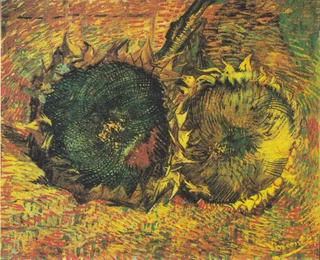
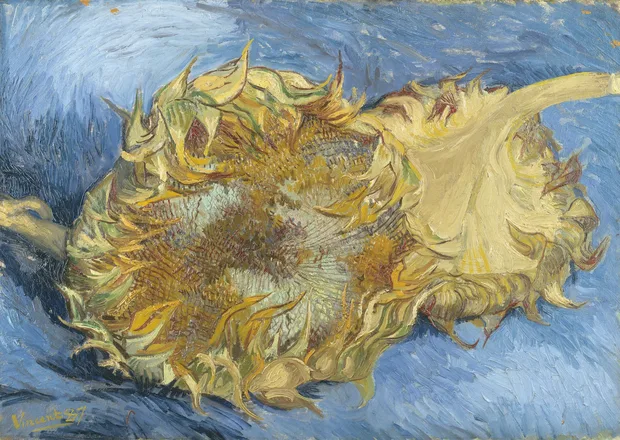
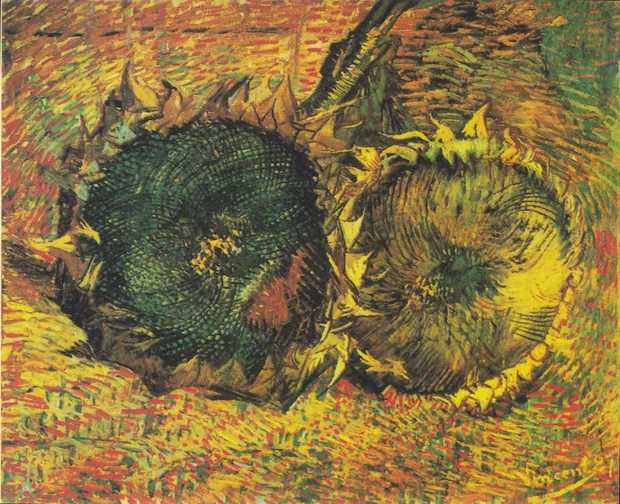
That same summer Van Gogh painted two small canvases, each with two cut sunflowers. At the end of 1887 or the beginning of 1888 Paul Gauguin took both in exchange for a painting of his own and hung them over his bed.
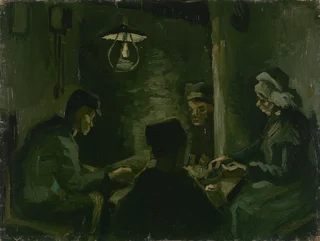
3. The Potato Eaters — Vincent van Gogh, 1885
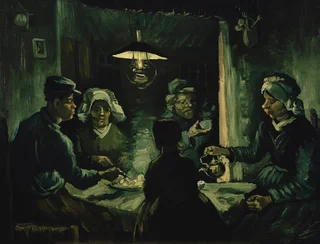
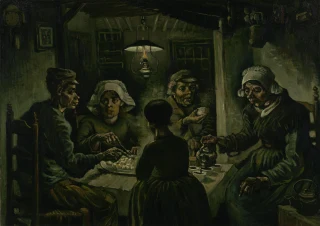
In 1942 Hugo Tutein Nolthenius, a factory director and collector in Delft, received an offer from Bremmer to sell The Potato Eaters to the museum. Bremmer called the painting “an extremely important addition to our collection”, and the museum authorised him to pay up to 7,000 guilders, but Tutein Nolthenius refused. He died in December 1944, after which the painting passed to the Hague dealer Herman d'Audretsch, and in April 1946 the museum obtained it from him in an exchange. In return it gave Landscape with Couple Walking and Crescent Moon, a late Van Gogh from Saint-Rémy that Helene herself had bought, and paid 2,500 guilders on top. The museum's director, Willy Auping, called The Potato Eaters “a crown on our collection of Van Goghs from the Dutch period”.
What Otterlo has is the large painted study made before the Amsterdam picture. In the spring of 1885 in Nuenen, Van Gogh first made a small oil sketch with four figures, now in the Van Gogh Museum, then this second study, almost the size of the finished picture, and only after that the final version, which is also in Amsterdam. The De Groot-van Rooij family sat for him, and he painted the study in their home. On 9 April he told Theo that he was working on “those peasants around a dish of potatoes” again, that he had just come home from them and had gone on working by lamplight, although this time he had started in daylight. He painted the final picture in the studio, from the studies and from memory.
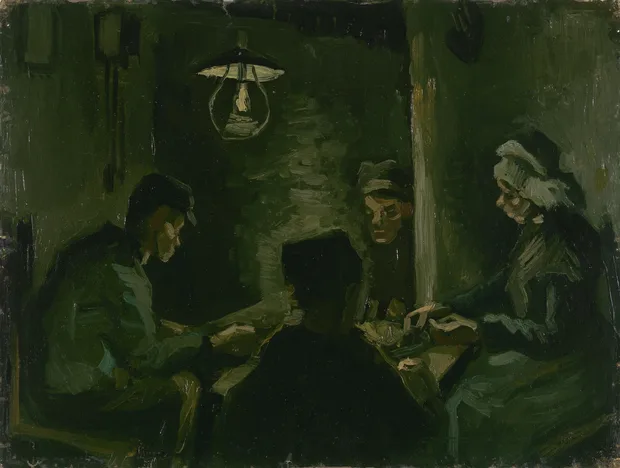
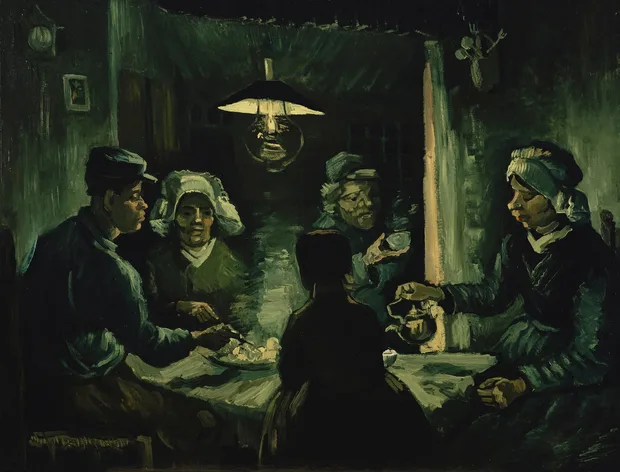
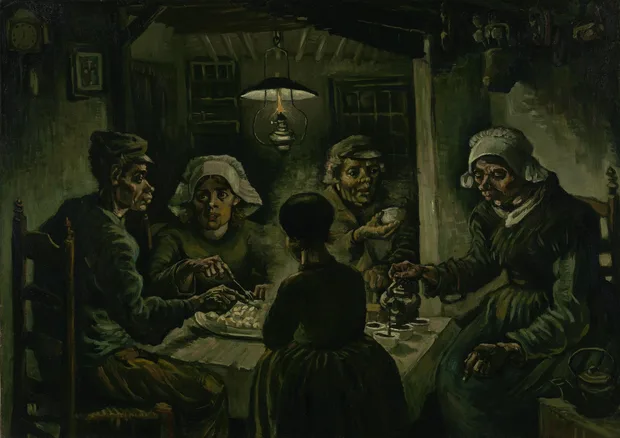
Five people sit at a table under a lamp hung on a rod, and the whole picture is painted in deep greens, blue-greens and greenish ochres. The faces are blocked in with a few quick strokes. In the middle a small figure sits with its back to the viewer, an almost black silhouette against the pale tablecloth. An elderly man behind the table holds a cup on his open palm, and the woman on the right pours from a metal kettle. A round clock hangs on the wall at the left, and at upper right there is a holder with two spoons and two forks.
In 2021 the Van Gogh Museum held an exhibition on how The Potato Eaters came to be made and showed the small sketch and a pencil drawing in it. Otterlo did not lend its study. According to The Art Newspaper, it is one of the most popular paintings in Otterlo, and visitors expect to see it there.
Van Gogh: From Seeing to Meaning
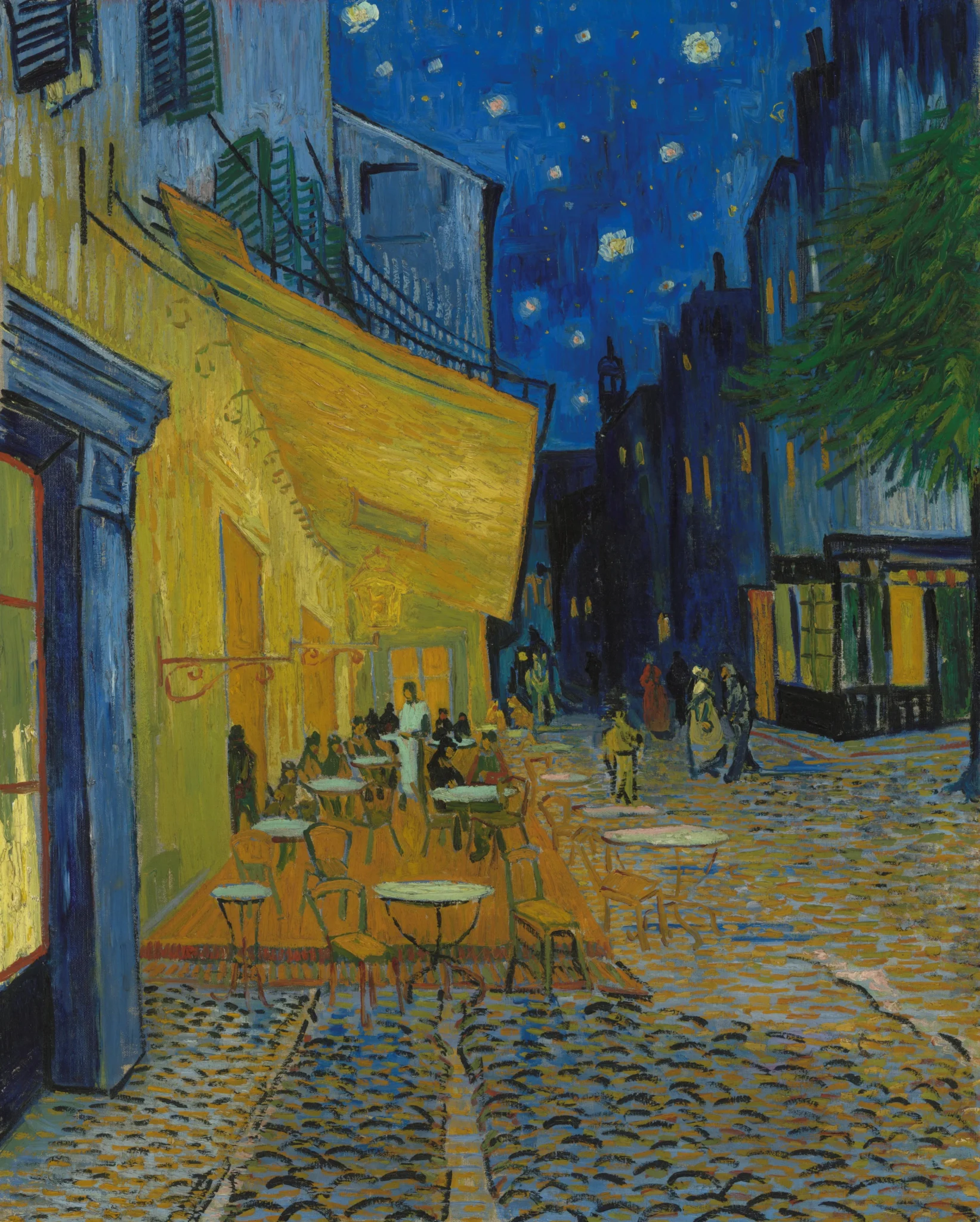
4. Café Terrace at Night — Vincent van Gogh, 1888
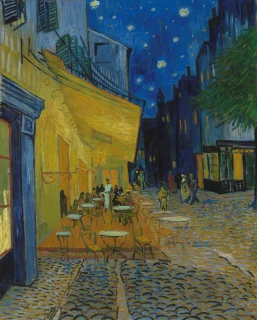
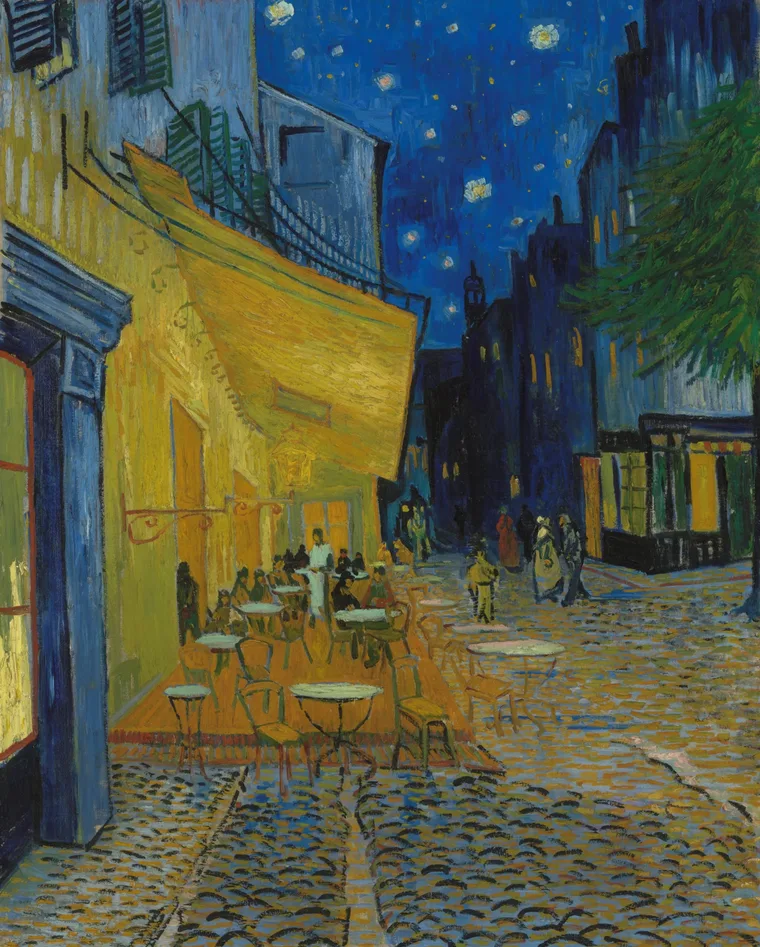
On 30 September 1888 the Arles paper La Chronique artistique et musicale told its readers that Monsieur Vincent, an Impressionist painter, was working, so they were assured, in the evenings by the light of the gas lamps in one of the town's squares. The square was the Place du Forum, and by then Van Gogh had already finished his painting of it. In mid-September he had written to his sister Wil that he enormously enjoyed painting on the spot at night. In the past, he explained, people drew at night and painted the picture from the drawing in the daytime, but it suited him to paint the thing straightaway. This picture, he wrote, was “a painting of night without black. With nothing but beautiful blue, violet and green, and in these surroundings the lighted square is coloured pale sulphur, lemon green.”
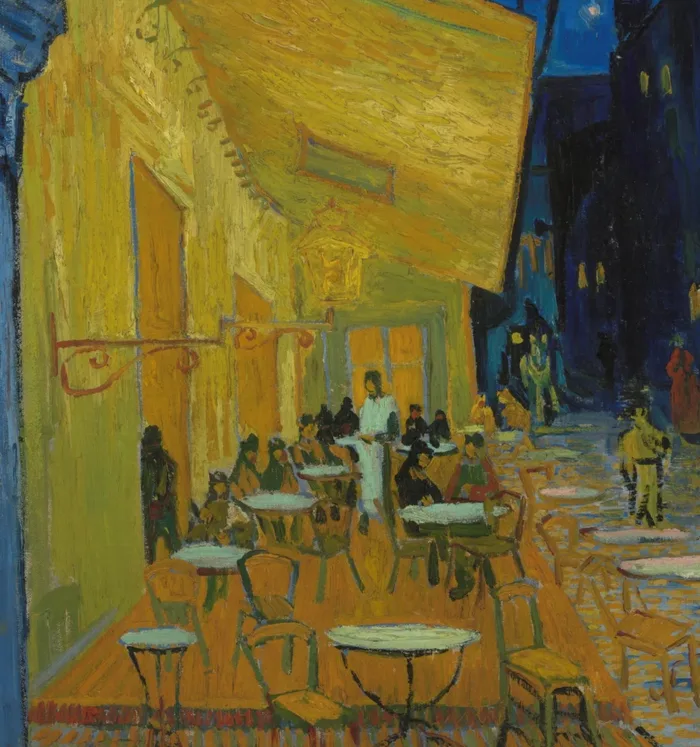
The big yellow awning comes into the picture at upper left and ends in a sharp corner right of centre, and the café wall beneath it glows yellow-green and orange. The lantern that the letter calls huge and yellow appears on the canvas as a small many-sided shape under the awning, outlined in orange. A waiter in a long white apron stands among the round tables. The right half recedes into a dark blue street with violet houses, and a pale horse can be seen at the end of it. The stars above the roofs are round, whitish-yellow blots with pale haloes, some of them with pink or orange centres. The cobbles are built from short strokes of ochre, light blue and grey-blue, and each stone is edged with a dark, almost black arc.
From the autumn of 2025 the painting spent almost a year in Japan, at an exhibition named after it. While it was away, the museum built a set of the Place du Forum in Otterlo, and visitors had their photographs taken “on Vincent's terrace”.
This was the first starry sky Van Gogh painted. Starry Night over the Rhône followed at the end of the same September and The Starry Night in June 1889, and he came back to a star over a road a few days before he left Saint-Rémy (no. 8).
5. The Langlois Bridge at Arles with Women Washing — Vincent van Gogh, 1888
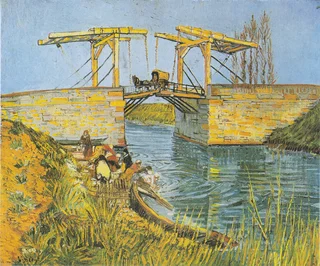
The collection of the Dutch collector Cornelis Hoogendijk was auctioned in Amsterdam on 21 May 1912, and Bremmer bid there for the Kröllers. That day they took 15 paintings, four Van Goghs among them. For The Langlois Bridge Bremmer paid almost 16,000 guilders, more than five times the starting price. Helene called it one of “the most beautiful, most powerful, the crystal-clearest”.
Van Gogh painted it in mid-March 1888, in his first weeks in Arles, and in those same days he told Theo, “you know, I feel I'm in Japan”. The wooden drawbridge stands in the middle of the picture, two yellow frames with long lifting beams against a turquoise sky. The deck is down, and a horse is pulling a small yellow covered cart across it. At lower left, on a wooden landing by the water, washerwomen in blue, pink, red and white bonnets are at work: one stands wringing out linen, the others bend over the water, and beside them rings spread across the blue surface.
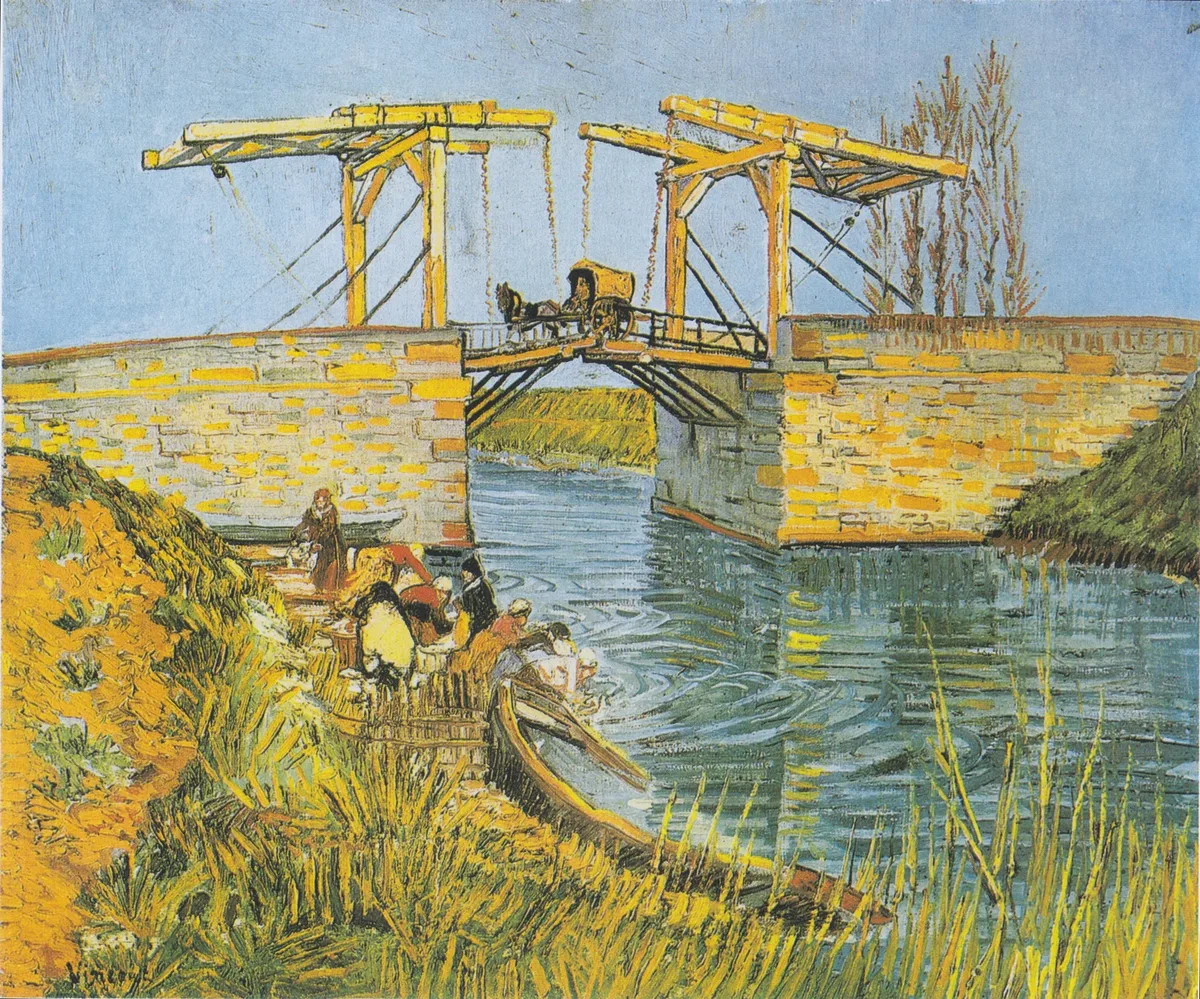
At the beginning of April Van Gogh chose this canvas for Tersteeg, the Hague art dealer under whom he had started work at the firm of Goupil as a teenager. Tersteeg had asked Theo to send him the Impressionists that Theo himself thought among the best, and Vincent wanted to convince his former employer that he too was an Impressionist. He designed a frame for it in royal blue and gold, the flat part blue and the outer strip gold, and wrote a dedication to Tersteeg on the canvas. Tersteeg never received it. Someone later scraped off the dedication, and just above the signature “Vincent” in the lower left corner the paint is thin at that spot or worn down to the weave of the canvas.
In 2026, when the museum showed all 88 of its Van Gogh paintings together for the first time since 1984, a relief copy of The Langlois Bridge was made for blind visitors to explore with their hands, and an audio description was recorded to go with it.
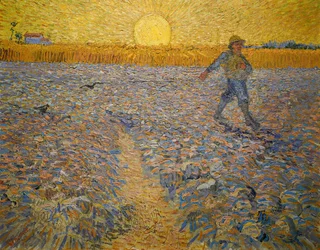
6. The Sower (Sower at Sunset) — Vincent van Gogh, 1888
Van Gogh had wanted to paint a sower for a long time, and on 21 June 1888 he admitted to Theo that “the desires I've had for a long time aren't always achieved”. After Jean-François Millet, whose Sower he had copied many times since deciding to become an artist, what remained to be done, as he put it, was “the sower, with colour and in a large format”. The canvas he was then working on in Arles worried him. He called it a study and wondered whether he should later make “a tremendous painting” out of it.
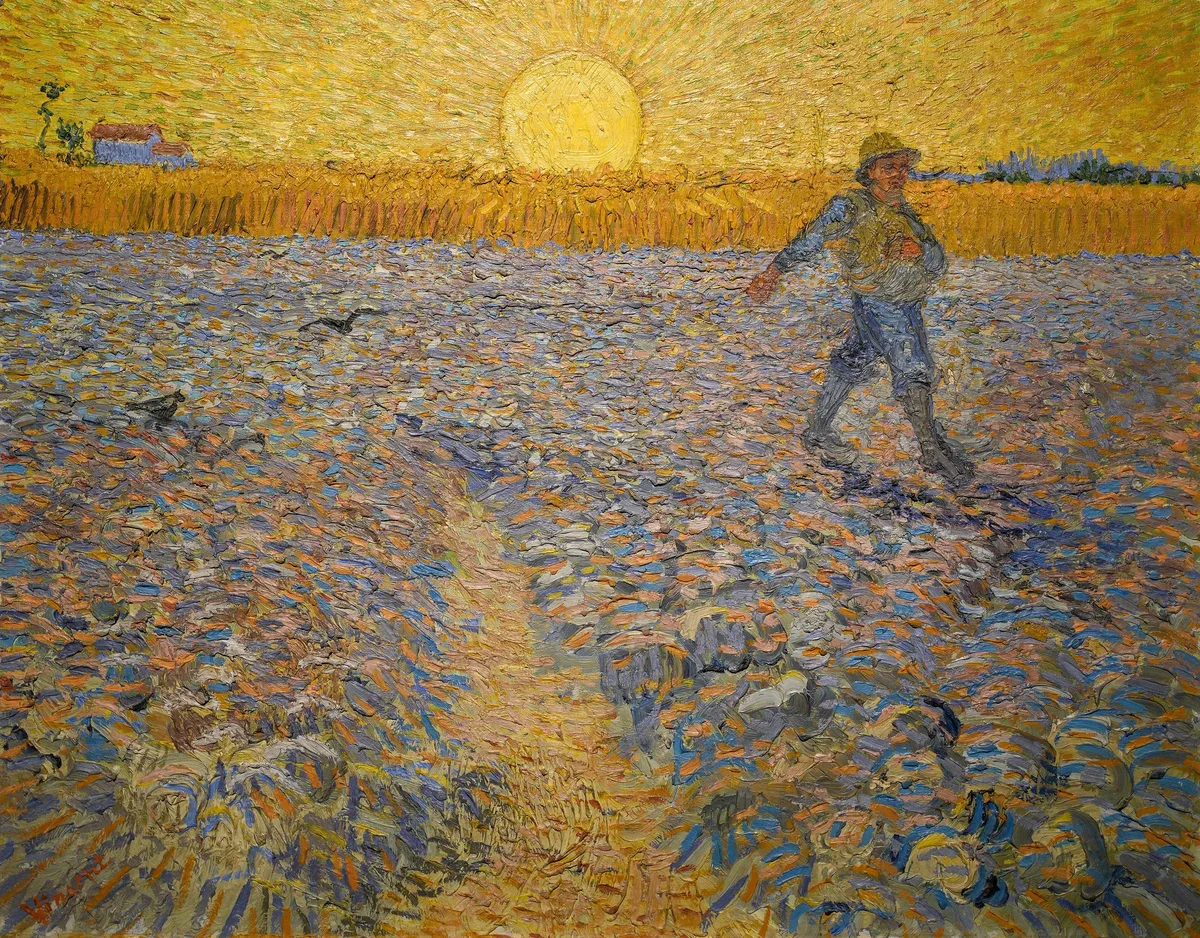
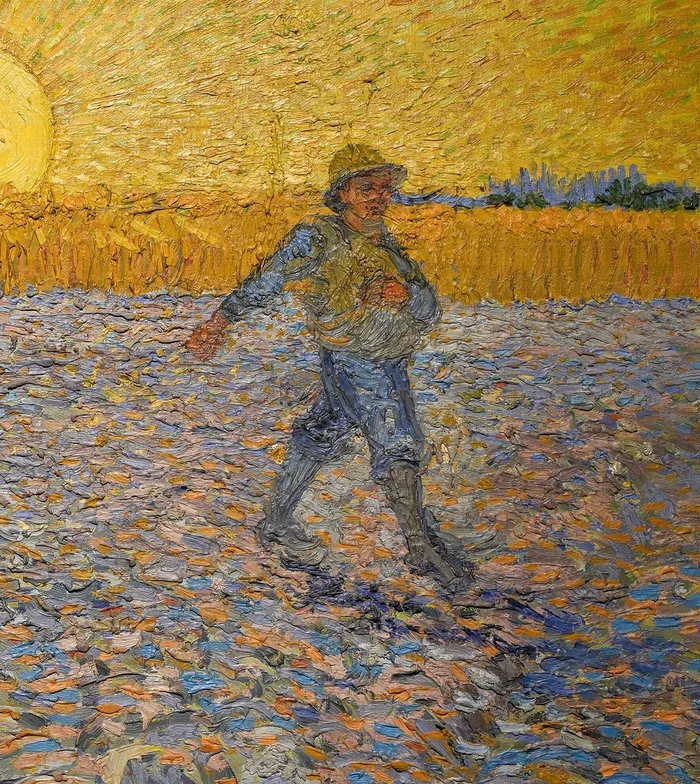
The picture is divided into three bands: yellow sky, a narrow strip of ripe wheat and the ploughed field, which fills two-thirds of the height. A huge, pale yellow sun sits right on the horizon a little left of centre, and rays of short yellow strokes with pale green sparks spread from it across the whole sky. The sower, in the right third of the canvas, strides to the left and towards the viewer, one arm flung out to the side and the other dipped into a grey seed bag, and a long blue shadow stretches from his feet. The field is laid on in thick strokes of blue, violet, orange, cream and white, and at the bottom the clods stand out almost in relief. Two black birds fly over the left half of the field, and a third sits on the ground.
Around 19 June Van Gogh described the picture to the painter Émile Bernard, and at that point the sky was chrome yellow, almost as bright as the sun itself, and the sower's trousers were white, to rest the eye from the “excessive simultaneous contrast of yellow and violet”. Around 28 June Van Gogh repainted the picture completely, and the sky on the canvas is now yellow-green and the trousers blue. In the same letter to Bernard he confessed that “yearnings for that infinite of which the Sower, the sheaf, are the symbols, still enchant me as before”. A week later he wrote to Bernard about Christ, “an artist greater than all artists”, and about his parables, “what a sower, what a harvest, what a fig tree”.
On 21 May 2025, at his first general audience, Pope Leo XIV spoke about the parable of the sower and brought up The Sower at Sunset. The sower, he said, stands to one side, and the whole painting is dominated by the sun.
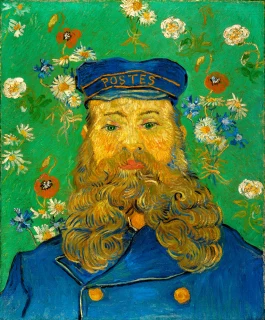
7. Joseph Roulin — Vincent van Gogh, 1889
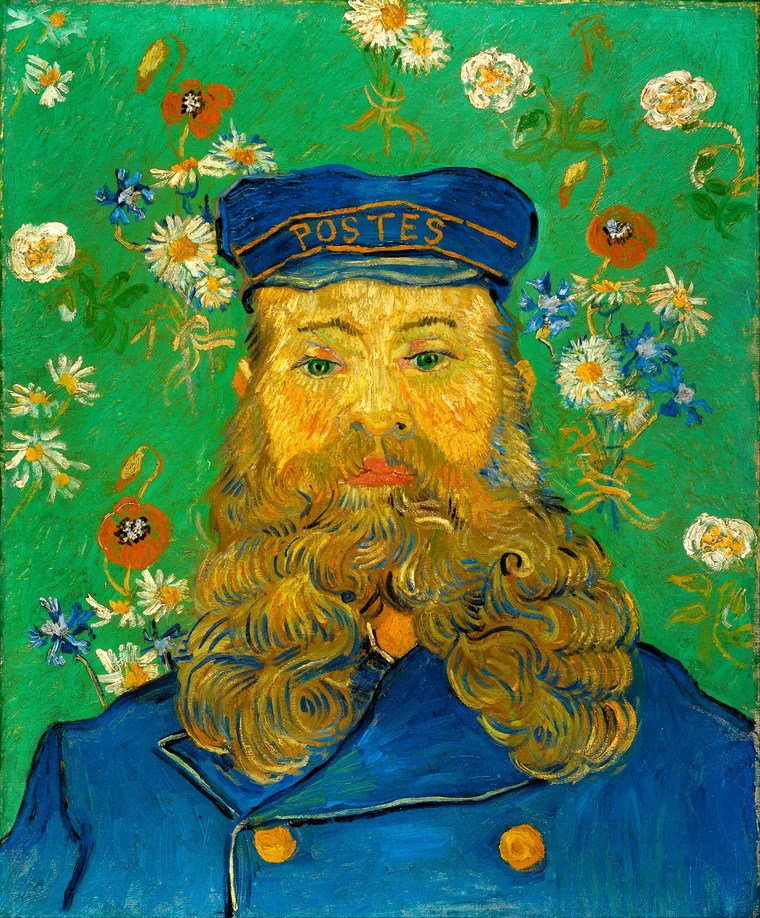
Joseph Roulin worked for the post office at the Arles railway station, loading and sorting the mailbags. Van Gogh painted him six times, between August 1888 and the spring of 1889. After the business with the ear at the end of December 1888, Roulin took him home, saw him into hospital and took charge of his affairs. On 21 January 1889 Roulin left to take up a post in Marseille, and around 4 April, on his 48th birthday, he came back to visit his friend. Van Gogh then wrote to Theo: “While Roulin isn't exactly old enough to be like a father to me, all the same he has silent solemnities and tendernesses for me like an old soldier would have for a young one.”
The letters mention no sittings after 21 January, so researchers think that Van Gogh painted the last three portraits, the ones with flowers in the background, from the earlier ones and from memory. The museum dates the Otterlo portrait to February–March 1889, while others connect it with Roulin's visit in April. As early as September 1888 Van Gogh had told Theo that he would like “to paint men or women with that je ne sais quoi of the eternal, of which the halo used to be the symbol, and which we try to achieve through the radiance itself, through the vibrancy of our colorations”.
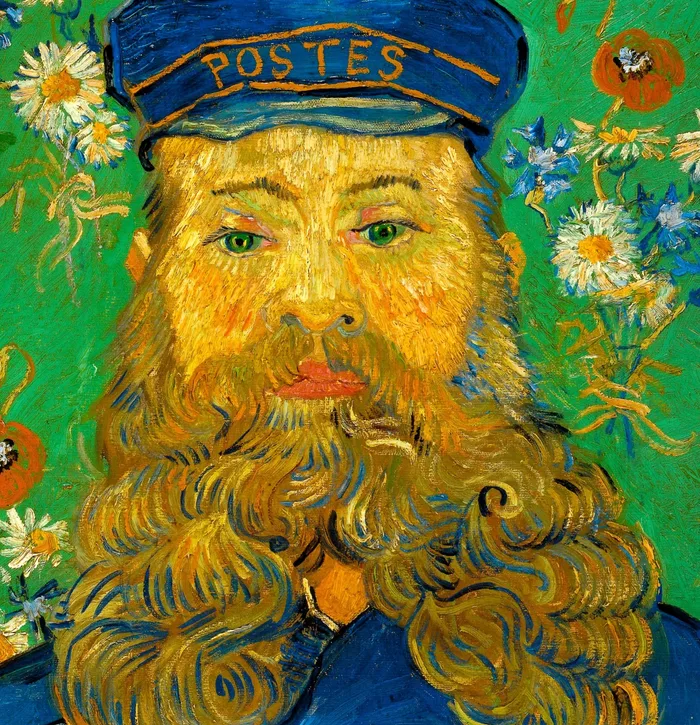
Roulin looks straight at the viewer, strictly from the front, and his shoulders run off the edges of the canvas. POSTES is lettered in orange on his blue cap. The green ground, laid in with cross-hatching, is strewn with flowers like wallpaper, with red poppies with black-and-white centres, white daisies, blue cornflowers, full white roses and three unopened poppy buds on curling stems. The face and the beard are painted in the same warm ochre, and to the right of the chin one curl of the beard is outlined in black and wound into a tight spiral.
The first known owner of the portrait was the painter Émile Schuffenecker. The authors of the 2003 catalogue of the Otterlo collection thought it quite possible that Van Gogh gave the only signed portrait of Roulin, the one now in the Barnes collection, to the postman himself, and meant this one for his wife, Augustine.
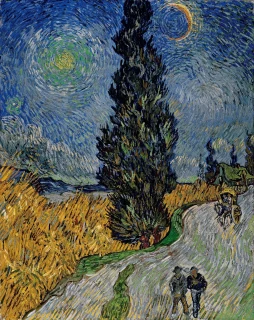
8. Road with Cypress and Star — Vincent van Gogh, 1890
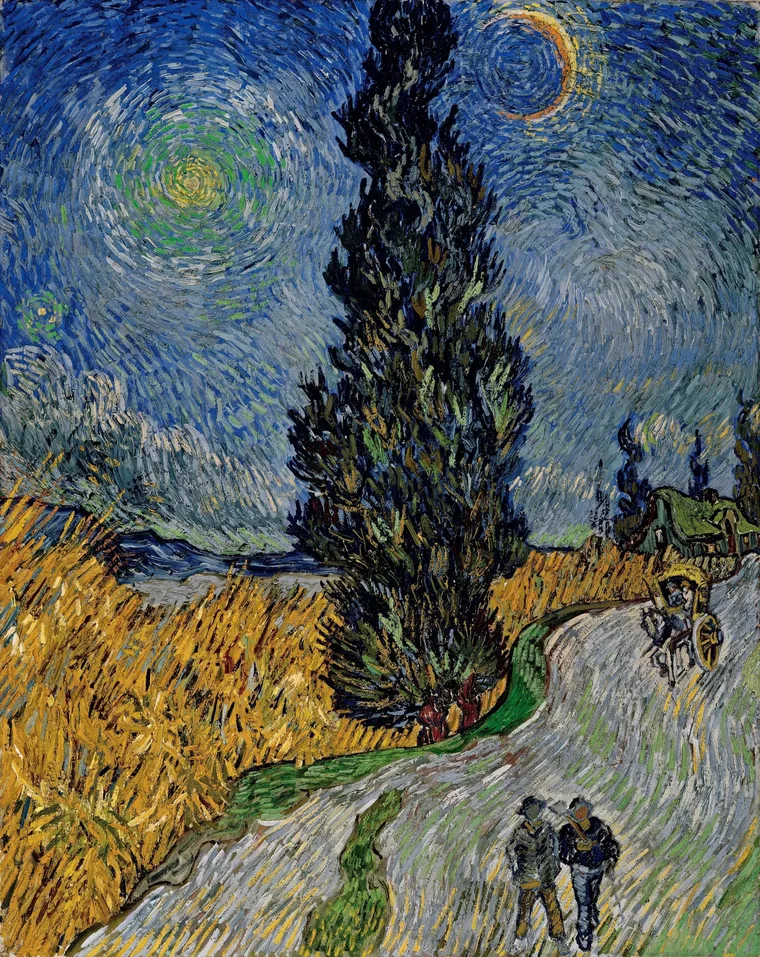
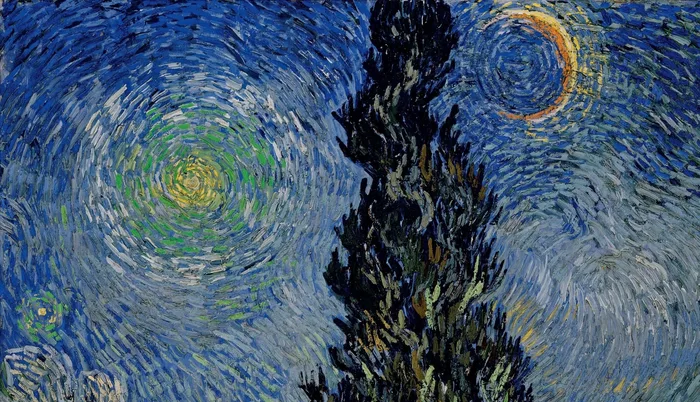
A tall, almost black cypress stands in the middle of the picture, runs off the top edge and divides it in two. To its left a large star made of concentric rings of pale yellow and green strokes burns in the sky, with a second, smaller one below it, and to its right is a thin orange crescent moon in rings of light blue strokes. The whole sky swirls with blue strokes around the star and the moon. At lower left tall yellow-ochre canes rise. Two men walk towards the viewer along the pale grey-lilac road, and the one on the right carries a hoe or a pick with a pale blade on his shoulder. Further back a carriage with a yellow hood, drawn by a white-grey horse, comes along the road, and a low house with a green roof stands at the right edge.
Van Gogh painted it in Saint-Rémy around 12–15 May 1890, one of his last pictures before he left the asylum on 16 May. The museum calls it Country Road in Provence by Night and considers the view invented, a summing-up of his impressions of Provence. In June, by then in Auvers, Van Gogh began a letter to Gauguin and described this painting in it, but he neither finished the letter nor sent it. Theo's widow, Johanna van Gogh-Bonger, later found the draft among his papers. “I also have a cypress with a star from down there. A last try, a night sky with a moon without brightness, the slender crescent barely emerging from the opaque projected shadow of the earth, a star with exaggerated brightness, if you like, a soft brightness of pink and green in the ultramarine sky where clouds run.” He went on to list the road bordered by canes, an old inn with orange lighted windows, the yellow carriage and “two late walkers”, and concluded that it was “very romantic if you like, but also ‘Provençal’ I think”.
The Texas astronomers Donald Olson and Russell Doescher calculated that on the evening of about 20 April 1890 a thin crescent moon stood over Saint-Rémy close to Venus and Mercury, and they believe that Van Gogh remembered this sky, although on the canvas the moon and the two planets are placed in mirror image.
He intended to make an etching of the picture, together with other reminiscences of Provence, and to send it to Gauguin, but the etching was never made.
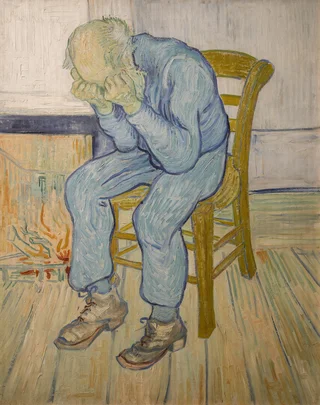
9. At Eternity's Gate (Sorrowing Old Man) — Vincent van Gogh, 1890
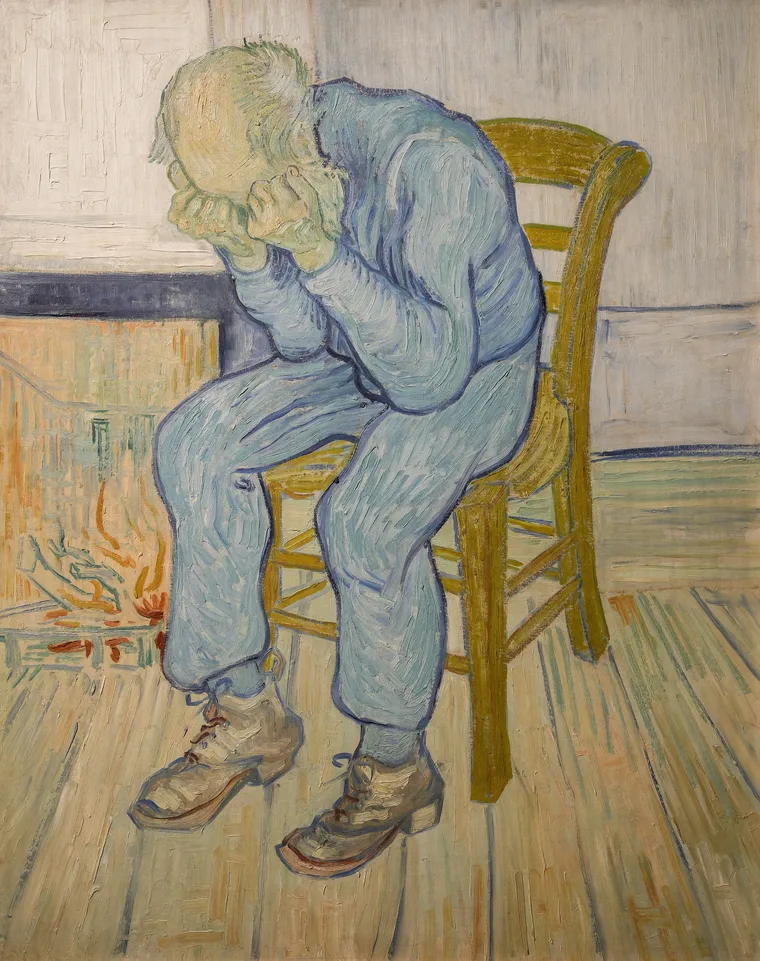
Adrianus Zuyderland, a pensioner from a Hague almshouse and a war veteran, bald and with sideburns, posed for Van Gogh about 40 times. In November 1882 Van Gogh spent two days in a row drawing him seated, elbows on his knees and his face in his hands. He had drawn the same pose a year earlier in Etten, from another old man, and, as he wrote to Theo, “always kept the drawing, because I wanted to do it better another time”. The Hague drawings were called Worn Out. From one of them he made a lithograph, and on one of the seven known impressions he wrote in English “At Eternity's Gate”. A few days later he explained to Theo that one of the strongest pieces of evidence for the existence of “something on high”, the God and the eternity in which Millet believed, was “the unutterably moving quality that there can be in the expression of an old man like that … as he sits so quietly in the corner of his hearth”. That was what he had tried to say with the lithograph.
Eight years later, at the end of April 1890 in Saint-Rémy, Van Gogh came out of an attack that had lasted about nine weeks and asked Theo to send him his old figure drawings. In May he painted this old man in oils. The painting took over the lithograph's title as well, and the museum gives it in brackets after its own, Sorrowing Old Man.
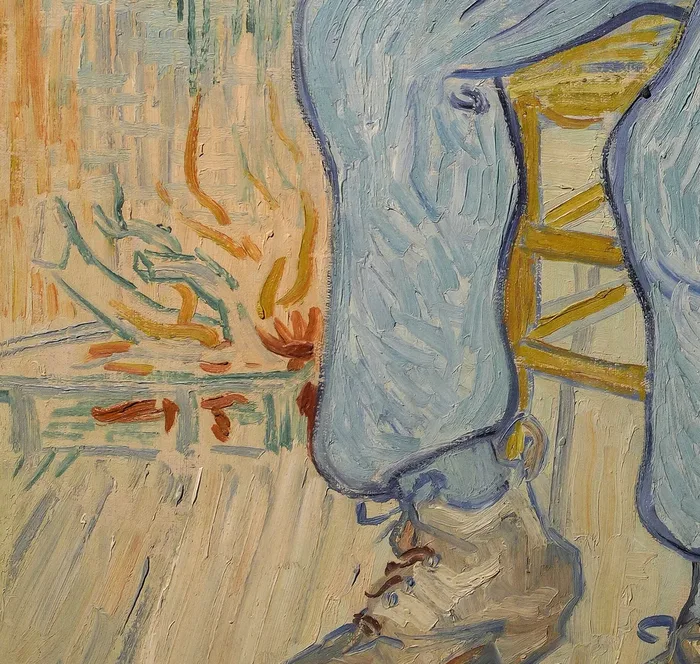
The face cannot be seen. The old man is bent double with both fists pressed into his eyes, so that only the cream-coloured bald crown with greenish strands of hair shows. The pale blue suit is drawn in long parallel strokes with a dark blue outline, the chair is mustard-olive, and the worn, light-coloured boots stand apart. Right by his shins a small fire burns in the hearth, a few orange strokes and some red embers, and these embers are the only red in the picture.
The museum suggests that Van Gogh took the chair and the stove from the furnishings of the asylum, and that one of the patients may have posed for him.
Ancestors and Neighbours
10. Venus and Amor — Hans Baldung Grien, 1524–1525
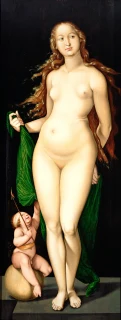
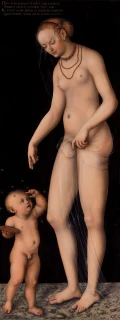
In the summer of 1940 Kajetan Mühlmann, an SS officer, went to see the museum's director, Sam van Deventer, and demanded three 16th-century German paintings by way of “repatriation”: Venus and Amor by Hans Baldung Grien, Venus with Amor the Honey Thief by Lucas Cranach the Elder and a double panel by Barthel Bruyn the Elder. The demand rested on the claim that the paintings held great emotional value for Germany, and Hermann Göring argued in addition that the Kröllers had bought them cheaply after the First World War. Helene had bought the Baldung on Bremmer's advice in 1913, before the war. In July Reichskommissar Seyss-Inquart visited the museum, and under German pressure the museum gave up the three paintings for 600,000 guilders. The deal was left out of the annual report and recorded only in the “Secret Report”. The Baldung went into Göring's collection.
The panel is tall and narrow, taller than a person, and the naked Venus on it stands at about life size against a dark, almost black ground. She holds a green satin cloth by both ends, one at her waist in her raised hand and the other at her side in her lowered hand, and it hangs behind her without covering anything. At lower left Amor sits on a large pale ball. In one hand he holds an arrow with a burning tip, and with the other he grips the green cloth. His blindfold is pushed up onto his forehead, and with one eye he looks up at his mother.
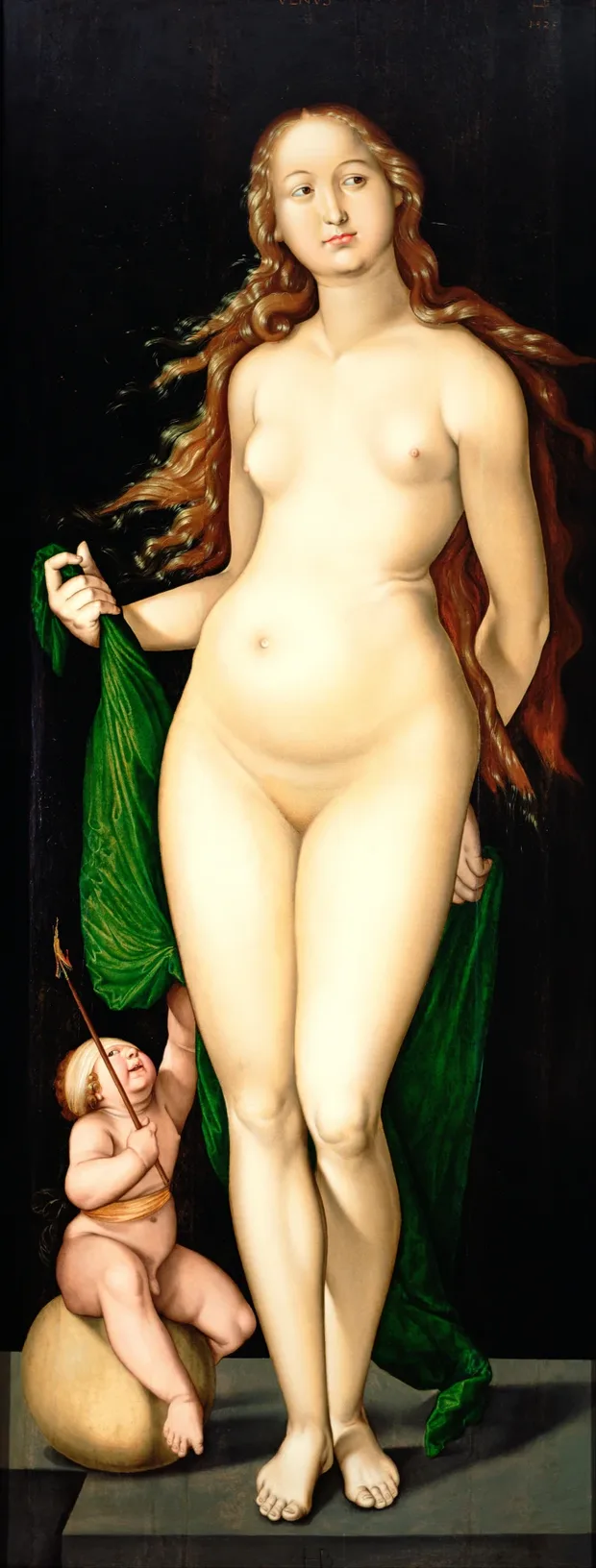
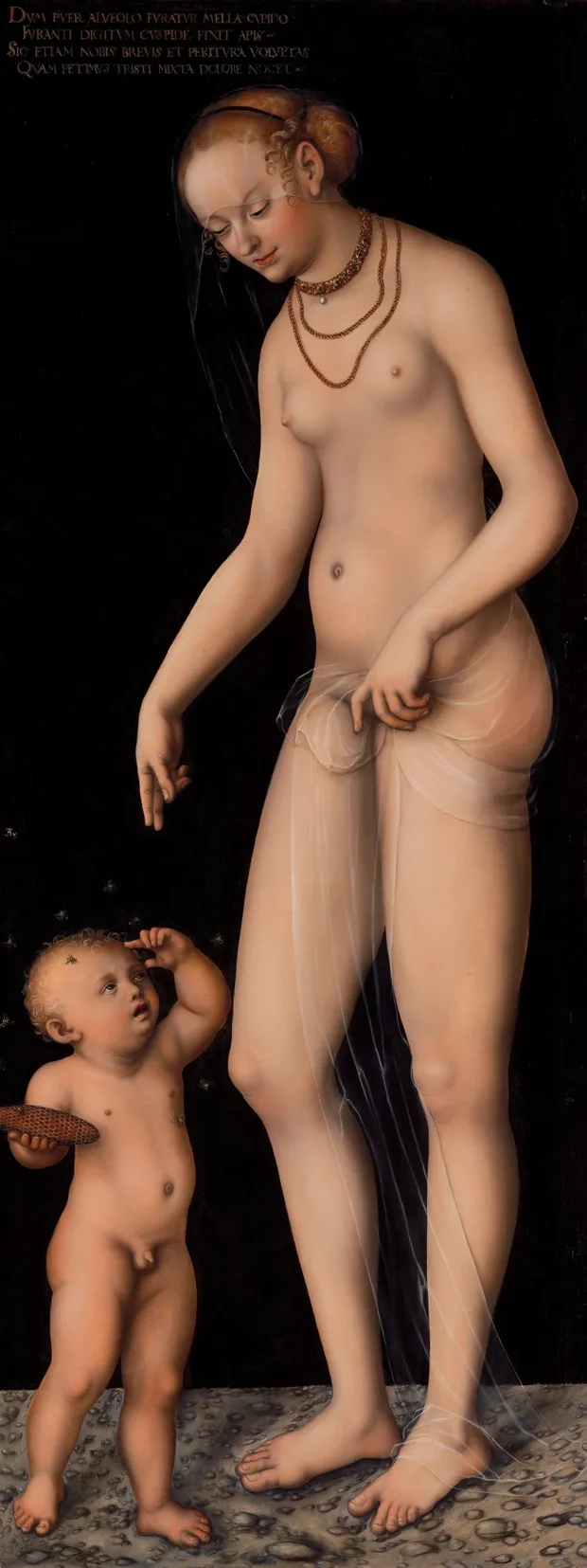
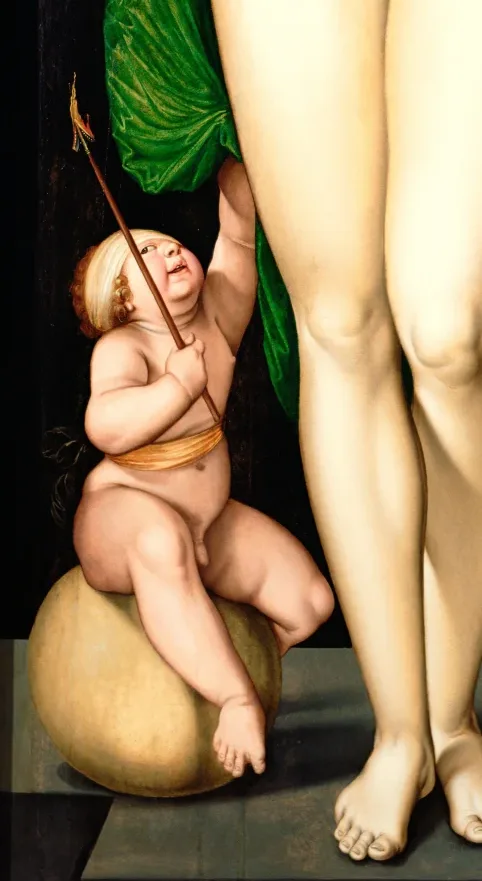
The museum reads the picture as a moral lesson. Amor in his blindfold cannot see the truth, which is the ball he sits on, and if he could, he would know that spiritual love of God outlasts carnal love and that the beauty of Venus is fleeting. Neither Helene nor Bremmer explained why a collector of Van Gogh wanted a German master of the 16th century.
According to the museum, the money paid for about 20 paintings bought by 1946, first a portrait of a man by Manet and a road leading to a lake by Cézanne, then works by Degas, Gauguin, Pissarro and Corot. Two of them had to be given up after the war, because they had been taken from Jewish collectors in Berlin and Paris.
On 7 November 1945 Venus and Amor was returned to the Netherlands. Since then the painting has belonged to the Dutch State's collection of art recovered after the war, where its number is NK2640, and it is in Otterlo on long-term loan.
11. Le Chahut — Georges Seurat, 1889–1890
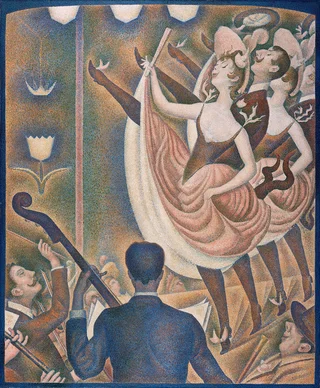
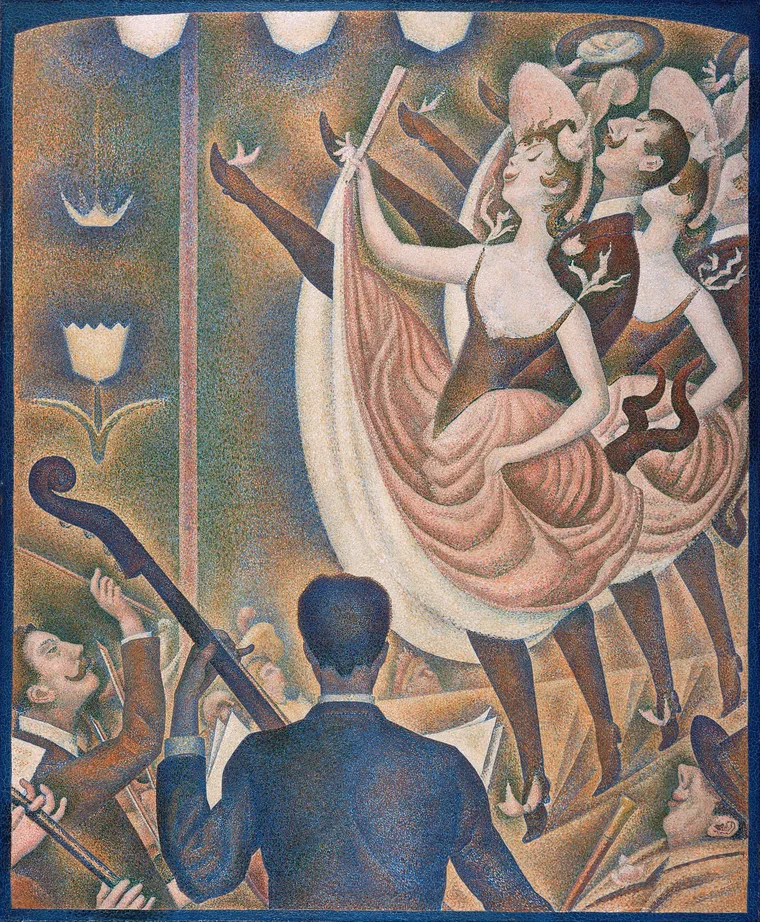
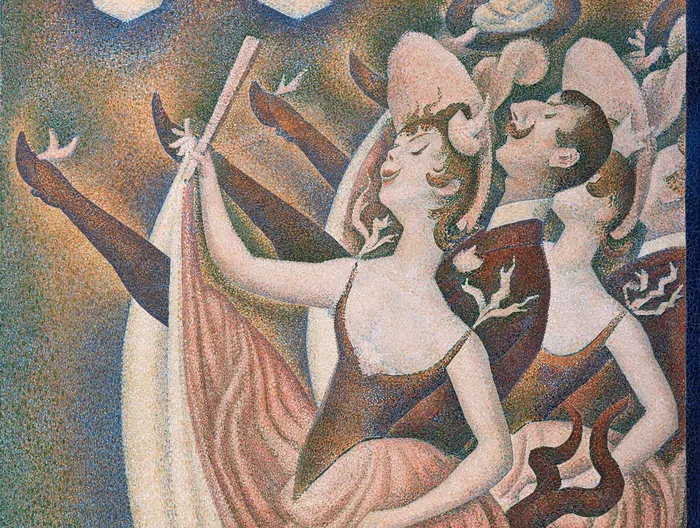
In 1922 Helene wrote a long letter to Sam van Deventer, later the director of her museum, in defence of one painting. Her youngest son had been astonished that his mother had bought, of all things, a dance, and for the first time, Helene wrote, he had not understood her. She explained that Le Chahut had taught her to see more in dance than the soulless swinging of arms and legs it had always seemed to her.
The painting was bought in February 1922 at the Hôtel Drouot auction house in Paris, at the sale of the collection of Richard Goetz, a German painter and collector who had lived in Paris since 1900. During the war France had sequestered his collection as the property of a German national, and in 1922 it was put up for auction. The architect Henry van de Velde, who was then designing the large museum for her, told Helene about the sale. Le Chahut was her last major purchase before the financial crisis of 1922, which halted the building of that museum.
Georges Seurat painted Le Chahut in the winter of 1889–1890 and showed it at the Salon des Indépendants in the spring of 1890. It was the last large painting he managed to finish. He died in March 1891, at the age of 31.
Four legs in dark stockings kick up and to the left in parallel, as identical diagonals. The corners of the mouths of the dancers, whose eyes are closed, turn upward, and so do the moustache of the man in the dark red jacket and the bows on the costumes. Seurat was following the theory of the scientist Charles Henry that rising lines convey gaiety. In the lower right corner a man in a hat looks up at the dancers from below, narrowing his eyes and smiling. Everything is painted in small separate dots, and a dark blue dotted border runs round the edge of the canvas, bowing up at the top into a shallow arch.
At Groot Haesebroek, the Kröllers' villa in Wassenaar, Le Chahut hung above a sofa in a richly furnished drawing room, and anyone sitting there could lean their head against its frame.
12. The Cyclops — Odilon Redon, c. 1914
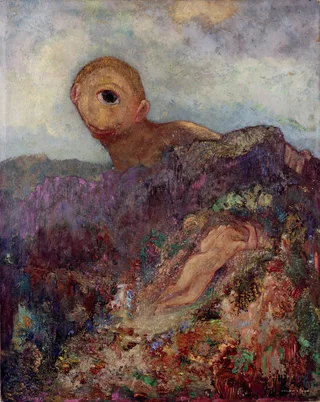
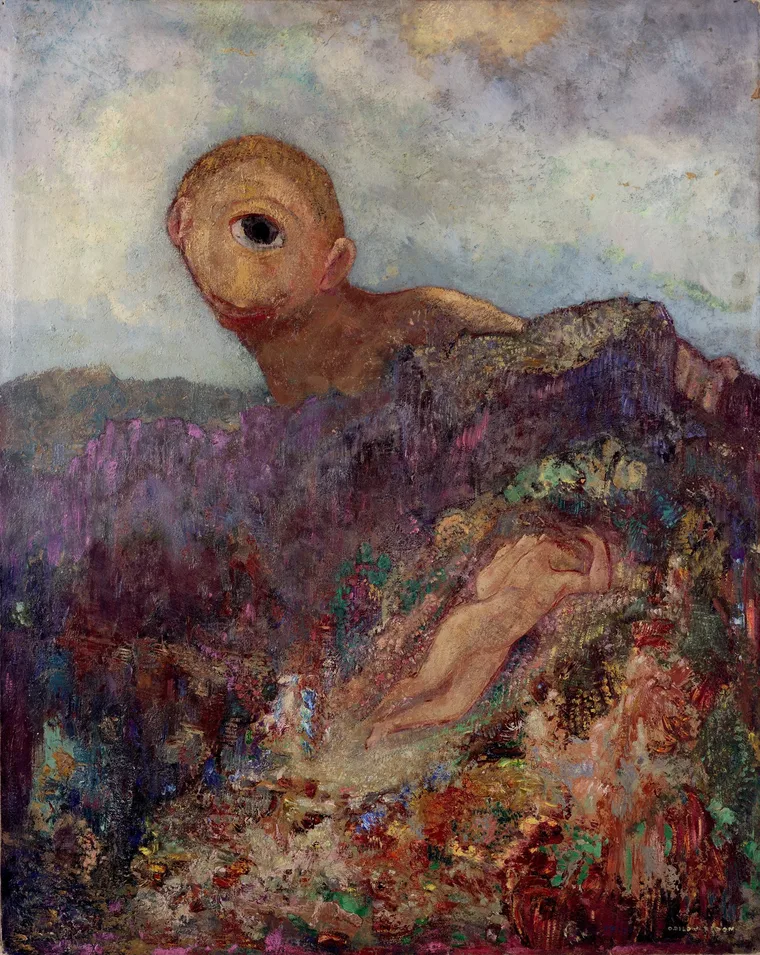
In Ovid's Metamorphoses the one-eyed giant Polyphemus loves the Nereid Galatea, while she loves Acis, and in the end the Cyclops kills Acis with a lump of rock. Redon painted what came before, when Polyphemus is only watching.
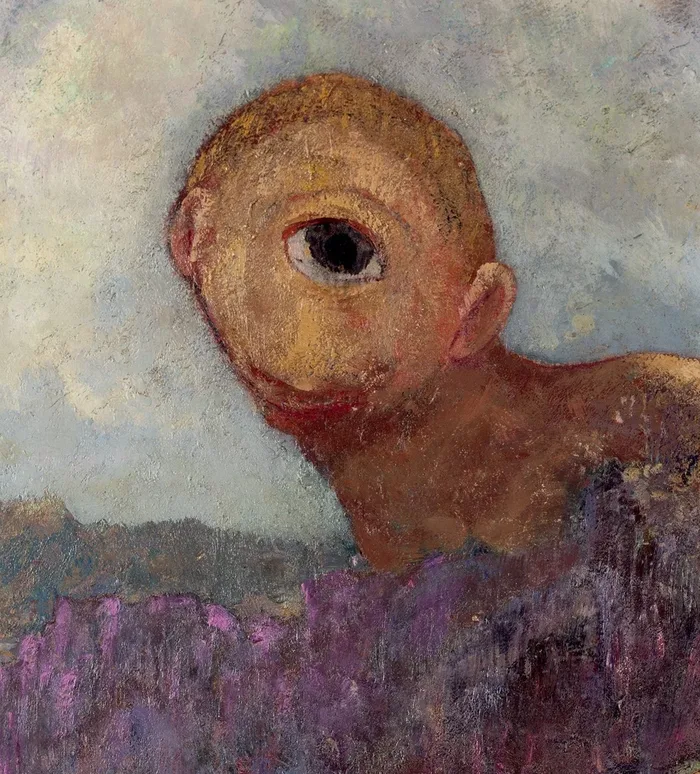
A round, bald, ochre-orange head rises over a mountain ridge, and almost the whole face is taken up by a single eye, grey-white with a dark iris and a black pupil, ringed with red. The pupil sits exactly in the middle, so the Cyclops seems to look at the viewer rather than down. Galatea lies further to the right, halfway up, naked on a flowering slope, and her body is the same warm pinkish colour as the slope, so that she dissolves into it. The sky is pale, grey-blue with a tinge of green, and the violet is kept for the rock at the left. Lower down, the slope is built of patches of green, turquoise, red, orange, yellow and pink in which flowers can be made out.
The museum reads this gaze as spying and menace, which the bright, unusual colours only heighten. Other writers see the giant as a shy lover who does not dare to come closer.
For many years Redon worked only in black, in charcoal and lithography, and single floating eyes often appear in these sheets, which he called his noirs. According to the museum, the eye in Redon's work often becomes a being in its own right and stands for the human soul and a mysterious inner world. Redon was known early in the Netherlands, and around 1920 Bremmer published facsimiles of his prints. The museum dates The Cyclops to about 1914, two years before the artist's death, while other catalogues give dates as early as 1898.
In the lower right corner ODILON REDON is written in pale yellow-green capitals, and just to the left a fainter blue inscription, ODILO..., shows through, apparently an earlier signature.
Mondrian, Gris, Léger
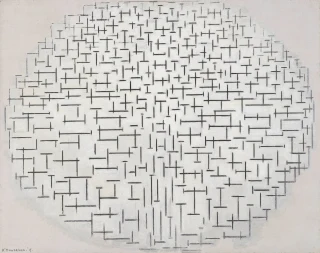
13. Composition 10 in Black and White (Pier and Ocean) — Piet Mondrian, 1915
Piet Mondrian, a Dutch painter who before the war had worked in Paris and painted grids there that grew out of cubism, came to the Netherlands in the summer of 1914 to visit his family, and once the war began he could not go back. He was a theosophist, and the museum describes his aim as the harmony and rhythm of opposites, horizontal and vertical. In 1914 he lived by the sea, in Domburg and Scheveningen, and drew the sea, the breakwaters and the starry sky, and from these drawings came the canvas he finished for an exhibition at the Stedelijk Museum in Amsterdam in October 1915.
Almost the whole canvas is taken up by an oval of short black bars, only horizontal and vertical, some single, some combined into plus signs and the letters T and H, and no two of them are alike. As the museum reads it, the long horizontals across the middle are the waves, and the cluster of verticals at the bottom centre is a breakwater running out into the sea. Pale grey bars can be seen beside the black ones, painted over or left half-transparent. The white inside the oval is brighter and cooler than in the pinkish-grey corners, and in the lower left corner is the signature “P. MONDRIAAN. '15”. The museum considers this Mondrian's first painting in black and white alone.
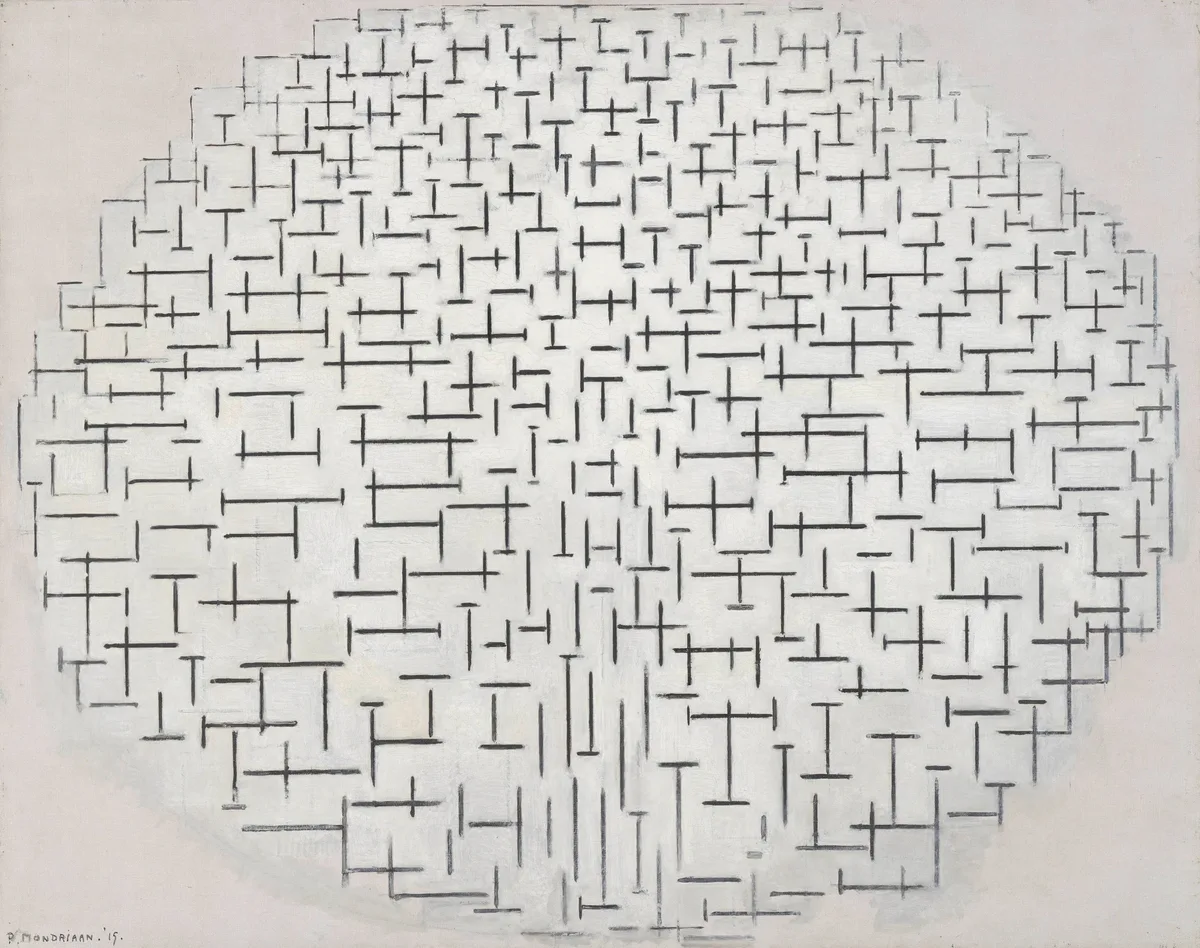
Bremmer bought it for Helene a few weeks after it was first shown. The painter Theo van Doesburg saw the canvas at the exhibition and wrote that Mondrian had reduced his means to white paint on a white canvas, horizontals and verticals, and had still given a pure impression, and he called the feeling the picture gave him calm, the stillness of the soul. Their acquaintance began at this exhibition, and in 1917 they launched the magazine De Stijl together.
In December 1915, at an arts congress in the Amsterdam Concertgebouw, Bremmer interpreted the painting as a “Christmas mood”. The painter Otto van Tussenbroek objected from the floor that the maker himself would know better than the interpreter. Mondrian was not at the congress, and in January 1916 he wrote to Bremmer that he agreed with him. That summer Bremmer published an article in his magazine about the smooth white mood of a Christmas night, and Mondrian praised it.
In the descriptions of Helene's collection the painting was listed as Kerststemming, “Christmas Mood”, and that remained its official title until the first years after the Second World War.
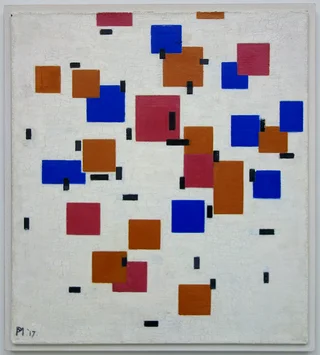
14. Composition in Colour A — Piet Mondrian, 1917
From March 1916 Bremmer paid Mondrian a monthly allowance against future paintings, and Mondrian's work went into the Kröller-Müller collection. Mondrian was living at the time in the artists' village of Laren, and there he met Bart van der Leck, to whom Helene paid the same kind of allowance. Van der Leck was already painting flat patches of pure colour on white, and Mondrian, in the words of the Kunstmuseum in The Hague, was very taken with his colour. The influence ran both ways, and Van der Leck took from Mondrian the word “composition” and the step to abstraction.
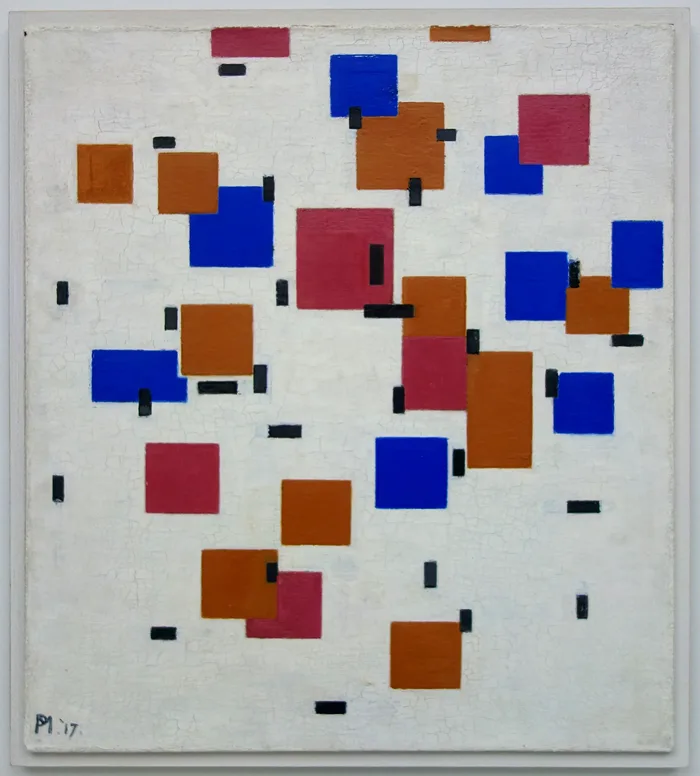
About 25 almost square rectangles in three colours are scattered over a white, slightly warm ground: ochre, bright ultramarine and a muted raspberry pink. Some stand alone and others overlap, with a red square lying across the corner of a blue one at upper right and an ochre one lying on a red one at lower left. Between them are about 27 short dark bars, like those in the black-and-white Composition 10. Some hang in the empty white, others lie across the corner of a patch of colour. The bottom sixth of the canvas is almost empty. The white ground is covered with a dense network of fine cracks, while the patches of colour have cracked less, and at the lower left are the monogram PM and “'17”.
In May 1917 Mondrian showed the painting at the Stedelijk in Amsterdam, in an exhibition of the Hollandsche Kunstenaarskring, a Dutch artists' society, together with Composition in Colour B and Composition in Line, a few months before the first issue of De Stijl. The museum calls it a study towards pure neo-plasticism, after which Mondrian would drop the sense of movement and depth and keep only red, yellow and blue.
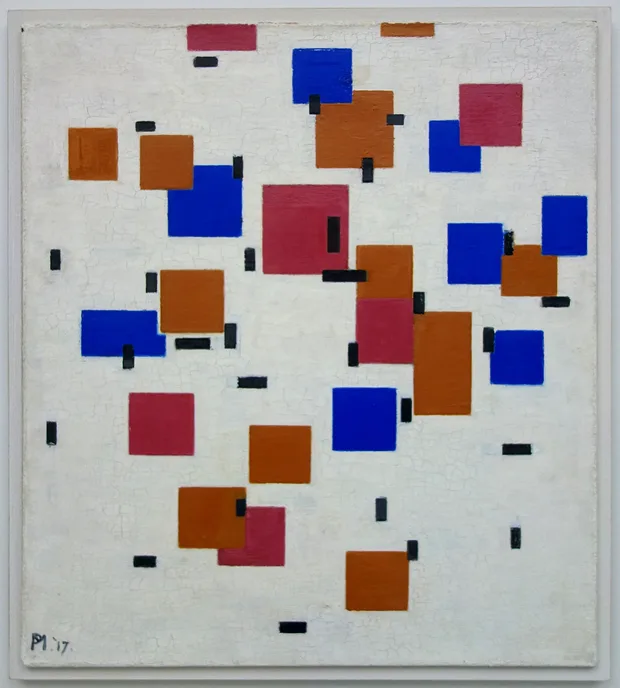
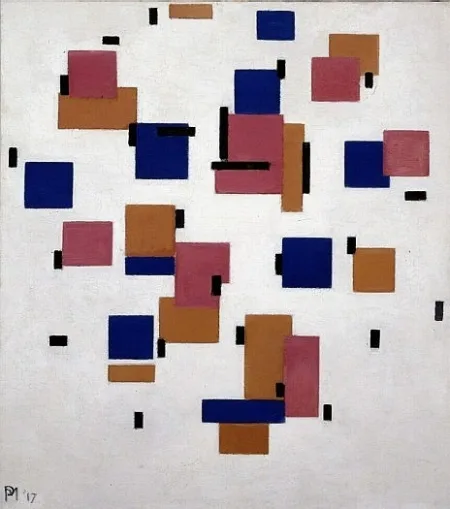
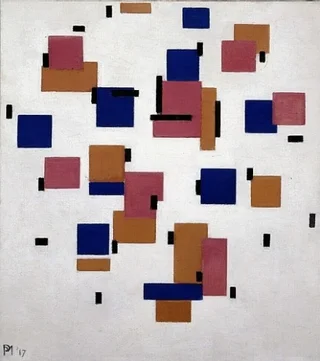
Its pair, Composition in Colour B, from the same year, of the same size and with the same signature, is also in Otterlo.
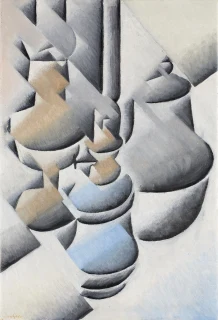
15. Still Life with Oil Lamp — Juan Gris, 1912
José Victoriano González-Pérez came from Madrid to Paris in 1906, settled in the Bateau-Lavoir next door to Picasso and for several years earned his living with satirical drawings for magazines. He began to paint seriously around 1910–1911, under the name Juan Gris, and 1912, the year of this still life, was his first cubist year.
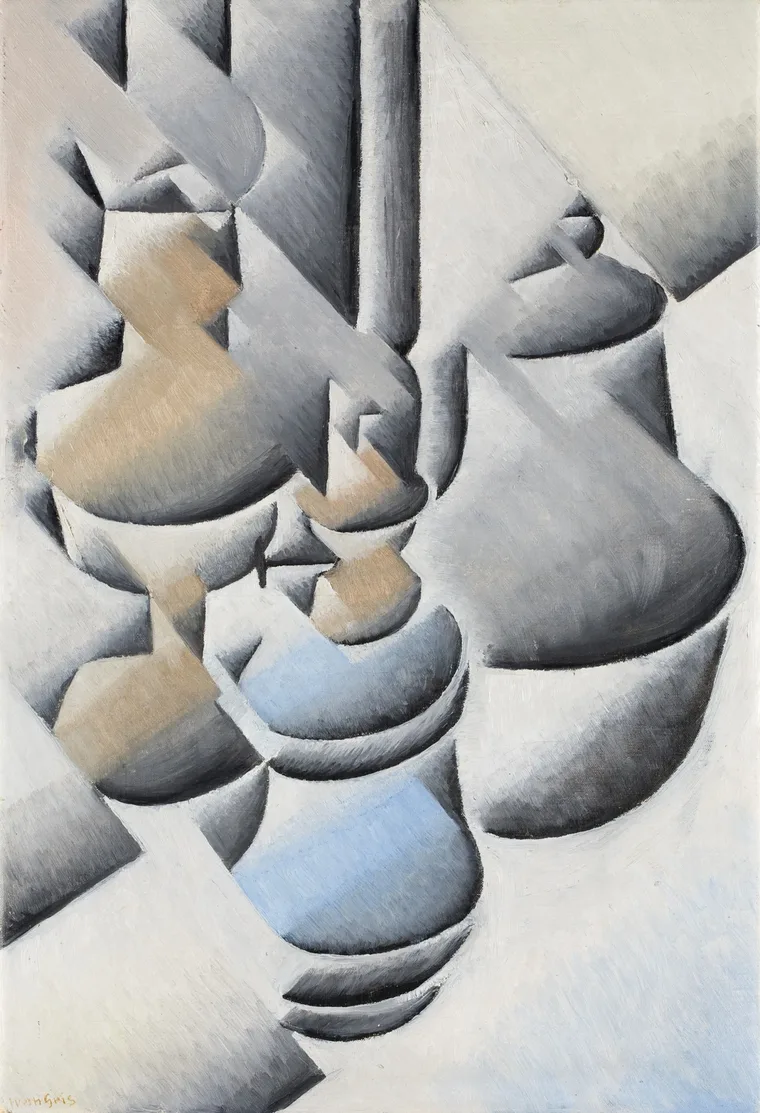
The lamp and the vessels are cut into facets but can still be recognised. At the top, almost in the middle, stands a tall, narrow grey cylinder, the lamp chimney, with a stack of rounded slices beneath it, as though the lamp's reservoir had been seen from several heights at once, and on the right is a large pear-shaped grey vessel with a lid and a small knob. Pale diagonal bands, like beams of light, run through the objects from the upper right corner to the lower left. The shadows are laid in with short parallel strokes, from light grey to almost black at the edge of every curve. The only warm colour is in flat patches of ochre, and at the bottom there are two pale blue patches. In the lower left corner “Juan Gris” is written in a small brown hand.
According to the museum, Helene bought this painting in 1913, and it was the first cubist painting she had ever seen. She went on to collect a large group of works by Gris.
In The Hague, in the house on the Lange Voorhout where Helene showed her collection from 1913, the largest room was given to Van Gogh, and the “ultra-moderns”, Gris, Auguste Herbin, Van der Leck and Mondrian, were gradually hung on the floor above.
16. La Partie de cartes — Fernand Léger, 1917
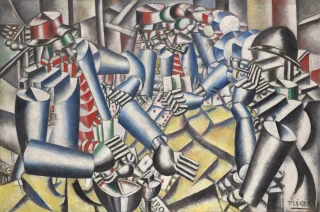
Three soldiers sit at a card table, and they are assembled from tubes, cones and discs. Their arms are polished cylinders in steel and blue-grey with a hard white highlight on one side, and their hands are stacks of flat slats. On the left sits a figure in a grey hat with a green band, with red-and-white zigzag stripes on its chest and a small cross-shaped medal. In the centre is a soldier with a pipe between his teeth, and on the right a huge soldier in a dark, round helmet raises a pipe to his face with a striped hand. Cards with red diamonds are fanned out in the middle, and the table has become a tilted yellow plane, the lightest area of the picture. The museum writes that the soldiers' arms are like forged steel pipes and that the soldiers themselves look more like robots.
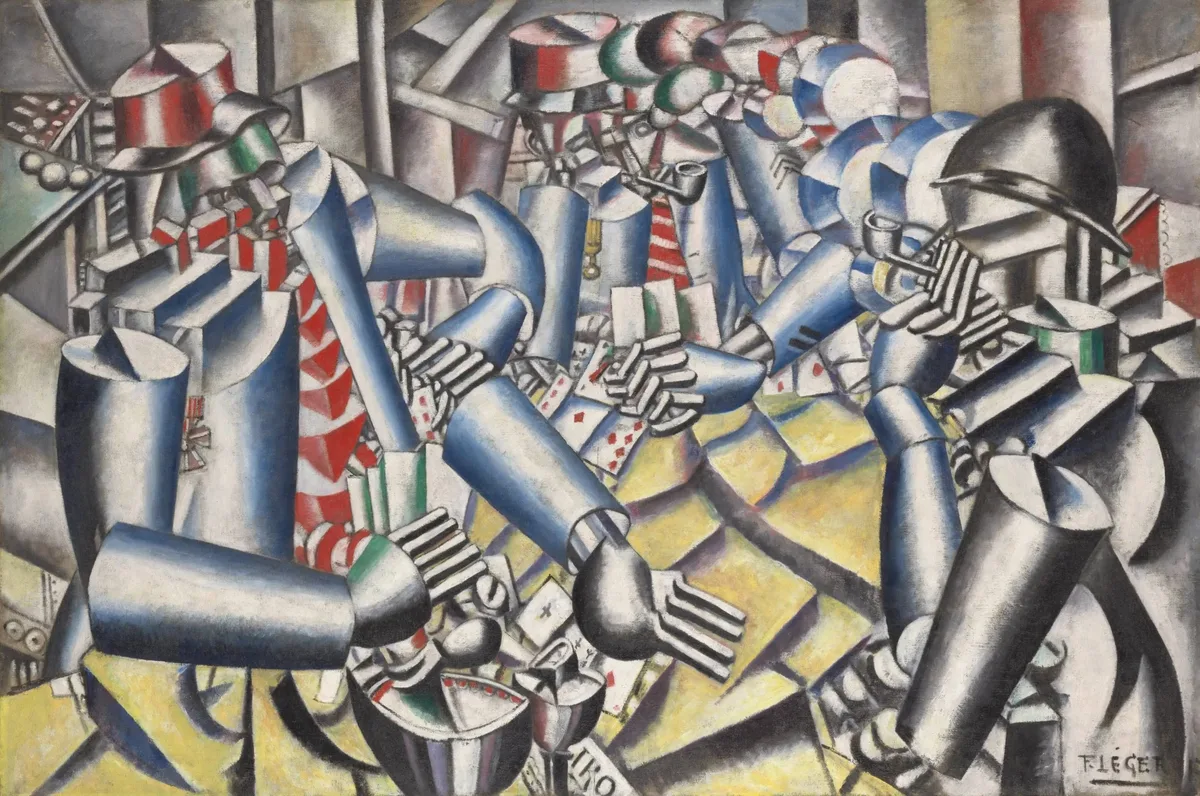
Fernand Léger was called up on 2 August 1914. He served as a sapper digging trenches and later as a stretcher-bearer, was in the Argonne and at Verdun, and drew at the front on coarse wrapping paper. He made the drawing of soldiers playing cards near Verdun in 1916. According to the museum, he painted the picture while recovering from a gas attack at Verdun. Léger later recalled that at the front he had been dazzled by the breech of a 75-millimetre gun in full sunlight, by the magic of the light on bare metal. On 5 December 1917 he sold the painting, the drawing for it and the studies to his new dealer, Léonce Rosenberg.
In 1921 Bremmer bought three paintings and a watercolour by Léger in Amsterdam for Helene. Helene went to see Léger in his studio in Montparnasse and kept buying his work, although Bremmer thought her admiration for him overdone, and in the early 1920s she bought La Partie de cartes as well.
Put to the Test After Her Death
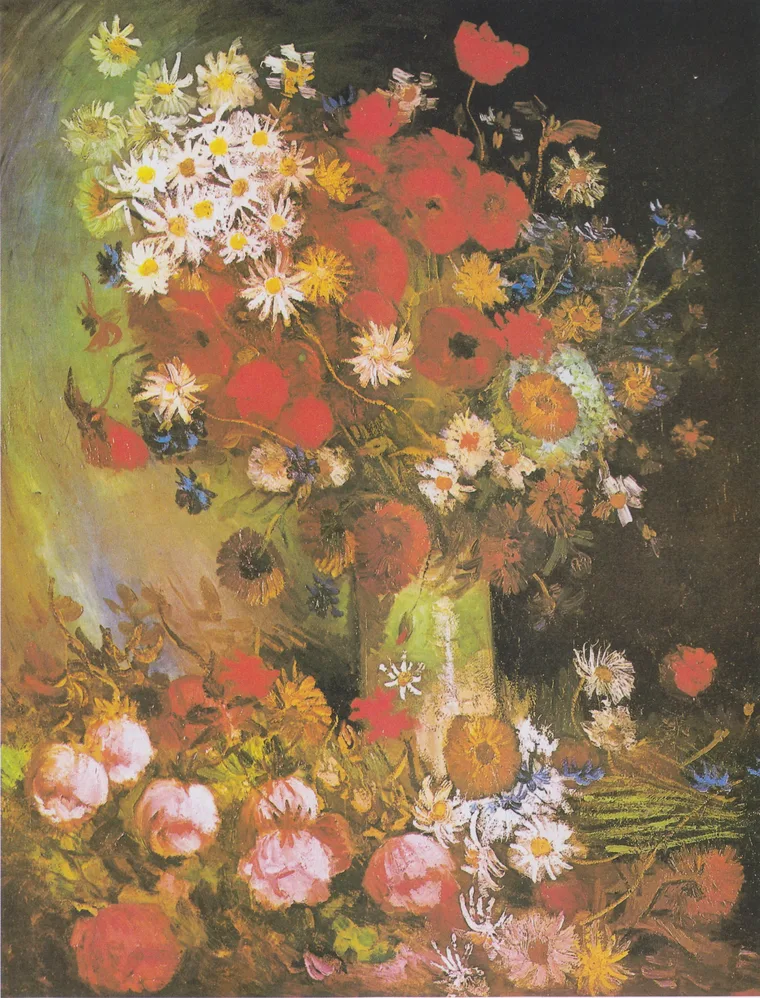
17. Still Life with Meadow Flowers and Roses — Vincent van Gogh, 1886–1887
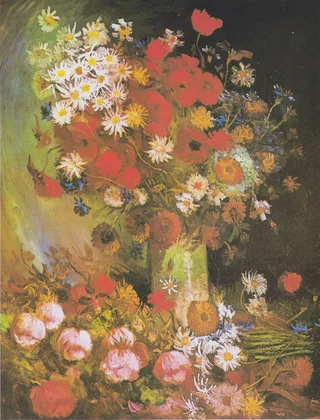
In 2003 the Kröller-Müller Museum itself struck this still life from the list of Van Gogh's paintings and entered it in its collection catalogue as the work of an unknown artist. It had been doubted ever since it was bought. In 1974 the state bought it for the museum from the Philips-de Jonge collection in Eindhoven, with support from the Rembrandt Association and the Prince Bernhard Fund, and even then there were misgivings about the unusual size of the canvas, the over-abundant flowers, a manner that did not fit Van Gogh's development and an unfamiliar signature.
In 1998 an X-ray showed another picture under the flowers, two half-naked wrestlers holding each other by the arms. At the end of January 1886 Van Gogh had written to Theo from Antwerp, where he was studying at the academy, that that week he had painted “a large thing with two nude torsos”, two wrestlers in a pose set by the academy's director, Charles Verlat, and that he really liked doing it. A link with the letter was suspected, but at the time nobody could prove it.
In 2010–2012 researchers from Delft University of Technology, the University of Antwerp, the DESY centre in Hamburg, the Van Gogh Museum and the Kröller-Müller itself scanned the painting and made maps of the chemical elements in both layers. The pigments in both layers matched Van Gogh's palette of those years, his brushwork was recognised in the wrestlers, and the unusual size of the canvas turned out to be the standard academy format for figure painting. He had painted the wrestlers with a great deal of slow-drying zinc white and laid the flowers over them in lead white before the lower layer had hardened, which is why the upper layer cracked. In March 2012 the museum gave the still life back to Van Gogh.
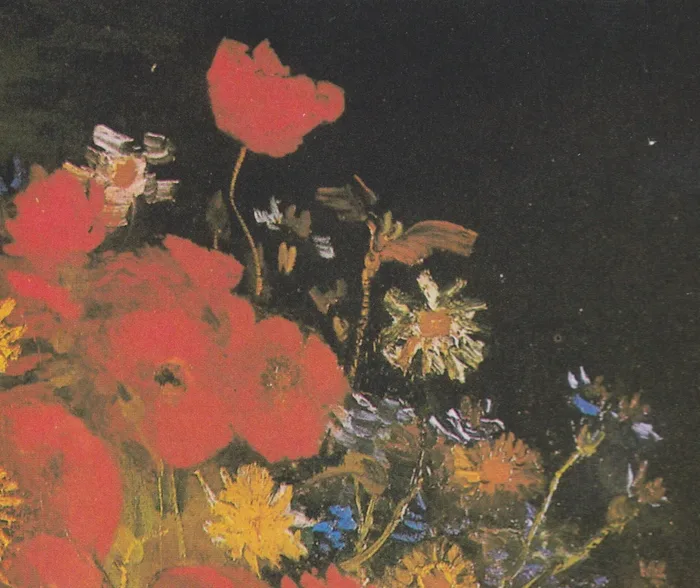
The pale green vase just right of centre is almost hidden by the flowers. A mass of daisies shows white at the upper left, red poppies blaze in the middle, blue cornflowers and orange flower heads fill the right, a row of plump pink-cream roses lies along the bottom, and highest of all, stopping just short of the top edge, stands a single red poppy on a thin stalk. The signature “Vincent” at the upper right is written in a dull, rusty ochre and is lost against the dark ground.
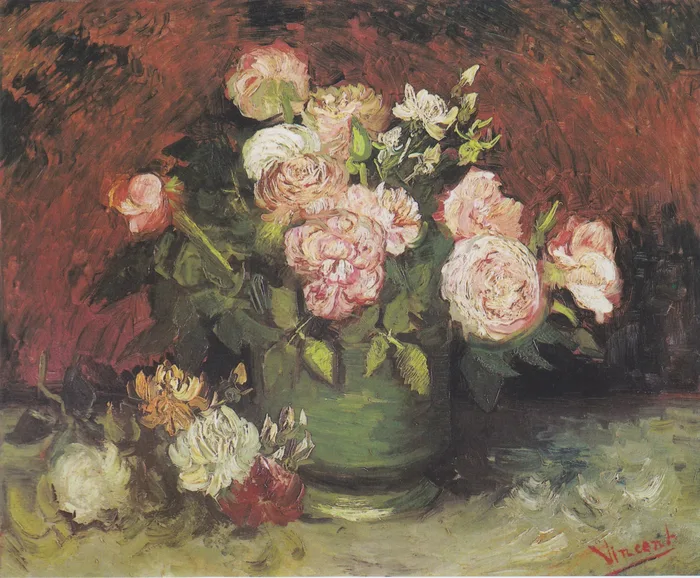
In December 2025 the museum put the opposite case on show, Seascape at Saintes-Maries-de-la-Mer, which Helene bought as a Van Gogh and which the museum attributes to the forger Leonhard Wacker.
The Garden She Never Saw
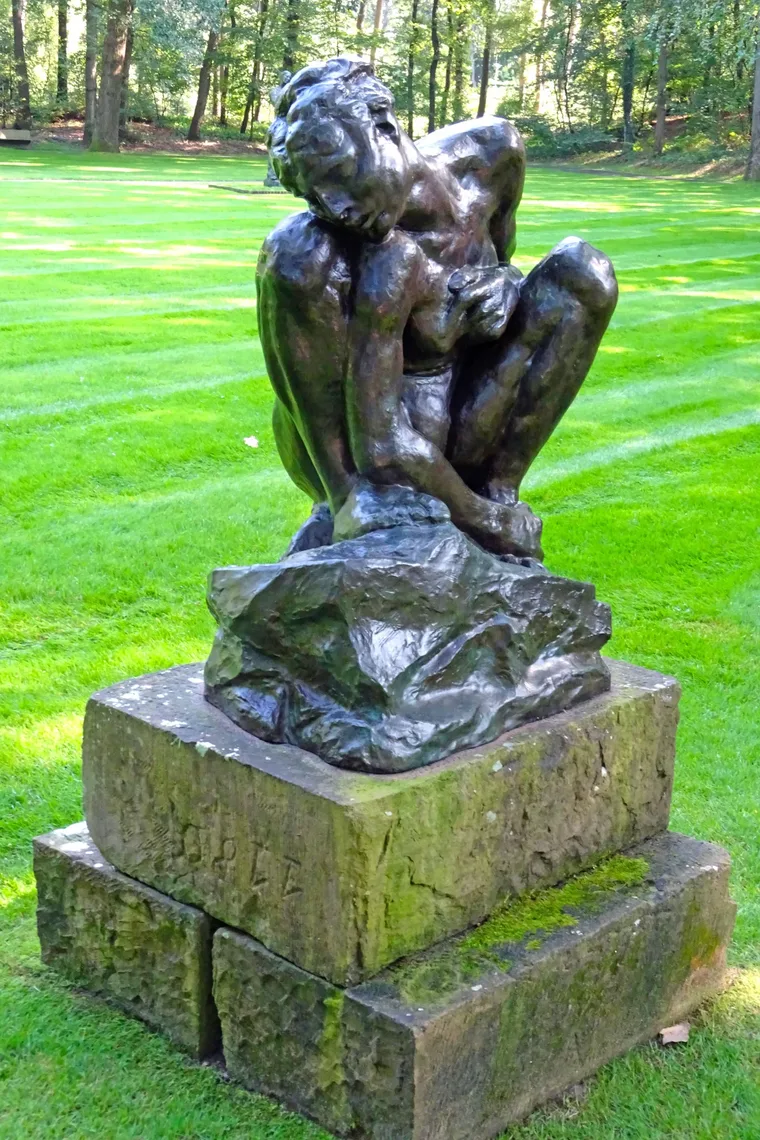
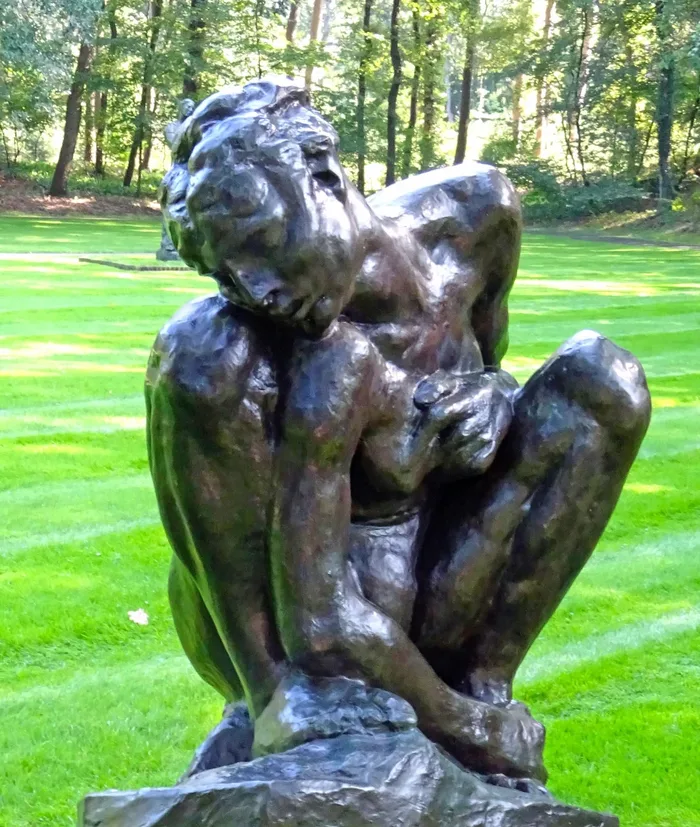
18. Squatting Woman — Auguste Rodin, model 1882
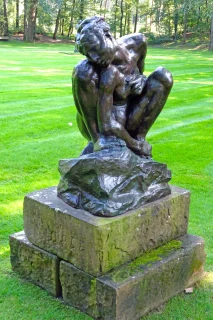
Helene left the museum a condition: after her death the collection could be added to only with works by artists who were already in it. Bram Hammacher, the museum's director from the late 1940s, decided that the condition applied only to painting, since sculpture is not even mentioned in it, and in 1950 he bought three bronzes by Auguste Rodin. They were a mask of the Japanese actress Hanako, a small study for Eustache de Saint-Pierre from The Burghers of Calais, and this crouching woman, Hammacher's personal favourite. For him Rodin was the founding father of modern sculpture, and Rodin's “sculptor's spirit”, he wrote, lived in the treatment of the surface.
Rodin made the figure around 1882 for The Gates of Hell, bronze doors on subjects from Dante's Inferno that the state commissioned from him in 1880 for a museum of decorative arts in Paris. The museum was never built, and Rodin went on working on the doors for decades. In the tympanum above the doors the woman is small and sits not far from The Thinker. The one in Otterlo is an enlarged version, at life size.
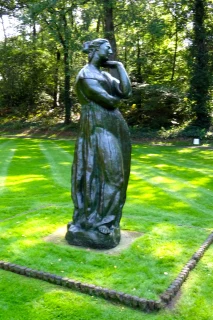
A naked woman crouches on an uneven bronze rock, her knees pulled up high and spread wide, her right foot on top of the rock and her left lower down, in front. She has laid her cheek on her right knee and lowered her eyes. With her left hand she presses her breast, and her right arm passes diagonally in front of her body and holds her left foot at the ankle, so that the whole body is packed into a tight upright block. The writer Octave Mirbeau called his marble version of this figure “my frog”. The bronze shines dark brown, almost black, and green shows in the hollows of the rock.
In 1953 the sculpture was placed in the new sculpture gallery. When the minister Jo Cals opened the sculpture garden on 3 June 1961 by breaking through a polystyrene wall, it was moved out into the garden, and there it stands on a pedestal of two rough-hewn blocks of pinkish-grey sandstone.
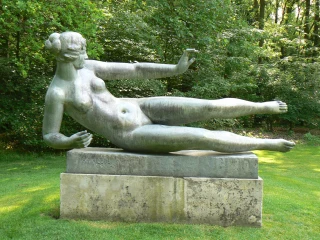
19. L'Air — Aristide Maillol, 1939 (cast 1962)
In 1938 the city of Toulouse commissioned from Aristide Maillol a monument to the crews of the Aéropostale, the airmail line from France to South America, who had died in service. Shortly before, in December 1936, the line's pilot Jean Mermoz had disappeared over the South Atlantic. Maillol was 77, and he made the new figure out of an old one. He took the plaster of a reclining woman from his earlier monument to Cézanne, cut it up, reassembled it and altered it, and he compared the method to layering in the garden, when a new plant is rooted from a branch not yet cut from the old one. The stone statue was finished at Banyuls in 1939.
In his last years Maillol, together with Dina Vierny, who posed for him, reworked the large plaster and removed the drapery and the supports. After his death six figures were cast from this plaster, and the one in Otterlo was cast in a lead alloy in 1962. L'Air first came to the garden on loan, and then the museum bought it. Hammacher called it a masterpiece and set it on a rise, on a concrete pedestal. Helene herself had already bought Maillol, so her condition was respected.
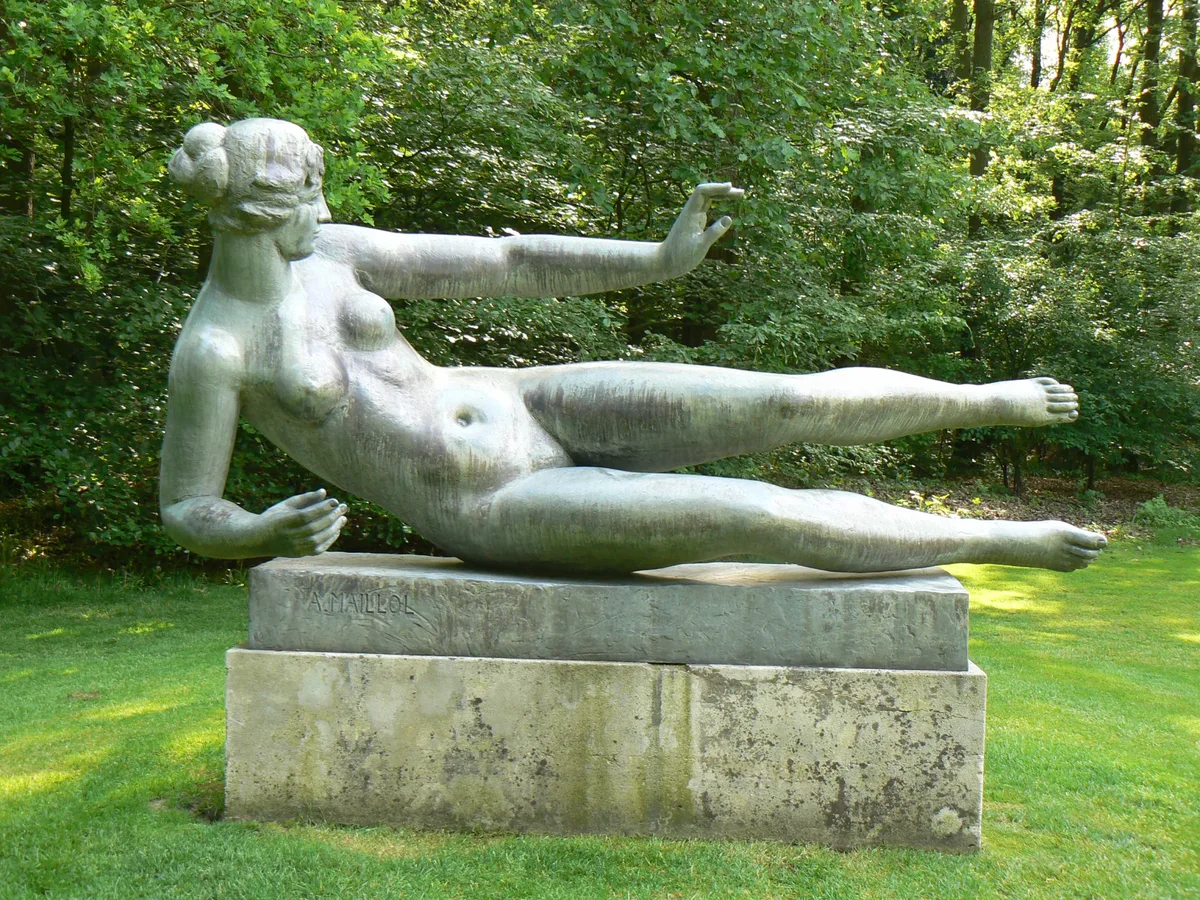
The woman lies on her right side with her front turned to the viewer and touches the slab only with her right hip. Her head, both arms and both legs are held in the air: the upper arm stretches out over her body towards her feet with the hand bent upward, the upper leg is raised and straight, and the lower one almost touches the base. Her face is in profile, and she looks along her own body. The metal is silvery grey with a soft sheen, and dark purplish-brown streaks run down the belly, the thighs and the outstretched arm.
The stone monument was put up in Toulouse, in the Jardin Royal, in 1948, four years after Maillol was killed in a car accident.
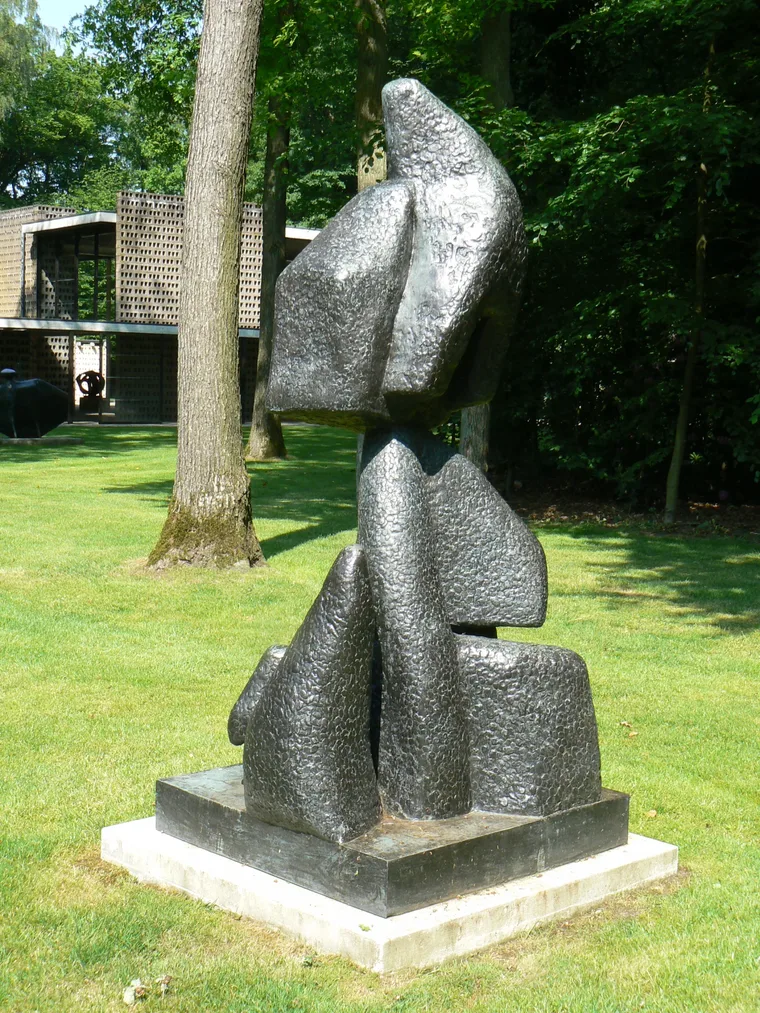
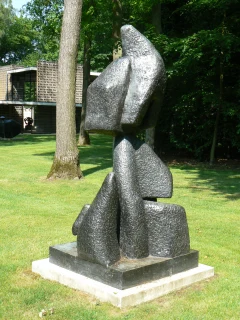
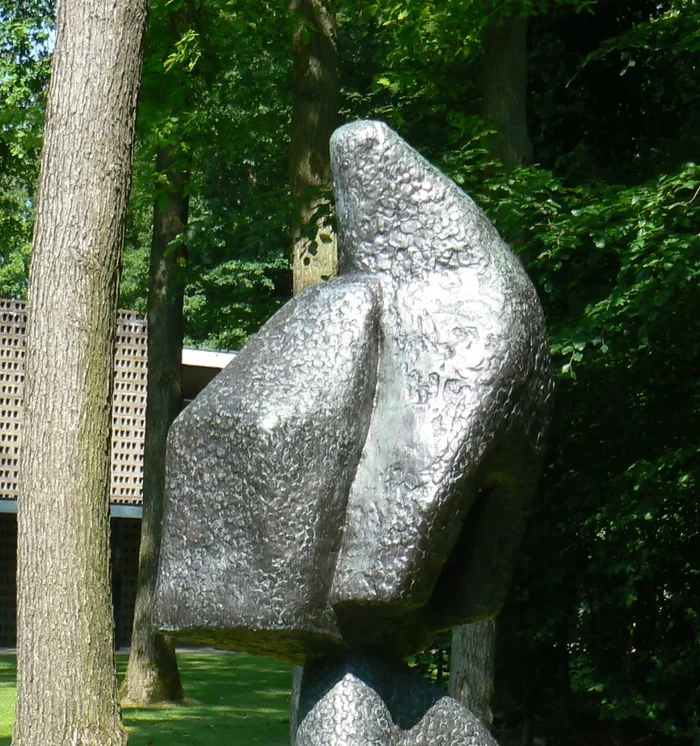
20. Composition — Otto Freundlich, 1933 (cast 1961)
The cover of the guide to the “Degenerate Art” exhibition, which the Nazis opened in Munich in 1937, carried a photograph of Otto Freundlich's plaster Large Head with the caption “The New Man”. The head itself was later lost.
Freundlich was born in 1878 in Stolp, in Pomerania, was one of the first abstract artists and from 1908 lived in Paris for long periods. A German Jew with left-wing views, he was held in a French internment camp at the start of the war and then hid in the Pyrenees. In February 1943 he was denounced and arrested, on 4 March he was deported from the Drancy camp on convoy no. 50, and in March 1943 he was murdered in occupied Poland, most likely at Sobibor, although older literature names Majdanek.
He made the plaster model of Composition in Paris in 1933 and never saw a bronze of it in his lifetime. The plaster survived the war in his studio, and after the war his widow, Jeanne Kosnick-Kloss, and the artist's friends set out to fulfil his wish to have the sculpture cast in bronze. The cast was made in Paris in 1961, and the museum bought it that same year, when the sculpture garden opened. It is probably the first bronze of this model.
The bronze, a little taller than a person, is built of separate rounded blocks stacked on and leaning against one another. On one side, at the bottom, stand a pointed teardrop-shaped block, a round column and an almost square block, and at the top, on a narrow neck, sits the heaviest mass, which juts out to the left and curves back into a bent point like a beak or a horn. Seen from the opposite side, the same bronze is put together differently, with a cone standing on a large house-shaped block and a bar lying at the bottom. Light passes through the gaps between the blocks. The whole surface is covered with small flattened lumps like cobbles, and in the sun each of them flashes silvery grey.
Helene had allowed only artists already represented in the collection to be bought after her death. Bram Hammacher decided that this restriction did not apply to sculpture. The sculpture garden opened in 1961, and in the same year the museum bought Otto Freundlich's bronze Composition, cast 18 years after he was murdered.
Beyond the Twenty
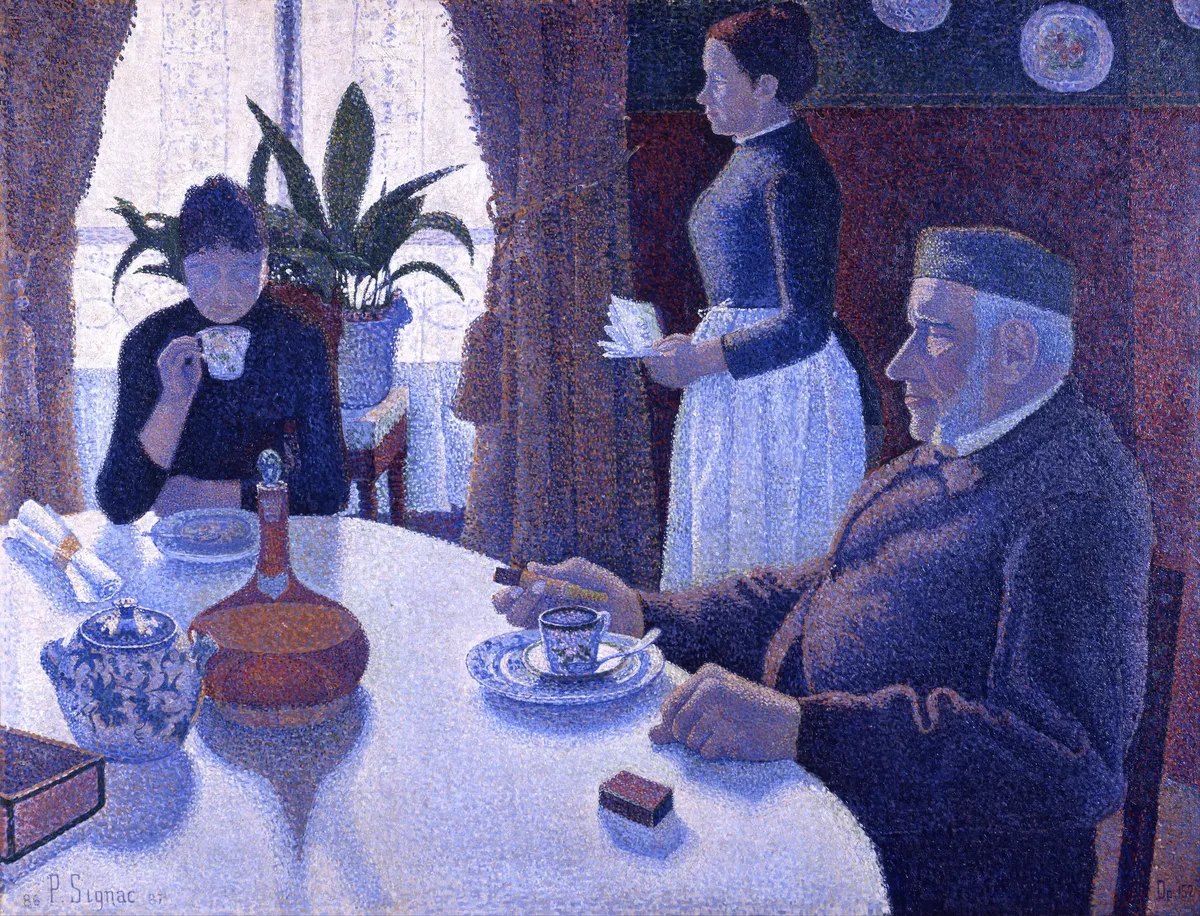
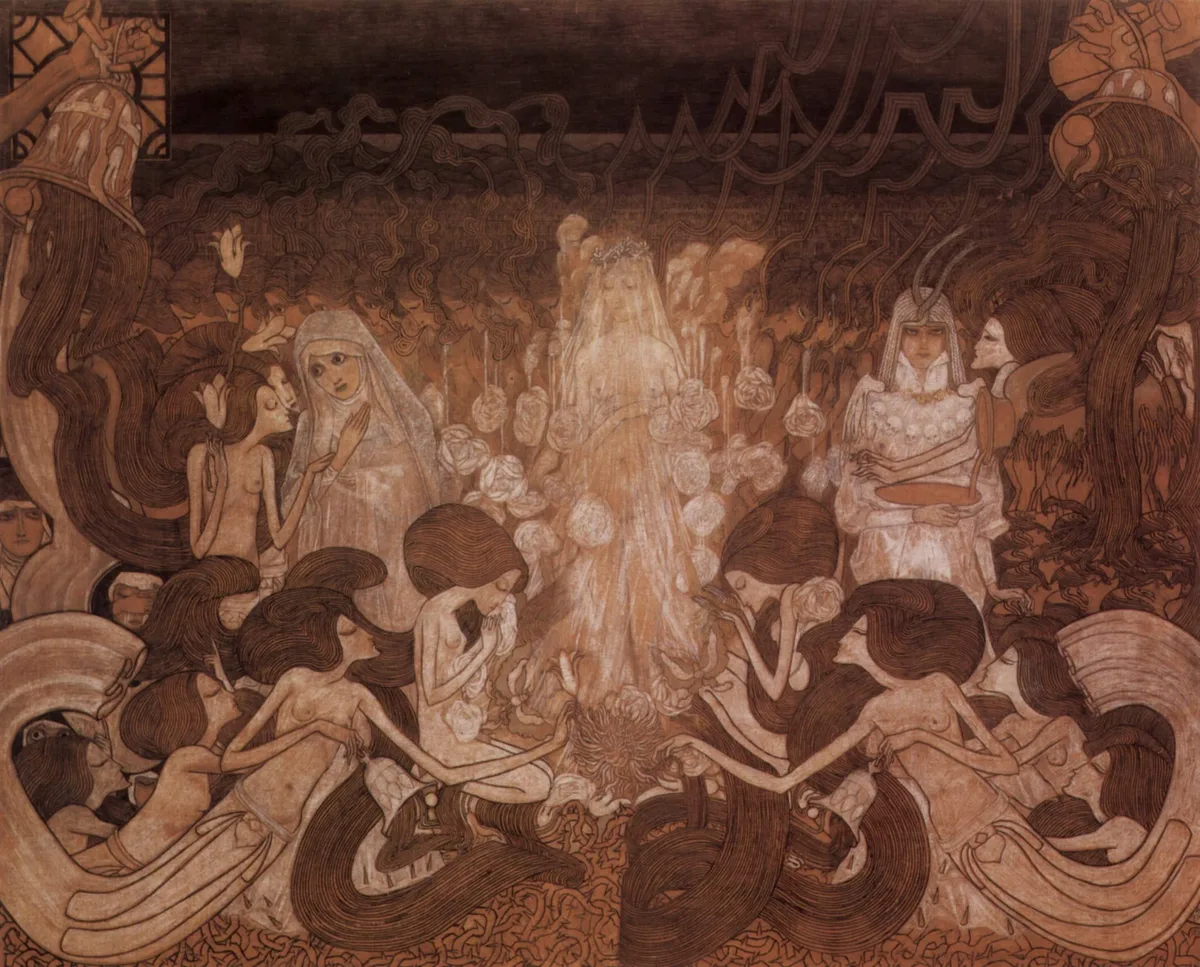
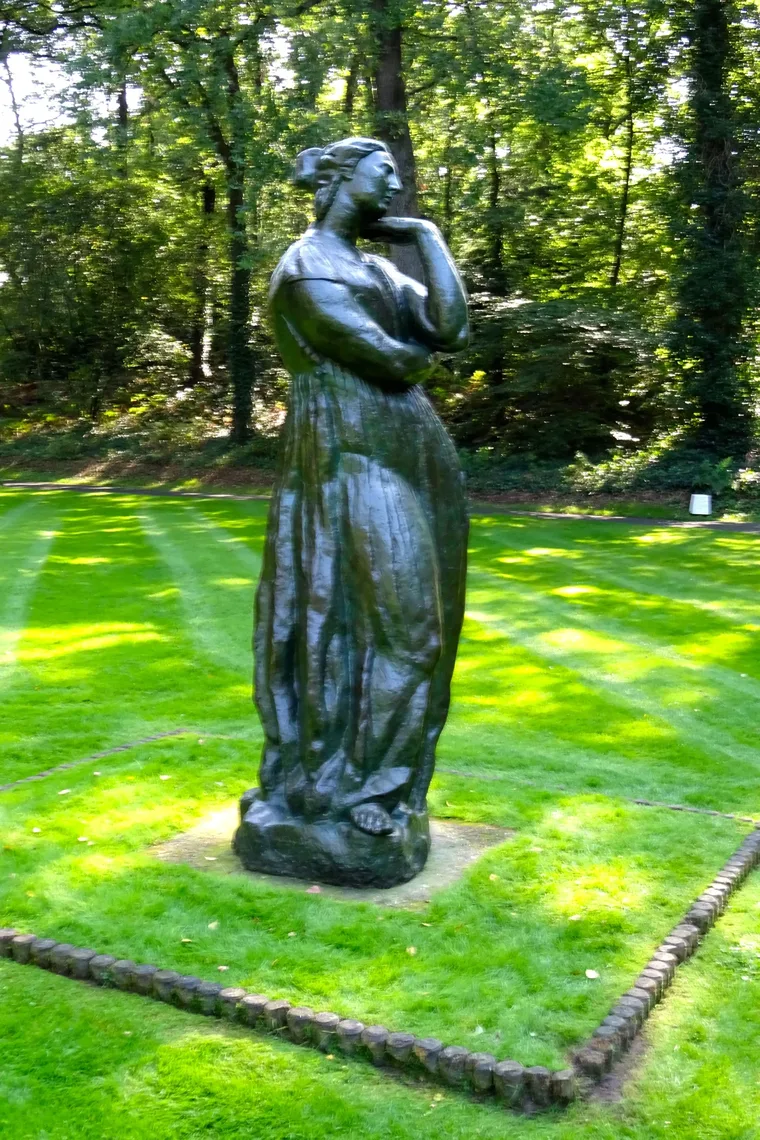
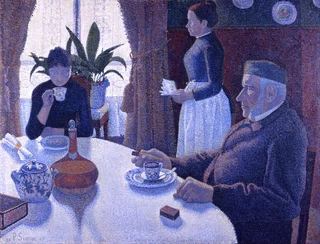
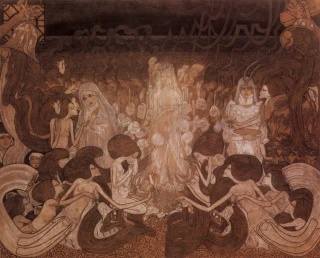
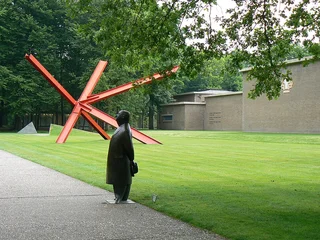
On a second visit it is worth starting with the other 78 Van Gogh paintings and his 172 works on paper, and then moving on to the Neo-Impressionists whom Helene collected alongside Seurat, beginning with Paul Signac's Breakfast. The collection also includes Bart van der Leck, to whom she paid an allowance for years, and Jan Toorop's drawing The Three Brides, which she bought at auction in 1919. More than 200 works stand in the 25-hectare sculpture garden, among them Jean Dubuffet's Jardin d'émail, Marta Pan's Floating Sculpture, made for this garden, and Antoine Bourdelle's Large Pénélope. Pavilions by Gerrit Rietveld and Aldo van Eyck also stand there among the trees.